
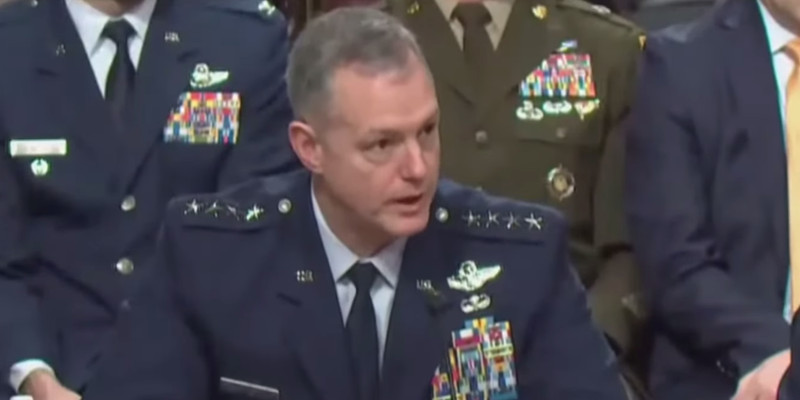

NATO’s top military commander in Europe said Tuesday that additional US troop withdrawals from the continent are expected in the years ahead as European allies expand their own military capabilities. Speaking after a meeting of NATO military chiefs in Brussels, American Gen. Alexus Grynkewich said the shift would happen gradually, without a fixed timeline. The comments come as several European governments are already voicing concern over recent Pentagon redeployments.
“What we’re basically saying is, as the European pillar of the alliance gets stronger, this allows the US to reduce its presence in Europe and limit itself to providing only those critical capabilities that allies cannot yet provide,” Grynkewich, the Supreme Allied Commander Europe, said, per the Military Times. “So we should expect there to be a redeployment of US forces over time as allies build their capacity.”
The Pentagon recently confirmed plans to pull 5,000 troops from Germany, while also canceling the deployment of a long-range fires battalion and a planned armored brigade combat team rotation to Poland. The armored brigade alone involved more than 4,000 soldiers.
Grynkewich said the troop changes do not affect the “executability” of NATO’s regional defense plans. He also noted planning is underway for “additional minor elements” involving several hundred more personnel.
The comments come as European NATO members boost military spending following commitments made during the alliance’s 2025 summit in The Hague. Grynkewich said countries along NATO’s eastern flank, including Poland and the Baltic states, have significantly increased their ground combat capabilities since 2022.
He pointed to the Canada-led multinational brigade in Latvia, which he called “highly effective,” and said Germany continues building up a brigade presence in Lithuania. “As allies build up their capability, the United States is able to pull capability back and use it for other global priorities,” Grynkewich said.
“What we’re basically saying is, as the European pillar of the alliance gets stronger, this allows the US to reduce its presence in Europe and limit itself to providing only those critical capabilities that allies cannot yet provide,” Grynkewich, the Supreme Allied Commander Europe, said, per the Military Times. “So we should expect there to be a redeployment of US forces over time as allies build their capacity.”
The Pentagon recently confirmed plans to pull 5,000 troops from Germany, while also canceling the deployment of a long-range fires battalion and a planned armored brigade combat team rotation to Poland. The armored brigade alone involved more than 4,000 soldiers.
Grynkewich said the troop changes do not affect the “executability” of NATO’s regional defense plans. He also noted planning is underway for “additional minor elements” involving several hundred more personnel.
The comments come as European NATO members boost military spending following commitments made during the alliance’s 2025 summit in The Hague. Grynkewich said countries along NATO’s eastern flank, including Poland and the Baltic states, have significantly increased their ground combat capabilities since 2022.
He pointed to the Canada-led multinational brigade in Latvia, which he called “highly effective,” and said Germany continues building up a brigade presence in Lithuania. “As allies build up their capability, the United States is able to pull capability back and use it for other global priorities,” Grynkewich said.
Admiral Pierre Vandier, NATO’s Supreme Allied Commander Transformation, said recent wars have demonstrated the growing importance of drones, electronic warfare, software, and data systems alongside traditional weapons.
“More of the same is necessary, but more of the same will not be enough by far,” Vandier said.
NATO members are also reportedly discussing whether alliance forces could help secure commercial shipping routes through the Strait of Hormuz if disruptions continue into July, according to Bloomberg. The proposal has not received unanimous support among members.