
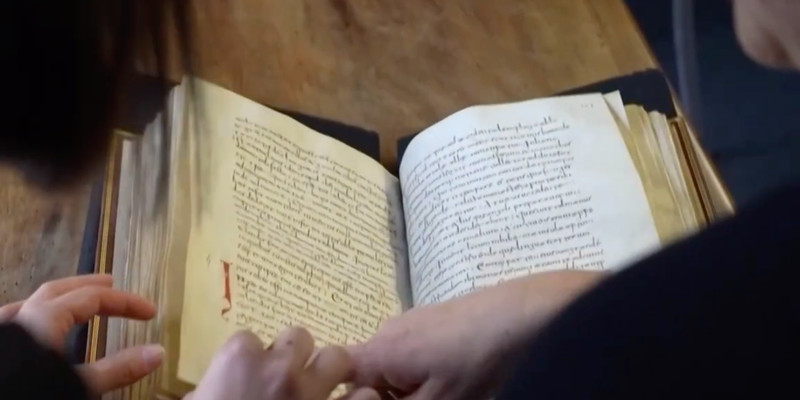

Researchers at Trinity College Dublin say they have identified one of the oldest surviving copies of “Caedmon’s Hymn,” an early Old English poem believed to be the earliest known English verse, inside a medieval manuscript held in a library in Rome.
The find came after scholar Elisabetta Magnanti received digitized images of a manuscript copy of Ecclesiastical History of the English People, a Latin text written by Venerable Bede, according to CBS News. While reviewing the pages, Magnanti and colleague Mark Faulkner spotted the Old English poem embedded directly in the main body of the text, which was unusual. "We were extremely surprised. We were speechless. We couldn't believe our eyes when we first saw that," Magnanti said. "It was extraordinary."
The manuscript, dated to the 9th century, is now considered one of the oldest known surviving copies containing the poem. Researchers said two earlier copies also include “Caedmon’s Hymn,” but only as later additions written in margins or appended separately:: “Prior to the discovery of the Rome manuscript, the earliest one was from the early 12th century. So this is three centuries earlier than that. And so it attests to the importance that was already being attached to the English in the early 9th century," Faulkner said.
According to the researchers, “Caedmon’s Hymn” was composed in the 7th-century by Caedmon, a Northumbrian worker linked to Whitby Abbey.
"Embarrassed that he didn't know anything suitable, Caedmon left the feast and went to bed," Faulkner said. "A figure then appeared to him in his dreams telling him to sing about creation, which Caedmon miraculously did, producing the nine-line hymn."
The poem reads:
"Now let us praise Heaven-Kingdom's guardian,
the Maker's might and his mind's thoughts,
the work of the glory-father—of every wonder,
eternal Lord. He established a beginning.
He first shaped for men's sons
Heaven as a roof, the holy Creator;
then middle-earth mankind's guardian,
eternal Lord, afterwards prepared
the earth for men, the Lord almighty."
The manuscript itself traveled extensively over the centuries. Scholars said it was originally copied by monks at the Benedictine abbey of Nonantola in northern Italy before later being moved through multiple religious institutions, private collections, and eventually to New York City.
Italian officials later acquired the manuscript in 1972 as part of efforts to recover lost texts from the Nonantola collection. Since then, it remained in Rome's National Central Library but had received little scholarly attention: "I knew that the book was listed in the library's catalog, so I was almost certain that the book was, in fact, still here," Magnanti said.
Researchers said the library has since digitized the full Nonantolan collection, making manuscripts available online for further study.
"The discovery made by the experts of Trinity College is just one starting point, a single manuscript that might pave the way for countless other discoveries, in countless other fields, through international cooperation like this," Andrea Cappa said.
The find came after scholar Elisabetta Magnanti received digitized images of a manuscript copy of Ecclesiastical History of the English People, a Latin text written by Venerable Bede, according to CBS News. While reviewing the pages, Magnanti and colleague Mark Faulkner spotted the Old English poem embedded directly in the main body of the text, which was unusual. "We were extremely surprised. We were speechless. We couldn't believe our eyes when we first saw that," Magnanti said. "It was extraordinary."
The manuscript, dated to the 9th century, is now considered one of the oldest known surviving copies containing the poem. Researchers said two earlier copies also include “Caedmon’s Hymn,” but only as later additions written in margins or appended separately:: “Prior to the discovery of the Rome manuscript, the earliest one was from the early 12th century. So this is three centuries earlier than that. And so it attests to the importance that was already being attached to the English in the early 9th century," Faulkner said.
According to the researchers, “Caedmon’s Hymn” was composed in the 7th-century by Caedmon, a Northumbrian worker linked to Whitby Abbey.
"Embarrassed that he didn't know anything suitable, Caedmon left the feast and went to bed," Faulkner said. "A figure then appeared to him in his dreams telling him to sing about creation, which Caedmon miraculously did, producing the nine-line hymn."
The poem reads:
"Now let us praise Heaven-Kingdom's guardian,
the Maker's might and his mind's thoughts,
the work of the glory-father—of every wonder,
eternal Lord. He established a beginning.
He first shaped for men's sons
Heaven as a roof, the holy Creator;
then middle-earth mankind's guardian,
eternal Lord, afterwards prepared
the earth for men, the Lord almighty."
The manuscript itself traveled extensively over the centuries. Scholars said it was originally copied by monks at the Benedictine abbey of Nonantola in northern Italy before later being moved through multiple religious institutions, private collections, and eventually to New York City.
Italian officials later acquired the manuscript in 1972 as part of efforts to recover lost texts from the Nonantola collection. Since then, it remained in Rome's National Central Library but had received little scholarly attention: "I knew that the book was listed in the library's catalog, so I was almost certain that the book was, in fact, still here," Magnanti said.
Researchers said the library has since digitized the full Nonantolan collection, making manuscripts available online for further study.
"The discovery made by the experts of Trinity College is just one starting point, a single manuscript that might pave the way for countless other discoveries, in countless other fields, through international cooperation like this," Andrea Cappa said.