
Taiwan’s representative to the United States said the ongoing crisis involving Iran and the Strait of Hormuz is disrupting global trade and energy markets while also placing added pressure on Communist China ahead of President Donald Trump’s summit with Chinese leader Xi Jinping.
President Trump arrived in Beijing om Wednesday for a two-day summit with Xi Jinping, accompanied by several high-profile business leaders, including Elon Musk and Jensen Huang, as discussions are expected to center on trade and the war involving Iran. Looming over the talks is the US blockade of Iranian oil shipments bound for China, as the administration seeks Beijing’s assistance in helping de-escalate the Middle East conflict.
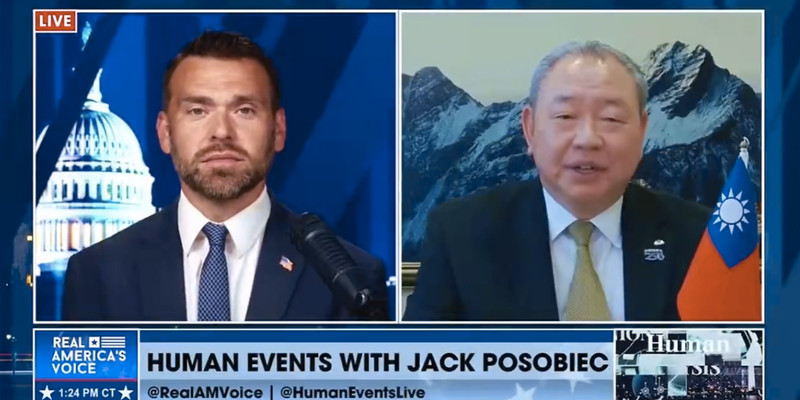
Appearing on Human Events Daily, Ambassador Alexander Yui said the closure of the Strait of Hormuz is already affecting economies far beyond the region.
“Look, the Iran crisis right now, the Strait of Hormuz closed because of what's happening there by the Iranians closing the strait,” Yui said. “It's causing a lot of disruptions in world trade, world economies.”
Military leaders in Iran have indicated that control over the Strait of Hormuz could be more valuable strategically than exporting oil itself. Roughly 20 percent of the world’s oil supply typically passes through the waterway, making disruptions there a major concern for markets globally.
Yui said Taiwan and the United States are both experiencing the consequences: “So not only the United States, Taiwan, we're all facing some issues with energy, with rising prices in commodities, etc.”
He noted that China is also exposed because of its reliance on Middle Eastern energy, particularly Iranian oil.
“PRC China is also suffering the same thing,” Yui said. “Again, they're the ones who consume a lot of energy from that region, especially, I think they're the number one users of Iranian oil, etc. So they have a lot at stake also.”
Asked by Posobiec whether Beijing could seek leverage related to Taiwan amid any broader Iran negotiations, Yui said China has its own incentive to see the crisis resolved. “I think the Chinese themselves want the Iran crisis to end as quickly as possible.”
Yui also dismissed suggestions that recent US actions in Iran and Venezuela could embolden Beijing toward Taiwan. “Actually, I see the other way around,” he said.
“I think Xi Jinping has looked at what the United States is doing in Venezuela and Iran and other parts of the world, and they've realized the United States is willing to use all instruments, all resources available to accomplish your goals.”
Calling the current US posture a deterrent, Yui added: “It's a warning to Xi Jinping, actually.” He said Taiwan has maintained reserves in preparation for regional instability: “Taiwan, we have a strategic reserve to counter a crisis with China if it happens.”
President Trump arrived in Beijing om Wednesday for a two-day summit with Xi Jinping, accompanied by several high-profile business leaders, including Elon Musk and Jensen Huang, as discussions are expected to center on trade and the war involving Iran. Looming over the talks is the US blockade of Iranian oil shipments bound for China, as the administration seeks Beijing’s assistance in helping de-escalate the Middle East conflict.
Appearing on Human Events Daily, Ambassador Alexander Yui said the closure of the Strait of Hormuz is already affecting economies far beyond the region.
“Look, the Iran crisis right now, the Strait of Hormuz closed because of what's happening there by the Iranians closing the strait,” Yui said. “It's causing a lot of disruptions in world trade, world economies.”
Military leaders in Iran have indicated that control over the Strait of Hormuz could be more valuable strategically than exporting oil itself. Roughly 20 percent of the world’s oil supply typically passes through the waterway, making disruptions there a major concern for markets globally.
Yui said Taiwan and the United States are both experiencing the consequences: “So not only the United States, Taiwan, we're all facing some issues with energy, with rising prices in commodities, etc.”
He noted that China is also exposed because of its reliance on Middle Eastern energy, particularly Iranian oil.
“PRC China is also suffering the same thing,” Yui said. “Again, they're the ones who consume a lot of energy from that region, especially, I think they're the number one users of Iranian oil, etc. So they have a lot at stake also.”
Asked by Posobiec whether Beijing could seek leverage related to Taiwan amid any broader Iran negotiations, Yui said China has its own incentive to see the crisis resolved. “I think the Chinese themselves want the Iran crisis to end as quickly as possible.”
Yui also dismissed suggestions that recent US actions in Iran and Venezuela could embolden Beijing toward Taiwan. “Actually, I see the other way around,” he said.
“I think Xi Jinping has looked at what the United States is doing in Venezuela and Iran and other parts of the world, and they've realized the United States is willing to use all instruments, all resources available to accomplish your goals.”
Calling the current US posture a deterrent, Yui added: “It's a warning to Xi Jinping, actually.” He said Taiwan has maintained reserves in preparation for regional instability: “Taiwan, we have a strategic reserve to counter a crisis with China if it happens.”