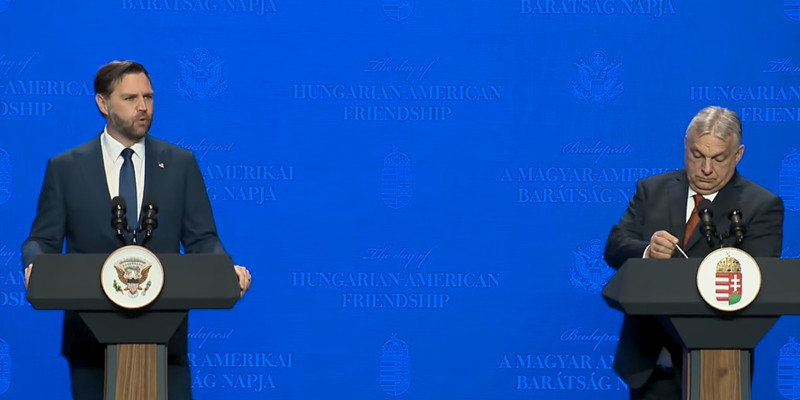

Vice President JD Vance accused the European Union of interfering in Hungary’s national election during a visit to Budapest on Tuesday, just days before voters head to the polls. The remarks came as Prime Minister Viktor Orban faces a tight race after more than a decade in power.
Speaking alongside Orban at a press conference, Vance praised the Hungarian leader and criticized Brussels over its role in European politics. “The bureaucrats in Brussels have tried to destroy the economy of Hungary, they have tried to make Hungary less energy independent, they have tried to drive up costs for Hungarian consumers,” Vance said. He added that EU actions were politically motivated and tied to Orban’s refusal to align with liberal policies.
Vance also raised concerns about the EU’s digital regulations, including rules governing online content, arguing they could influence voters ahead of the election. “Why are bureaucrats in Brussels telling social media companies what information they’re giving to Hungarian voters?” he said.
The vice president further claimed foreign actors beyond the EU may be involved. “We’re certainly aware that there are elements within the Ukrainian intelligence services that try to put their thumb on the scale,” he said.
The visit comes five days before Hungary’s election, where Orban’s Fidesz party is facing a strong challenge from the opposition Tisza party led by Peter Magyar. A recent poll from the 21 Research Institute shows Tisza leading among decided voters with 56 percent support, compared to 37 percent for Fidesz, reports Euronews.
Despite the polling gap, Vance expressed support for Orban and signaled a willingness to assist. "I want to help as much as I possibly can," he told reporters in Budapest.
President Donald Trump has also voiced support for Orban, calling him “a true friend” and praising his policies on migration. During a separate event, Vance put President Donald Trump on speakerphone during a joint rally with Orban in Budapest to boost Orbán's reelection bid, saying that he loved Orban and backed his campaign.
Hungary’s relationship with the EU has been rough in recent months. Orban vetoed a €90 billion aid package for Ukraine in March, while the EU has withheld funding. Hungarian officials have also warned about foreign efforts to influence the vote and have taken steps to protect key infrastructure.
Speaking alongside Orban at a press conference, Vance praised the Hungarian leader and criticized Brussels over its role in European politics. “The bureaucrats in Brussels have tried to destroy the economy of Hungary, they have tried to make Hungary less energy independent, they have tried to drive up costs for Hungarian consumers,” Vance said. He added that EU actions were politically motivated and tied to Orban’s refusal to align with liberal policies.
Vance also raised concerns about the EU’s digital regulations, including rules governing online content, arguing they could influence voters ahead of the election. “Why are bureaucrats in Brussels telling social media companies what information they’re giving to Hungarian voters?” he said.
The vice president further claimed foreign actors beyond the EU may be involved. “We’re certainly aware that there are elements within the Ukrainian intelligence services that try to put their thumb on the scale,” he said.
The visit comes five days before Hungary’s election, where Orban’s Fidesz party is facing a strong challenge from the opposition Tisza party led by Peter Magyar. A recent poll from the 21 Research Institute shows Tisza leading among decided voters with 56 percent support, compared to 37 percent for Fidesz, reports Euronews.
Despite the polling gap, Vance expressed support for Orban and signaled a willingness to assist. "I want to help as much as I possibly can," he told reporters in Budapest.
President Donald Trump has also voiced support for Orban, calling him “a true friend” and praising his policies on migration. During a separate event, Vance put President Donald Trump on speakerphone during a joint rally with Orban in Budapest to boost Orbán's reelection bid, saying that he loved Orban and backed his campaign.
Hungary’s relationship with the EU has been rough in recent months. Orban vetoed a €90 billion aid package for Ukraine in March, while the EU has withheld funding. Hungarian officials have also warned about foreign efforts to influence the vote and have taken steps to protect key infrastructure.