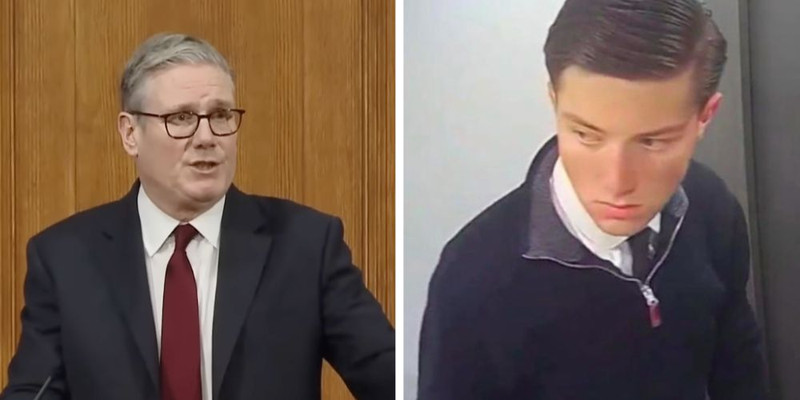

UPDATE: Prime Minister Keir Starmer has responded to the Nowak case, posting to X on Monday: "This an awful, shocking case.
Henry’s loved ones have gone through the trauma of a long trial and endured Henry's killer making up appalling claims about their son who was thoughtful, kind and deeply loved.
It is right that the IOPC is investigating the police’s response to his senseless murder. And we must end the cycle of tragedy by tackling the horror of knife crime.
Henry’s family, friends, his university and the city of Southampton will continue to feel his loss, and our thoughts will always be with them."
Original article below.
UK Prime Minister Keir Starmer is facing criticism for spending more time on high-profile political and activist causes in the past than on the recent killing of an 18-year-old student who was arrested after his own stabbing.
18-year-old Henry Nowak was fatally stabbed in December by Vickrum Digwa using a 21-centimeter “ceremonial” blade known as a kirpan, which he was legally permitted to carry for religious reasons. During the investigation, Digwa reportedly told police that Nowak had “racially abused him,” a claim later determined to be false. Despite being the victim of the attack, Nowak was arrested and handcuffed by officers while suffering stab wounds that he would ultimately die from.
After Digwa was found guilty of murder, Hampshire Police apologized for their handling of the incident. Deputy Chief Constable Robert France said the case was an “absolute tragedy,” adding that he was “sorry that Henry’s life couldn’t be saved that night” and that he was handcuffed and arrested.
“He was the victim," France said.
Amid backlash surrounding the murder, criticisms have intensified against Starmer, who previously moved quickly to engage with several activist issues but has recently been quiet.
Following the death of George Floyd in 2020 in the United States, Starmer showed support for protests, also engaging in a spectacle in which he was seen “taking a knee” in a posted photo to support the Black Lives Matter movement. Despite Nowak also calling out “I can’t breathe” as he was dying in the street, he has seen far less public outrage following his death.
Starmer also drew attention for commenting on the Netflix series Adolescence, a drama that promoted anti-masculinity and warned about social media influences on young men, particularly the dangers of the “manosphere.” Starmer praised the show, adding that as a father to a teenage son and daughter, it “hit home hard.” He also expressed support for the show to be shown for free in schools across the country.
He has also shown a willingness to engage in activism against his political opponents. Earlier this month, Starmer’s government blocked 11 protesters from entering the country to attend a rally organized by right-wing activist Tommy Robinson. Prior to the protest, Starmer said that the UK is “in a fight for the soul of this country,” and that the government will block individuals from coming into the country who “seek to incite hatred and violence.”
Starmer likewise faced criticism surrounding rapper Kanye West, after UK authorities withdrew permission linked to a planned performance in London. West was banned from entering the UK, forcing the festival he was set to perform at to be cancelled. Starmer called the scheduled performance “deeply concerning,” pointing to West’s past antisemitic comments, to which he has since apologized for.
Starmer has also attempted to maintain support of the LGBT community in the UK, even after he has flipped on trans-related issues. After he emphasized the UK Supreme Court’s judgement that a woman is defined by biology, the prime minister hosted a Pride party at 10 Downing Street. In an address to attendees, Starmer said the event was to “celebrate that truly transformational work” accomplished by the LGBT community.