
After a mass shooting in Austin, Texas, last week, voters headed to the polls on Tuesday, March 3rd, in what was one of the most closely watched primary elections in the country, and the most expensive.
This year, both parties entered the race deeply divided. But the results made one thing clear: voters in Texas showed up ready to send a message about the direction of their parties. Conservative voters signaled growing tension between the Republican establishment and its grassroots base, while Democratic voters focused on who would ultimately secure the final seat.
In a surprising twist, four-term incumbent Rep. Dan Crenshaw lost his primary to state Rep. Steve Toth in Texas' 2nd Congressional District. Despite a massive fundraising advantage and years of being heralded as a rising star in Republican politics, it still wasn't enough to keep his seat.
Toth ultimately secured 36,760 votes (55.8%), while Crenshaw received 26,764 votes (40.7%). Crenshaw reportedly raised roughly $1.3 million more than Toth, highlighting the gap between financial advantage and voter sentiment.
Toth's campaign was endorsed by Turning Point Action and Sen. Ted Cruz, reinforcing his image as a candidate supported by grassroots conservatives. "Congressional District 2 voters want a representative in D.C. who will stand firm in his convictions, fight for his constituents, and follow through on his promises. I won't let them down," Toth said in a statement following his victory.
In House District 23, Brandon Herrera is heading to a rematch runoff against incumbent Rep. Tony Gonzales. Herrera previously ran in 2024 and narrowly lost the runoff with 49.4% of the vote, making this "round two" a race to watch closely. The social media–savvy conservative has built a strong grassroots following, and his repeated challenge underscores the appetite among Texas voters for candidates who challenge the GOP establishment. The outcome of this race, like the other runoffs, will be a key indicator of the direction of the party in the Lone Star State.
If Crenshaw's loss was the night's biggest upset, the most consequential race of the evening was the Republican primary for U.S. Senate.
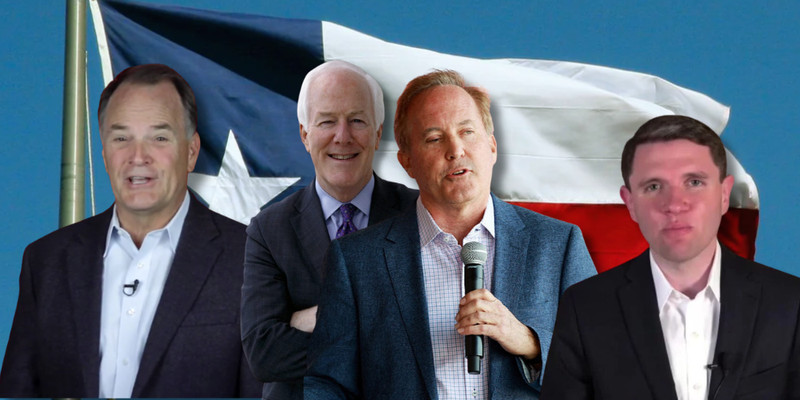
The contest is now headed to a runoff between Texas Attorney General Ken Paxton and longtime Sen. John Cornyn. The showdown represents two very different visions for the Republican Party in Texas. Cornyn, a fixture of Senate leadership for years, represents the party's institutional wing. Paxton, meanwhile, has built his brand as a fighter aligned with grassroots conservatives and populist messaging.
Cornyn received the largest amount of advertising support ever for an incumbent in a non-presidential primary race, emphasizing the scale of the contest. Even after reportedly overspending Paxton by a shocking margin, roughly $69 million to $4 million, Cornyn failed to secure the majority required to win, forcing the race into a run-off scheduled for May 26, 2026. Despite the massive financial disparity, voters remained divided, setting up what will likely become one of the most closely watched runoff elections of the 2026 cycle. Paxton framed the race as a battle between grassroots voters and political insiders, telling supporters after the results were announced that "Texas is not for sale."
On the Democratic side, the primary produced a very different outcome. State Rep. James Talarico secured the Democratic nomination for Senate, but election night was not without controversy. Confusion at a polling location in Dallas led a local judge to temporarily extend voting hours by two hours, though the Texas Supreme Court ultimately blocked the extension.
Talarico's win highlights Democrats' continued effort to remodel their Texas message around younger candidates and faith-based rhetoric — an attempt to appeal to voters in a state that has remained firmly Republican at the statewide level for more than three decades. Rep. Jasmine Crockett, his opponent, ran a campaign focused heavily on personality-driven messaging and sharp ideological contrasts, ultimately receiving 46% of the vote.
The Democratic primary showcased two competing approaches to energizing the party's voters: one rooted in combative, identity-driven politics, and another that sought to soften the message while maintaining progressive policy goals.
Meanwhile, the Texas Senate primary has already become the most expensive in U.S. history, signaling just how high the stakes have become in Texas politics. With a momentous runoff now looming between Paxton and Cornyn, Republicans face what could become a bruising internal battle over the party's future direction.
And if Tuesday night proved anything, it's that Texas voters are not afraid to challenge the political status quo — even within their own party. One thing is certain: the Lone Star State is heading into one of the most unpredictable election cycles in recent memory.