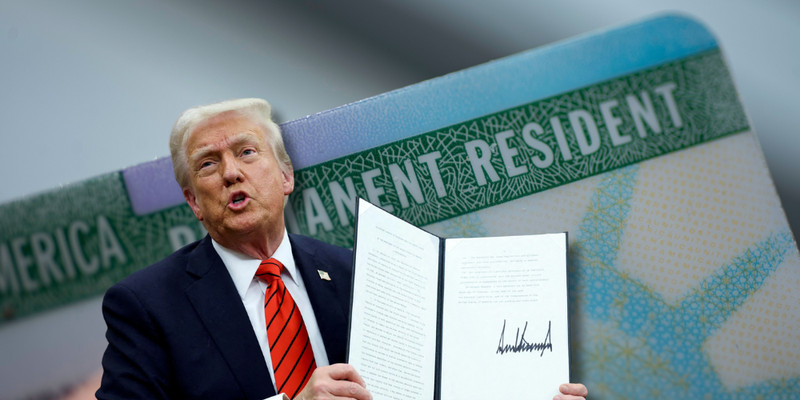

Ever since the Trump Administration began to crack down on illegal immigration, the talk about legal aspects of immigration has increased. Many American citizens wonder what the requirements are for a Green Card and citizenship. One of the things that appears to be confusing is the language requirement to obtain a Green Card. In fact, there is no requirement to be proficient in the English language to apply and receive a Green Card.
Naturally, this will raise suspicion and questioning as to why such a requirement is not in place. Some of the answers to this question may be found in official government designations. There is no official language in the United States, and because of this, requirements are loose. The Trump administration has changed that. On March 1, 2025, President Trump signed an executive order declaring English as the official language of the United States.
This change will most likely affect immigration requirements; however, at this point, the law remains the same as before the executive order was issued. From a legal standpoint, everything appears to be in order. But from a cultural standpoint, we have to ask what this means for a larger issue of immigration and assimilation.
First of all, we must begin to explicitly make a difference between legal and illegal immigration. If someone crosses the border into America illegally, then it should be understood that they have no rights and should be immediately turned away. In addition, if someone is residing in the United States illegally and has been found guilty of criminal activities, then that too should result in immediate deportation. This should be obvious, but to today's leftists, it seems to be a point of debate.
Things do get muddier when we find cases of people who came here illegally but have lived in the US for decades, have been working, and have not engaged in criminal activities. But even here, there must be a recognition that they have arrived illegally, and that the government does have a right to deport.
The law has been largely ignored. I arrived in the United States as a refugee in 1996, a survivor of the Bosnian war of the 1990s. The process to enter America was long and arduous. At the time, I lived in a refugee camp in what was then Czechoslovakia and the Czech Republic. During that time, I discovered a program that allowed me to apply for the opportunity to come to America.
After the initial interview, my application was denied. Naturally, I was very disappointed. I hardly expected such a result, but at the same time, I understood that I had no right to demand an entrance into America. The government officials informed me that I could appeal the decision if I chose to, and that is what I did. Luckily, after the appeal, my application was accepted, and my journey was scheduled. The entire process took almost two years, and I touched American soil on May 15, 1996.
My status was that of a refugee because of the war, and I followed the procedures that came next. There was never a doubt in my mind that I wanted to become an American citizen. Immediately, I became familiar with the process. It took about a year to obtain a Green Card, and at that time, I was a high school senior, about to enter college. I didn't question the language proficiency requirement, nor was such a thing on my mind. I assumed that applicants had to demonstrate some knowledge of the English language to apply for the Green Card.
This brings me to the point about assimilation. There are nuances and intricacies of being an immigrant (legal, that is!) in the process of becoming an American. The interior life of an immigrant cannot be disregarded, especially if they (like me) have escaped a war-torn country. This is indeed a complex issue. However, there is nothing complex about the obvious fact that an immigrant must move forward to some kind of assimilation to work, function, and become a productive and contributing member of society. An immigrant should not expect to continue to live the way he was used to. Ideally, he starts as a guest of the United States, acts graciously, and works toward becoming a productive citizen. He must take this obligation seriously, and from my experience, most legal immigrants I have come in contact with during my early years in America have proved this to be true.
Our debates and conversations about immigration need to change desperately. Laws must be clearer and, most of all, must be enforced. We must reject the ideologues and agitators. I can only hope that we reach the point in society in which the richness of immigrant experience and the need for law can work in concert.