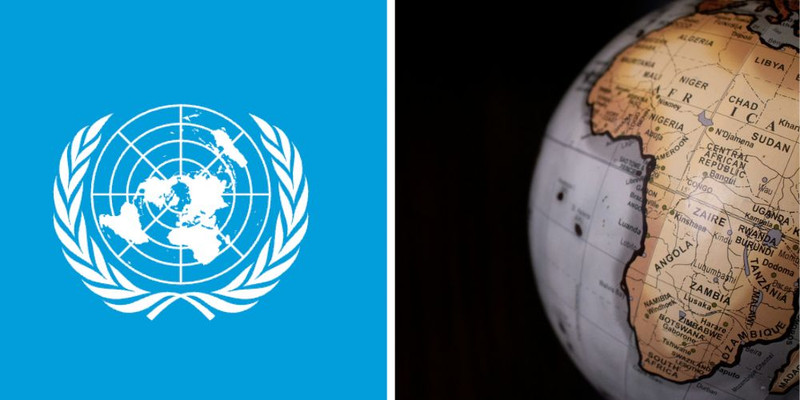

The United Nations General Assembly voted nearly unanimously on Friday to promote a new world map projection that increases the size of Africa, with the United States casting the lone vote against the resolution.
The “Correct the Map” resolution, sponsored by the African nation of Togo and backed by members of the African Union, passed with 164 countries voting in favor. The United States was the only country to oppose the resolution.
The resolution is aimed at moving away from the Mercator map, which has been widely used since the 16th century. The Mercator projection has faced criticism because it significantly distorts the relative size of certain landmasses. For example, Greenland appears roughly the same size as Africa, despite Africa being about 14 times larger in actual area.
No flat, two-dimensional map can perfectly represent the Earth because the planet is three-dimensional, and transferring its surface onto a flat map inevitably produces some degree of distortion. The Mercator projection creates stretching that enlarges landmasses further away from the equator.
The Mercator projection was created in 1569 by cartographer Gerardus Mercator. It has historically been particularly useful for navigation because it preserves angles and makes lines of constant compass bearing appear as straight lines.
Modern critics of the projection, however, have argued that its distortion can affect how people perceive the importance of different regions. They argue that Africa, in particular, is minimized because it appears smaller than its actual area.
In 2018, cartographers created a map called the Equal Earth projection designed to represent relative sizes of continents more accurately. The 54 members of the African Union adopted the map in February, saying it “more accurately represents the sizes of all continents, particularly Africa.”
According to Reuters, Togo’s Foreign Minister Robert Dussey said before the vote that "A fair world begins with a fair map." He also told a UN briefing that “A map is never neutral. It shapes perceptions, influences how the place of peoples and continents in the world is understood."
"Changing the map obviously doesn't change the world. But correcting a representation that distorts it is already an act of truth," he added.
Yaryna Ferencevych, deputy US representative to the UN Economic and Social Council, called the resolution a “radical ideological project."
"Instead of focusing on genuine problems of international peace, prosperity or good relations, this body is debating map projects from the 16th century and their role in promoting reparations and cognitive justice," Ferencevych said. "Resolutions like this one and the ideological agenda they promote are barnacles on our work here and the reason this institution is losing its credibility."