
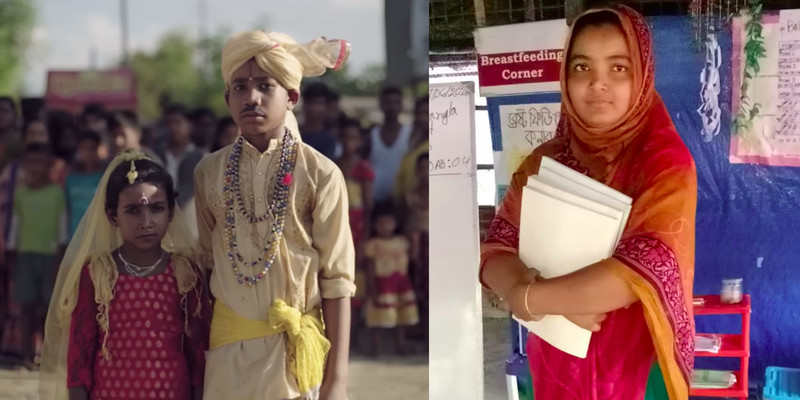

An ABC report has claimed to explain how climate-related disasters are contributing to child marriage across parts of Asia and the Pacific, with aid organizations warning that economic hardship caused by floods, cyclones, droughts, and other environmental shocks is pushing more families to marry off young girls.
The report centers on the story of Runa, a Bangladeshi girl who was forced into marriage at age 15 after Cyclone Remal destroyed her family’s livelihood in Cox’s Bazar. The storm killed her family’s chickens and ducks, which were their main source of food and income. After her widowed mother lost work following the disaster, the family struggled financially, and Runa said her mother felt she had no choice but to arrange her marriage.
“I did not want to get married. I wanted to continue my education,” Runa told ABC. According to Plan International, approximately 12 million girls are expected to become child brides this year worldwide. The organization says climate change is becoming an increasingly important factor because disasters often worsen existing problems such as poverty, food insecurity, and gender inequality.
Tanushree Soni from Plan International said climate disasters often lead to spikes in child marriage because families facing financial pressure may see marriage as a way to reduce economic burdens.
“Whenever there is a climate change impact … we see a spike in child marriage,” Soni said.
The report highlights Bangladesh as one of the countries most affected. More than 50 percent of girls there are married before turning 18, according to Plan International. The International Rescue Committee estimates child marriage rates can increase by up to 39 percent after natural disasters in Bangladesh.
Aid organizations are also warning about the potential impact of El Niño, which scientists say could intensify climate pressures in vulnerable regions. Kamrul Hasan Shawon of Plan International Bangladesh said repeated climate shocks are making life increasingly unstable for families.
“We are facing climate experiences almost every year and El Niño will affect us dearly,” Shawon said.
The report argues that current climate responses often focus heavily on rebuilding infrastructure while overlooking social consequences such as child marriage and violence against women. Advocates say climate adaptation programs need to include education, economic opportunities, and protections for girls.
Research from Plan International and the University of Technology Sydney is examining how climate-related pressures affect adolescent girls in Bangladesh, Nepal, and the Solomon Islands.
Shreya Ghosh from Girls Not Brides said child marriage has become a “coping strategy” for some families experiencing economic collapse, but argued it can be prevented with better support systems.
In Cambodia, Plan International said similar programs combining education, digital skills, and community advocacy helped reduce child marriage rates in targeted areas by at least 65 percent over three years.
The report centers on the story of Runa, a Bangladeshi girl who was forced into marriage at age 15 after Cyclone Remal destroyed her family’s livelihood in Cox’s Bazar. The storm killed her family’s chickens and ducks, which were their main source of food and income. After her widowed mother lost work following the disaster, the family struggled financially, and Runa said her mother felt she had no choice but to arrange her marriage.
“I did not want to get married. I wanted to continue my education,” Runa told ABC. According to Plan International, approximately 12 million girls are expected to become child brides this year worldwide. The organization says climate change is becoming an increasingly important factor because disasters often worsen existing problems such as poverty, food insecurity, and gender inequality.
Tanushree Soni from Plan International said climate disasters often lead to spikes in child marriage because families facing financial pressure may see marriage as a way to reduce economic burdens.
“Whenever there is a climate change impact … we see a spike in child marriage,” Soni said.
The report highlights Bangladesh as one of the countries most affected. More than 50 percent of girls there are married before turning 18, according to Plan International. The International Rescue Committee estimates child marriage rates can increase by up to 39 percent after natural disasters in Bangladesh.
Aid organizations are also warning about the potential impact of El Niño, which scientists say could intensify climate pressures in vulnerable regions. Kamrul Hasan Shawon of Plan International Bangladesh said repeated climate shocks are making life increasingly unstable for families.
“We are facing climate experiences almost every year and El Niño will affect us dearly,” Shawon said.
The report argues that current climate responses often focus heavily on rebuilding infrastructure while overlooking social consequences such as child marriage and violence against women. Advocates say climate adaptation programs need to include education, economic opportunities, and protections for girls.
Research from Plan International and the University of Technology Sydney is examining how climate-related pressures affect adolescent girls in Bangladesh, Nepal, and the Solomon Islands.
Shreya Ghosh from Girls Not Brides said child marriage has become a “coping strategy” for some families experiencing economic collapse, but argued it can be prevented with better support systems.
In Cambodia, Plan International said similar programs combining education, digital skills, and community advocacy helped reduce child marriage rates in targeted areas by at least 65 percent over three years.