
77 years ago, the Vatican publicly released a major Cold War-era decree on July 13, 1949, stating that Catholics who embraced or materially supported communism could face excommunication from the Roman Catholic Church.
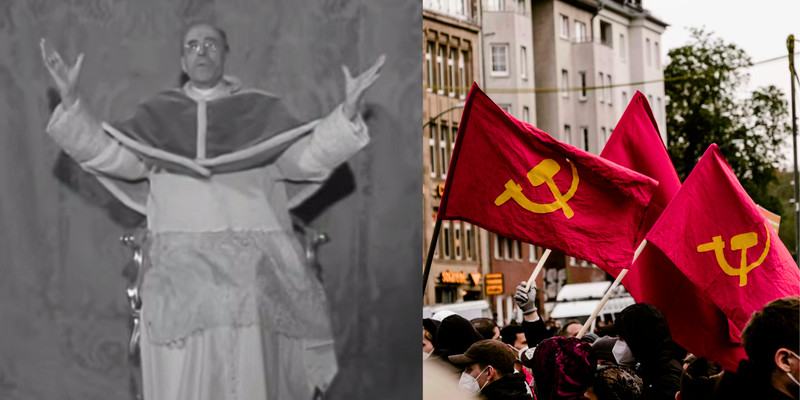
The decree, issued by Pope Pius XII through the Holy Office on July 1, 1949, became known as the “Decree Against Communism.” It was aimed at Catholics who joined communist parties, promoted communist doctrine, or collaborated with communist organizations. Pope Pius XII, who led the Catholic Church from 1939 to 1958, was a strong opponent of communism according to the History Network. The decree described communist ideology as incompatible with Catholic teaching, particularly because of its atheistic principles and its rejection of religious belief.
The Vatican’s position was a part of steps in the Cold War context to remove communist ideology as communist governments pushed their influence across Eastern Europe after World War II. Church leaders feared that the spread of communist rule would restrict religious freedom and weaken the influence of Christianity in society. Communists oppose organized religion.
Franklin C. Gowen, the acting representative at Vatican City to the US Secretary of State, wrote in a July 15, 1949 letter about a meeting with Vatican official Giovanni Battista Montini, who later became Pope Paul VI. According to the letter, Montini described communism as the “irreconcilable enemy” of the Catholic church and all of Christianity.
Pius XII’s opposition to communism was shaped partially by his earlier experience as a Vatican diplomat in Munich in 1919, when communist revolutionaries reportedly entered his residence and demanded his car at gunpoint.
In communist-governed countries such as Poland and Hungary, some priests continued to administer the sacraments to active communists, interpreting the decree as applying primarily to party leaders rather than ordinary members. The 1949 decree was a massive part of the Catholc Church’s anti-communist policy during the Cold War. It;s provisions were later superseded by the 1983 Code of Canon Law, which did not retain the decree in its original form.
The decree, issued by Pope Pius XII through the Holy Office on July 1, 1949, became known as the “Decree Against Communism.” It was aimed at Catholics who joined communist parties, promoted communist doctrine, or collaborated with communist organizations. Pope Pius XII, who led the Catholic Church from 1939 to 1958, was a strong opponent of communism according to the History Network. The decree described communist ideology as incompatible with Catholic teaching, particularly because of its atheistic principles and its rejection of religious belief.
The Vatican’s position was a part of steps in the Cold War context to remove communist ideology as communist governments pushed their influence across Eastern Europe after World War II. Church leaders feared that the spread of communist rule would restrict religious freedom and weaken the influence of Christianity in society. Communists oppose organized religion.
Franklin C. Gowen, the acting representative at Vatican City to the US Secretary of State, wrote in a July 15, 1949 letter about a meeting with Vatican official Giovanni Battista Montini, who later became Pope Paul VI. According to the letter, Montini described communism as the “irreconcilable enemy” of the Catholic church and all of Christianity.
Pius XII’s opposition to communism was shaped partially by his earlier experience as a Vatican diplomat in Munich in 1919, when communist revolutionaries reportedly entered his residence and demanded his car at gunpoint.
In communist-governed countries such as Poland and Hungary, some priests continued to administer the sacraments to active communists, interpreting the decree as applying primarily to party leaders rather than ordinary members. The 1949 decree was a massive part of the Catholc Church’s anti-communist policy during the Cold War. It;s provisions were later superseded by the 1983 Code of Canon Law, which did not retain the decree in its original form.