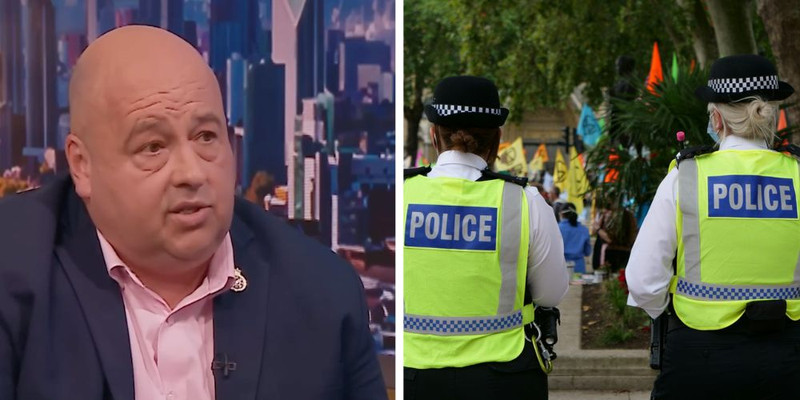

A Scotland Yard whistleblower has accused Scotland Yard of being captured by the “woke mind virus,” claiming that the Metropolitan Police has spent years prioritising diversity over effectiveness.
Rick Prior, former chairman of the Metro Police federation, argued that efforts to achieve equal outcomes among different ethnic groups have contributed to a loss of skills within the force over the past decade. In 2024, Prior was suspended from the federation after raising concerns about officers fearing racism complaints. He was later found by the High Court to have been unlawfully treated by former chief executive Mukund Krishna.
Following that ruling, Prior was asked last year to draft new DEI guidelines, where he suggested that officers be banned from wearing political symbols, including LGBT rainbow lanyards. The proposal was rejected.
“My own ongoing ordeal made me determined to produce a document that would create greater balance, and so restore the confidence of both officers and the public we serve,” he said, according to the Daily Mail.
Prior’s suggestions also included that, due to the Supreme Court’s ruling that the Equality Act referred to biological sex, the force policies should reflect this determination. When he presented his suggestions, a supervisor told him that he would be “better off in a different department.”
“Needless to say, my policy document was never adopted. Thus, the country's largest police force jettisoned a chance to bring itself into line with the law and to lead by example,” Prior said. “It seemed that the Met's senior management had been captured by the ‘woke mind virus’ and that its resistance to change was insurmountable.”
Prior was re-assigned to the Culture, Diversity and Inclusion Directorate. He said the team takes up “the entire second floor of New Scotland Yard” and that he lasted there less than a week.
“My sin was to ask, very politely, why a civilian supervisor included her preferred pronouns in her official police email signature,” he said.
“It has been clear to me that for more than a decade, the Met has been pursuing equity of outcome between ethnic groups rather than equality of opportunity and equal treatment under the law. I have seen it in the forced rotation of skilled firearms officers to manufacture ‘churn’ and diversify armed policing, at great cost in lost skills,” he explained. “I saw it in 2022, when two very senior officers were found by a tribunal to have racially discriminated against a white inspector, by removing him from a promotion process and inserting a less qualified black candidate instead.”
Prior also echoed ongoing allegations of two-tier policing, explaining that after the death of George Floyd in the US, the force had a policy of equal outcome, pointing to the national Police Anti-Racism Commitment issued in March last year and calling it “a smoking gun of two-tier policing, which baldly states that its goal of ‘producing equality of policing outcomes … does not mean treating everyone the same’ or being ‘colourblind.’”
Allegations of two-tier policing have intensified in the wake of the murder of Henry Nowak, an 18-year-old student who was stabbed to death by a Sikh man who falsely accused him of racism. Despite Nowak explaining he was stabbed and couldn’t breathe, police handcuffed him, and he ultimately died.
A previous report has found that a number of officers within the Hampshire police, the force involved in Nowak’s death, felt “controlled and pressured” during their mandatory DEI training, including participants who said they feared that they could be “ rejected for saying the wrong thing” and could not “freely share their attitudes.”