CHRISTIANE EMERY: Harvard slashes 'A' grades but the truth is students haven't been earning them
Students quickly organized petitions calling the policy "racist."
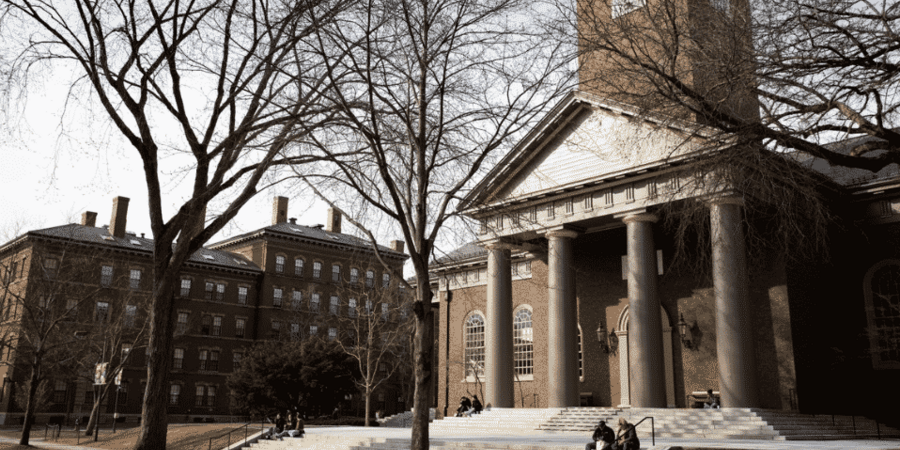
A university report found that more than 60 percent of grades awarded to Harvard undergraduates are now A's, compared to just a quarter that number two decades ago. To combat this, Harvard University recently announced plans to cap the number of A grades professors are allowed to award in undergraduate courses — and the backlash was immediate. The proposed reform would limit A grades to only 20 percent of students in each course. The response has been more revealing than the inflation itself. Students quickly organized petitions calling the policy "racist," despite the fact that the proposal does not even limit A-minus grades and had nothing at all to do with race.
Unfortunately, this is bigger than Harvard. The grade inflation crisis we are seeing in Cambridge is simply the final stage of a problem America has been fostering for over twenty years. After undergrad, I worked as a college and career advisor at lower-income, Title I high schools. The program moved me between three different campuses, and I saw firsthand what was happening inside the American education system. There were high school seniors on my caseload who did not know how to write an essay, some who didn't even know how to write an address correctly. These students would sometimes end up being in the top 20% of their class. Recently, viral TikTok videos showed students struggling to read complete sentences out loud. None of this shocked me.
In 2002, America embraced the No Child Left Behind Act. While the law sounded noble on paper, it created enormous incentives for schools to push students forward regardless of whether they were actually prepared. Schools that failed to meet federal standards risked penalties, leadership changes, or closure. Graduation rates became tied to funding and institutional survival. Predictably, academic honesty suffered. Cheating scandals erupted across the country as schools prioritized metrics over mastery.
Thirteen years later, the Every Student Succeeds Act replaced No Child Left Behind and handed more flexibility to the states. The law emphasized innovative and personalized learning approaches designed to meet students where they were. In theory, it sounds compassionate. In practice, it too often became another step away from excellence and toward accommodation culture. Students absolutely have different strengths, and there is nothing wrong with trade schools, alternative career paths, or individualized support. But elite academics are supposed to maintain elite standards. If universities continually lower expectations to match student underperformance, eventually the standards themselves become meaningless.
That is the precipice America now finds itself on. Harvard's own Dean of Undergraduate Education, Amanda Claybaugh, admitted that instructors worry giving lower grades will result in negative student evaluations that could hurt their careers. She also acknowledged students have become "increasingly litigious" when pressuring professors to raise grades. That is absurd.
Claybaugh herself connected the inflation problem to efforts encouraging professors to be more sensitive to students entering college with weaker academic preparation. But this is the Ivy League. Elite institutions cannot maintain credibility while simultaneously lowering standards to accommodate underperformance. Instead of maintaining standards throughout the educational pipeline, universities are now attempting to reverse decades of lowered expectations at the grading stage.
The coddling only intensified during the COVID-19 pandemic. Colleges across the country encouraged professors to grade with "grace," extend flexibility indefinitely, and lower expectations in response to student hardship. Universities told faculty to prioritize compassion above all else as students struggled through online learning, technology barriers, and personal stress.
Compassion matters, and real hardships exist, but adulthood still has to have standards. In the real world, grief does not indefinitely pause deadlines. Employers still expect performance. Licensing exams do not disappear because someone feels overwhelmed. At some point, institutions need to be preparing students for reality, not functioning as buffers shielding students from the real world.
This expectation of ease is downstream of nearly every layer of American culture. Participation trophies taught children that showing up was equivalent to achievement. Schools have increasingly avoided competition, failure, and consequences altogether. My school had A and B volleyball teams, but to avoid so many girls having to be cut, the school created an entirely new C team. Rather than encouraging us to improve and try harder, adults simply lowered the standard so everyone could feel successful.
This generation grew up with high-speed internet, same-day delivery, and instant access to virtually everything. We built a culture where patience, delayed gratification, and perseverance became increasingly foreign concepts. If rewards are guaranteed regardless of performance, why would anyone feel motivated to push themselves further?
Back in 2018, free speech advocate Greg Lukianoff and social psychologist Jonathan Haidt warned about this exact phenomenon in The Coddling of the American Mind. They argued that American institutions were teaching students three destructive ideas: that what doesn't kill you makes you weaker, that you should always trust your feelings, and that life is a battle between good people and evil people. The result was a culture of "safetyism" that made young adults less resilient, less independent, and less capable of handling adversity. when Haidt was invited to speak as a commencement speaker at his alma mater NYU, he was protested because students were "offended" that he suggested they'd been coddled.
Participation trophies, inflated grades, and constant institutional cushioning do not build confidence. Real confidence comes from overcoming difficulty, improving after failure, creating skills, and earning achievement honestly. People often forget there was a time in America when higher education was difficult to access because the standards were difficult to meet. A diploma represented discipline, competency, and achievement. Not everyone reached that bar, and that was okay.
But over time, America decided standards themselves were unfair. Now even Harvard is being forced to admit something has gone wrong. As Charlie Kirk often argued, a healthy society depends on resilient young Americans, not emotionally fragile ones. Harvard's grading crisis is not an isolated Ivy League problem — it is the inevitable result of a culture that spent decades confusing self-esteem with achievement.