
When I consider what life might have been like for my mother, or her mother—or mothers five generations ago—to have children, there's really never been an easier time to be a mother than now.
Not only is there more gender parity than at any other time in history, but technological advancements have made this especially apparent. Remote work offers flexible options for moms who want to balance work and motherhood. Smartphones let moms observe sleeping babies upstairs, order DoorDash when cooking dinner seems overwhelming, and book a virtual appointment with a physician for when a trip to the doctor's office seems like too much with toddlers in tow.
Yet the U.S. birth rate is at an all-time low, and now there's a newer, worse trend: women who regret having children.
I'm a mom of four, and I've regretted a lot of things in life—but not having children, even though I had four babies two years apart and now have (almost) four teenagers (talk about an avalanche of bills and attitude).
But having raised children for nineteen years now, I think I know why women regret it. It's not that complicated, and it might sound harsh, but it needs to be said.
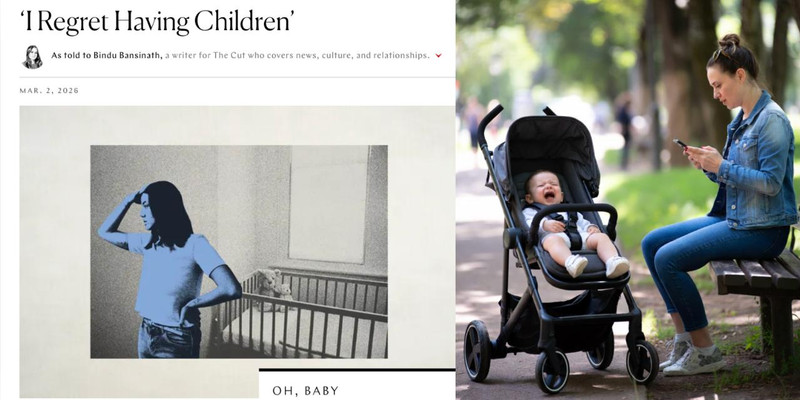
An early March piece in "The Cut" highlighted women who regret having children. It sparked discussion on social media. As if on cue, the BBC published a similar article on March 14 with their own version of mothers who regret having children. "Like a trap you can't escape," one mother said. The next day, The Telegraph published yet another article. "From the safety of online forums, more young parents admit they love their kids, but hate their lives," the subhead reads. Apparently, March is "Motherhood regret" month.
I don't know if there's always been a subset of women who regretted having children or if they're just now feeling they can speak up about it. It doesn't help that outlets seem to relish publishing what a lot of conservatives on social media dub blatant "anti-family propaganda."
I get that motherhood is frustrating and hard. I really do. For a mom in difficult scenarios—like raising a child with special needs, struggling with one's own mental health, or keeping a job or paying the bills— having to take care of children can seem like extraordinary stressors. Motherhood is certainly harder than I thought it would be, and this fluctuates depending on my and their season of life.
Children are unique in that they are, well, always around. Unlike a job, a spouse, or a friend, children require 24/7 care, attention, warmth, and love. They are a massive responsibility, and their needs change over time, creating new problems to solve, whether it's sleeping through the night, potty training, calculus, dating, or driving a car. Being a mother is no small task. As the writer G.K. Chesterton said, "A woman's function is laborious, but because it is gigantic, not because it is minute. I will pity Mrs. Jones for the hugeness of her task; I will never pity her for its smallness."
Some of the women in these articles who regret motherhood seem to be struggling with things like mental health, which can make everything seem hard. I know some women cite things like the cost of childcare or just the ongoing burden of caring for children and household chores that make being a mom just seem really difficult, even inspiring regret. These things are valid, and things both our culture and policies can do to improve some of these issues.
But I think at the core of motherhood regret there is something far more insidious: Pure selfishness. Motherhood requires a level of selflessness and sacrifice that many women find challenging. For many years, children are not self-aware enough to even appreciate the things mom is doing for them—the loss of self, the balancing act, and the constant stress of work and family. Eventually, when they do get old enough to notice, they want money, car keys, and to hang out with their friends.
Whether it's the constant care a baby requires or the attitude teens have, motherhood demands that a woman go deeper, give more, and do so with kindness, stability, and love. This is hard. And this spirit of selflessness contradicts society's modern message to adults, which is to put yourself first, love yourself, and do what feels good. In the battle of these conflicting messages, it sounds like for a lot of women, that's what wins—and the kids lose.
I feel sad for the women who regret motherhood, because it is a beautiful experience. Or it can be, with the right attitude. I also worry about the kids who eventually learn that their parents regretted them. How will that make them feel?
I know that motherhood is hard, but it's just going to be. Some systems and changes can ease the load, but it is a task that requires focusing on others. And I do think it's worth it. I hope this trend of regretting motherhood passes soon, and more women can enjoy a wonderful experience that, in perspective, is quite short—and easier than it ever has been for generations.