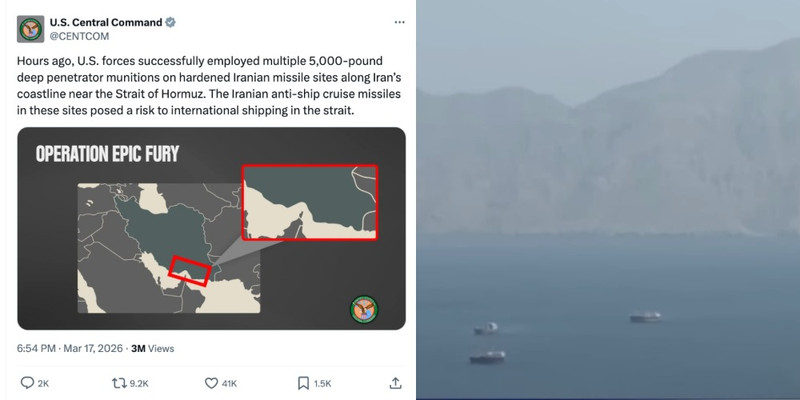

The US military carried out strikes Tuesday targeting Iranian missile infrastructure along the Strait of Hormuz, hitting what officials call hardened coastal positions with heavy bunker-penetrating bombs. The operation focused on anti-ship systems seen as a direct threat to vessels moving through the critical waterway.
US Central Command said the targeted sites housed Iranian anti-ship cruise missiles that posed a risk to international shipping. “The Iranian anti-ship cruise missiles in these sites posed a risk to international shipping in the strait,” the command said.
The strikes come as tensions build amid the US-Israel campaign against Iran, which began on Feb. 28. Since then, maritime attacks and disruptions have contributed to rising oil prices globally, and markets have been a bit shaky. About 20 percent of the world’s oil supply passes through the Strait of Hormuz, making the region especially sensitive in a conflict.
According to a US official cited by CNN, the weapons used in Tuesday’s strikes were GBU-72 Advanced Penetrators, 5,000-pound munitions designed to destroy fortified underground targets. The U.S. Air Force previously said, “The GBU-72 was developed to overcome hardened, deeply buried target challenges and designed for both fighter and bomber aircraft.”
Iran has signaled it may attempt to block the strait. Mojtaba Khamenei, the country’s new supreme leader, has said the waterway would remain closed in response to the ongoing air campaign, reports The Hill.
Concerns over Iran’s capabilities have also complicated any effort to reopen the passage. The country has the ability to deploy sea mines, launch drones, and fire anti-ship missiles, which has made some European allies hesitant to commit forces.
Sen. Lindsey Graham criticized that reluctance Tuesday, warning of “wide and deep” consequences for alliances if partners fail to act. President Trump, posting on Wednesday morning to Truth Social, suggested the US could step back from securing the route. “That would get some of our non-responsive ‘Allies’ in gear, and fast,” he wrote, adding that other countries reliant on the strait should take responsibility for keeping it open.
US Central Command said the targeted sites housed Iranian anti-ship cruise missiles that posed a risk to international shipping. “The Iranian anti-ship cruise missiles in these sites posed a risk to international shipping in the strait,” the command said.
The strikes come as tensions build amid the US-Israel campaign against Iran, which began on Feb. 28. Since then, maritime attacks and disruptions have contributed to rising oil prices globally, and markets have been a bit shaky. About 20 percent of the world’s oil supply passes through the Strait of Hormuz, making the region especially sensitive in a conflict.
According to a US official cited by CNN, the weapons used in Tuesday’s strikes were GBU-72 Advanced Penetrators, 5,000-pound munitions designed to destroy fortified underground targets. The U.S. Air Force previously said, “The GBU-72 was developed to overcome hardened, deeply buried target challenges and designed for both fighter and bomber aircraft.”
Iran has signaled it may attempt to block the strait. Mojtaba Khamenei, the country’s new supreme leader, has said the waterway would remain closed in response to the ongoing air campaign, reports The Hill.
Concerns over Iran’s capabilities have also complicated any effort to reopen the passage. The country has the ability to deploy sea mines, launch drones, and fire anti-ship missiles, which has made some European allies hesitant to commit forces.
Sen. Lindsey Graham criticized that reluctance Tuesday, warning of “wide and deep” consequences for alliances if partners fail to act. President Trump, posting on Wednesday morning to Truth Social, suggested the US could step back from securing the route. “That would get some of our non-responsive ‘Allies’ in gear, and fast,” he wrote, adding that other countries reliant on the strait should take responsibility for keeping it open.