
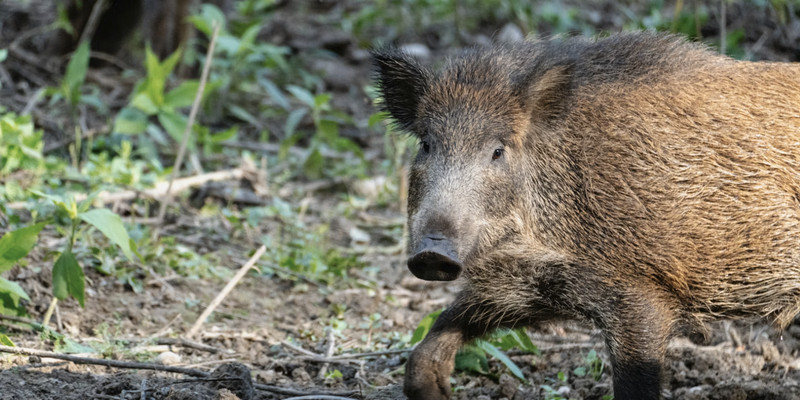

A growing population of hybrid wild pigs have been reported inside Japan’s Fukushima exclusion zone, with researchers linking the surge to genetic mixing between escaped domestic pigs and wild boars following the 2011 nuclear disaster.
The situation traces back to the Fukushima Daiichi nuclear plant meltdown in March 2011, triggered by a 9.0-magnitude earthquake and tsunami. Around 164,000 residents were evacuated, leaving farmland, towns, and infrastructure largely abandoned in the radiation zone.
In the years after the evacuation, domestic pigs that had escaped captivity reportedly survived in the wild and began interbreeding with native wild boars. The result, according to researchers, is a hybrid population with unusually rapid reproduction rates, reports Popular Science.
Wild boars typically breed once per year. Domestic pigs, however, can reproduce year-round with far shorter generational cycles. Scientists say that trait appears to have been passed down through maternal genetic lines in the hybrids, accelerating population growth.
“While it has been previously suggested that hybridization between rewilded swine and wild boars can contribute to population growth, this study demonstrates — through the analysis of a large-scale hybridization event following the Fukushima nuclear accident — that the rapid reproductive cycle of domestic swine is inherited through the maternal lineage,” Professor Shingo Kaneko of Fukushima University said in a statement.
Researchers from Fukushima University and Hirosaki University reached their conclusions through DNA analysis of the hybrid population. Their findings were published in the Journal of Forest Research.
The study also found the population boom may be altering genetic composition over time, with lower-than-expected levels of domestic pig DNA appearing in some hybrid groups.
“We wish to emphasize that this mechanism likely occurs in other regions worldwide where feral pigs and wild boars interbreed,” Hirosaki University geneticist Donovan Anderson added in a statement.
Feral swine are widely regarded as a destructive invasive species, known for damaging crops, livestock operations, and natural ecosystems. In the United States alone, control and damage costs are estimated at roughly $3.4 billion, according to the US Department of Agriculture.
Researchers say the Fukushima exclusion zone created unusually favorable conditions for population expansion due to the absence of humans combined with abundant space and resources. They added that understanding how maternal lineage affects reproduction cycles could help predict future population surges in invasive wild pig species.
The situation traces back to the Fukushima Daiichi nuclear plant meltdown in March 2011, triggered by a 9.0-magnitude earthquake and tsunami. Around 164,000 residents were evacuated, leaving farmland, towns, and infrastructure largely abandoned in the radiation zone.
In the years after the evacuation, domestic pigs that had escaped captivity reportedly survived in the wild and began interbreeding with native wild boars. The result, according to researchers, is a hybrid population with unusually rapid reproduction rates, reports Popular Science.
Wild boars typically breed once per year. Domestic pigs, however, can reproduce year-round with far shorter generational cycles. Scientists say that trait appears to have been passed down through maternal genetic lines in the hybrids, accelerating population growth.
“While it has been previously suggested that hybridization between rewilded swine and wild boars can contribute to population growth, this study demonstrates — through the analysis of a large-scale hybridization event following the Fukushima nuclear accident — that the rapid reproductive cycle of domestic swine is inherited through the maternal lineage,” Professor Shingo Kaneko of Fukushima University said in a statement.
Researchers from Fukushima University and Hirosaki University reached their conclusions through DNA analysis of the hybrid population. Their findings were published in the Journal of Forest Research.
The study also found the population boom may be altering genetic composition over time, with lower-than-expected levels of domestic pig DNA appearing in some hybrid groups.
“We wish to emphasize that this mechanism likely occurs in other regions worldwide where feral pigs and wild boars interbreed,” Hirosaki University geneticist Donovan Anderson added in a statement.
Feral swine are widely regarded as a destructive invasive species, known for damaging crops, livestock operations, and natural ecosystems. In the United States alone, control and damage costs are estimated at roughly $3.4 billion, according to the US Department of Agriculture.
Researchers say the Fukushima exclusion zone created unusually favorable conditions for population expansion due to the absence of humans combined with abundant space and resources. They added that understanding how maternal lineage affects reproduction cycles could help predict future population surges in invasive wild pig species.