CHRISTIANE EMERY: Jelly Roll praises God at the Grammys in much needed Hollywood Christian revival
Jelly Roll’s story matters because it cuts directly against the stereotype Hollywood prefers.
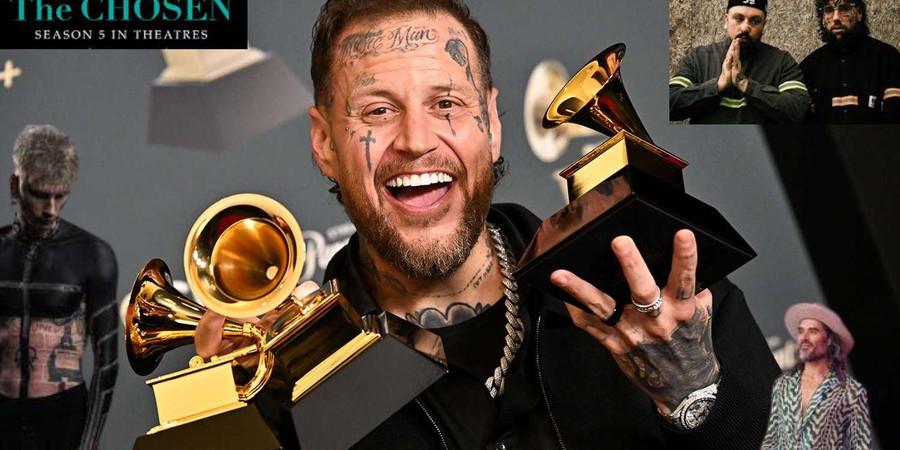
Jelly Roll’s profession of faith at the Grammys Sunday night is making waves as a rare public display of conviction in an industry often hostile towards Christianity. There has been a rumbling of a revival happening across the country for a while now. We saw it spike after the assassination of Charlie Kirk on September 10, 2025. This moment shook the nation and coincided with a record number of Americans returning to church and seeking baptism. Some faith leaders across the country reported upticks of 15% or more in their congregations.
But Hollywood has always been a different mountain.
For decades, faith has been treated as incompatible with credibility in elite cultural spaces. Awards shows, music labels, and streaming platforms reward cynicism, irony, and rebellion—not reverence. Christianity is tolerated only when it is vague, ironic, or safely distant. Which is why what happened at the Grammys matters.
In a room where faith is usually rejected or mocked, Jelly Roll took the stage and did something rare: he professed his love for Jesus Christ.
“First of all, Jesus, I hear you and I am listening, Lord,” he said, before thanking his wife and crediting music — and Jesus alone — for being the reason he is still alive today.
In an industry that rewards critics over conviction, this moment stood out. It wasn’t polished. It wasn’t political. It wasn’t packaged as activism. It was gratitude, humility, and testimony — spoken plainly, without apology.
And Jelly Roll is not alone.
For as long as anyone can remember, Hollywood elites have treated Christianity as a quirky personality trait at best and a professional liability at worst. Christian artists are dismissed as “Hallmark cards” or “Bible thumpers,” while faith itself is framed as unsophisticated or embarrassing. Yet this hostility reveals something deeper: Hollywood does not merely dislike Christianity — it competes with it. Who does the industry want you listening to — God, or its messaging?
That question is becoming harder to avoid as more public figures begin to break from the script.
Russell Brand, once a tabloid fixture and outspoken secularist, now speaks openly about his faith, prays publicly, and has shared his testimony on stages that mainstream media once deemed unacceptable. Machine Gun Kelly, an artist long associated with dark aesthetics and rumored occult imagery, has sparked conversation after blacking out most of his tattoos, leaving a visible cross, and releasing raw recordings reflecting on loss, repentance, and belief. Even the rap duo Suicideboys, whose early lyrics mocked Christianity, now give their testimony at concerts. Citing C.S. Lewis as a turning point and publicly altering lyrics that once glorified Satan to instead call on Jesus Christ.
These are not sanitized faith leaders or carefully curated Christian influencers. They are deeply flawed, controversial artists, which may be precisely why their words carry weight. Their stories resist the modern cultural lie that meaning is found only in self-expression, identity politics, or rebellion.
The shift isn’t confined to music. The Chosen, a television series centered on the life of Jesus Christ, has achieved near-universal audience approval, earning a 9/10 rating on IMDb and a 99 percent audience score on Rotten Tomatoes. What began as a streaming project has drawn such demand that it moved into theaters, an outcome Hollywood executives rarely predict for explicitly Christian content.
Jelly Roll’s story matters because it cuts directly against the stereotype Hollywood prefers.
He isn’t polished. He isn’t elite. He doesn’t speak in slogans or ideological talking points. His life has been marked by addiction, loss, and failure — the very things modern culture insists can be solved through affirmation alone.
Instead, his message was simple: redemption is real, and it comes from Christ.
For years, celebrities have been encouraged to shape culture by echoing approved narratives — whether political, social, or ideological. But what we are seeing now is something different. This is not virtue signaling or brand alignment. It is conviction.
Hollywood may still resist it, mock it, or attempt to repackage it. But a revival that reaches the Grammys cannot be dismissed as fringe. Whether the industry likes it or not, faith is no longer staying quiet, and the people leading the charge are not the ones Hollywood ever expected.
Related
More Culture