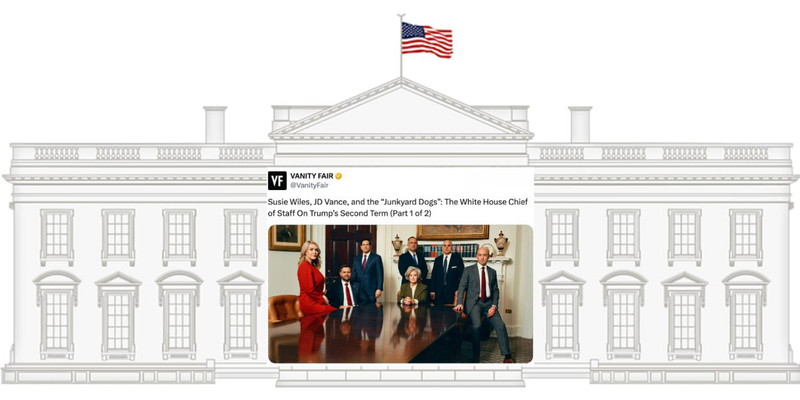

If you've ever wondered if some mainstream media publications struggle to hide their contempt for conservatives, particularly the Trump administration, look no further than the Vanity Fair piece published on Dec. 15, especially the photographs that accompany the interview.
The feature initially made waves because the notoriously behind-the-scenes White House Chief of Staff Susie Wiles had finally gone on the record, in no less than 11 interviews with Chris Whipple. Then she made some eyebrow-raising comments: She said Trump had "an alcoholic's personality," that Vice President J.D. Vance was prone to "conspiracy theories," and Tesla CEO Elon Musk was an "odd, odd duck" who used ketamine regularly.
While none of these are particularly revealing or shocking, they painted a picture that the administration and their allies are chaotic, unstable, and being run by a bunch of amateurs. After it was published and the fallout began, Wiles walked a lot of her comments back, calling the feature a "disingenuously framed hit piece." She said many of her statements were taken out of context. Whipple has produced recordings of the comments, showing otherwise.
I don't think Wiles' comments were taken out of context. Why she said them, I'm not sure. Perhaps she did want to distance herself from the administration. Perhaps these observations she felt were casual, unassuming, or would not be printed. That's a question only she and the administration can answer.
A more pressing question might be why the staff thought they'd give an interview to Vanity Fair, a publication hardly known for its center-right leanings. Were they giving them a chance? Did they think the magazine would be fair and balanced? If so, they were wrong, and the feature is just the beginning.
I didn't think the interviews themselves were as bad as the photographs. At first, when I saw them, I couldn't believe my eyes. Photographer Christopher Anderson took several portraits of Wiles, Vance, Secretary of State Marco Rubio, and Press Secretary Karoline Leavitt. Some are normal-looking, but several appear untouched, unvarnished, close-up, and in most cases, make everyone look unappealing and unattractive. Every wrinkle and blemish is obvious.
Leavitt's portrait is so close, viewers can see the injection sites on her lips. Vance, too, has an up-close portrait of an immature grimace. White House Deputy Chief of Staff Stephen Miller is shown with a shadowy, almost evil face, sitting in a way that reveals a paunch.
Social media has been abuzz with Anderson's photos, with leftists claiming it was a masterclass in how to show disdain for Trump without saying a word. In other words, most observers can see that the photographs are intentional and convey a clear message.
The Washington Post interviewed Anderson and asked him about it. "I didn't put the injection sites on her. People seem to be shocked that I didn't use Photoshop to retouch out blemishes and her injection marks. I find it shocking that someone would expect me to retouch out those things," he said.
Anderson's claim that he's simply following the photographer's version of journalism rules— leaving things raw, unedited, and as they are in real life is disingenuous, especially when the Trump administration's unflattering photos are compared to his glamorous photos of Barack and Michelle Obama, or movie stars like George Clooney.
Anderson's missive is obvious, and his photos portray more scorn for Trump's staff than a 5,000-word feature ever could. Anderson, along with the editors at Vanity Fair, obviously thinks the Trump administration portrays itself as polished. They wanted to show the public that, in reality, they are flawed, grotesque, and their narrative is full of holes — get it?
The whole thing was sneaky, too. There's no way anyone would sit down with a professional photographer taking portraits for Vanity Fair, presuming they're going to come out looking worse in print than they do in real life. To publish the photos unvarnished and do so under the pretense of journalistic integrity seems far-fetched even to a biased reader. If an elitist publication wanted to dupe the Trump administration into making themselves look awful so they could showcase their own contempt for conservatives, what would look different?
That said, I do think the Trump administration might have walked itself into this one, and it raises questions for Republicans about why this happened at all. I don't know why they granted interviews and portraits with a publication that has had no interest in showcasing conservatives' ideas. Vanity Fair is not known for being fair or unbiased toward Trump.
Was the administration taken in by their own vanity, being featured in Vanity Fair? That was probably their first mistake. In either case, the Trump administration likely won't make it again.