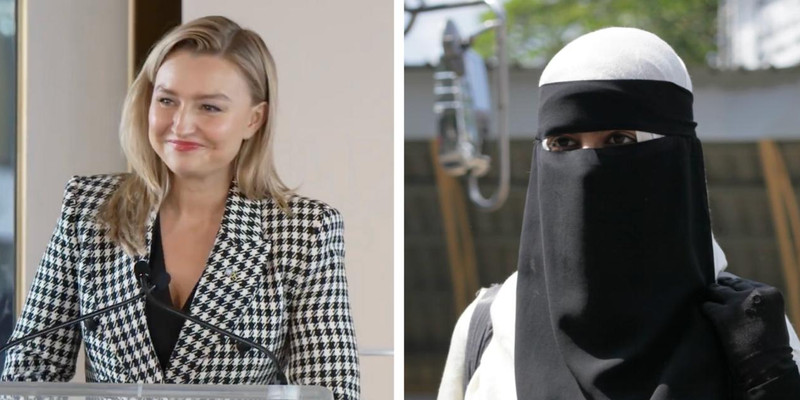

Sweden’s Deputy Prime Minister Ebba Busch has called for a nationwide ban on Islamic women's modesty dress burqas and niqabs, which cover a woman's face completely, saying the country should act “while we can” to address what she described as failed integration and social division.
Busch, who leads the Christian Democrats and also serves as Minister for Energy and Business, argued that full-face coverings have “no place” in Swedish society and represent “an expression of a strict interpretation of Islam practiced in totalitarian states such as Iran and Afghanistan.”
“You should be able to meet for real if you are on the street, if you are shopping in the square, in the Ica store or taking the children to the health center,” she told Aftonbladet. “Then I don’t want to meet someone who has covered their entire face.”
The proposal, which the Christian Democrats plan to bring to their national congress in November, would apply to public environments such as shopping centers, streets, and healthcare facilities. Sweden currently has no national restrictions on burqas or niqabs, though some municipalities have tried to impose local bans, including in schools.
Busch said the move is part of an effort to rebuild “social cohesion” to push back against what she called “naive liberalism” that allowed Sweden’s integration problems to worsen. “It is the type of very naive liberalism, or lax social policy, that has brought Sweden to the situation we are in today,” she said.
She also spoke to women’s rights issues, saying that nearly 70,000 women in Sweden have suffered from female genital mutilation. “You are very welcome to be a Muslim in Sweden,” Busch added, “but you have to adapt if you are already in the country.”
Liberal Party leader Simona Mohamsson, who serves as Minister of Education and Integration, backed Busch’s stance. She said it’s important to hold accountable those who “practice religious oppression,” such as enforcing compulsory veiling.
Busch, who leads the Christian Democrats and also serves as Minister for Energy and Business, argued that full-face coverings have “no place” in Swedish society and represent “an expression of a strict interpretation of Islam practiced in totalitarian states such as Iran and Afghanistan.”
“You should be able to meet for real if you are on the street, if you are shopping in the square, in the Ica store or taking the children to the health center,” she told Aftonbladet. “Then I don’t want to meet someone who has covered their entire face.”
The proposal, which the Christian Democrats plan to bring to their national congress in November, would apply to public environments such as shopping centers, streets, and healthcare facilities. Sweden currently has no national restrictions on burqas or niqabs, though some municipalities have tried to impose local bans, including in schools.
Busch said the move is part of an effort to rebuild “social cohesion” to push back against what she called “naive liberalism” that allowed Sweden’s integration problems to worsen. “It is the type of very naive liberalism, or lax social policy, that has brought Sweden to the situation we are in today,” she said.
She also spoke to women’s rights issues, saying that nearly 70,000 women in Sweden have suffered from female genital mutilation. “You are very welcome to be a Muslim in Sweden,” Busch added, “but you have to adapt if you are already in the country.”
Liberal Party leader Simona Mohamsson, who serves as Minister of Education and Integration, backed Busch’s stance. She said it’s important to hold accountable those who “practice religious oppression,” such as enforcing compulsory veiling.