
"General Robert E. Lee was, in my estimation, one of the supremely gifted men produced by our Nation. He believed unswervingly in the Constitutional validity of his cause, which until 1865 was still an arguable question in America; he was a poised and inspiring leader, true to the high trust reposed in him by millions of his fellow citizens; he was thoughtful yet demanding of his officers and men, forbearing with captured enemies but ingenious, unrelenting and personally courageous in battle, and never disheartened by a reverse or obstacle.
Through all his many trials, he remained selfless almost to a fault and unfailing in his faith in God. Taken altogether, he was noble as a leader and as a man, and unsullied as I read the pages of our history."
This stirring tribute to General Robert E. Lee wasn't launched by some dreaded "alt-right white supremacist" like Richard Spencer, who in any case, is more likely to leap to the defense of Kamala Harris or Joy Behar these days. President Dwight D. Eisenhower made it while he was still in office.
In 1960, President Eisenhower told the Republican National Convention, in passing, that he kept a portrait of the Confederate general in the White House. Not long after, he received an angry letter from a New York dentist, asking him "how any American can include Robert E. Lee as a person to be emulated," since the "most outstanding thing" he did "was to devote his best efforts to the destruction of the United States government."
The President responded calmly in a letter of his own.
After the paragraph I've just quoted, he continued: "From deep conviction, I simply say this: a nation of men of Lee's calibre would be unconquerable in spirit and soul. Indeed, to the degree that present-day American youth will strive to emulate his rare qualities, including his devotion to this land as revealed in his painstaking efforts to help heal the Nation's wounds once the bitter struggle was over, we, in our own time of danger in a divided world, will be strengthened and our love of freedom sustained."
In his gracious response, Eisenhower displayed a soldier and a true patriot's understanding of Robert E. Lee and his place in American history. Far from being a creature to be reviled for his association with an unjust or simply a defeated cause, Lee was a man who demanded respect for his many obvious virtues and his pure intentions, regardless of the outcome.
You can attempt to sanitize or censor the man, but in doing so, you cease to understand him, the conflict of which he was a part, or, indeed, the millions of men who shared in that conflict under him and with him and against him. Instead of being a tragedy, which it was, the American Civil War becomes a cheap morality play in which the losers deserved to lose because they lost, and the winners deserved to win because they won.
Such thinking may provide comfort for simple minds—and I suspect the doctor who wrote to Eisenhower had a simple mind—but we must never forget the more insidious, ideological purposes it can serve too.
President Trump has made the censoring and rewriting of American history one of the principal targets of his new administration. Early on in his second term, he issued an Executive Order that called, among other things, for a review of all monuments that have been removed from public display in the interests of political correctness; in particular, monuments taken down or destroyed by the Biden regime after the death of George Floyd.
The Executive Order made clear that the removal of every single monument was a political act, intended to further an anti-American political agenda, one designed to inculcate shame and regret in the American people about their history and identity.
The Order is worth quoting at length.
"Over the past decade, Americans have witnessed a concerted and widespread effort to rewrite our Nation's history, replacing objective facts with a distorted narrative driven by ideology rather than truth. This revisionist movement seeks to undermine the remarkable achievements of the United States by casting its founding principles and historical milestones in a negative light. Under this historical revision, our Nation's unparalleled legacy of advancing liberty, individual rights, and human happiness is reconstructed as inherently racist, sexist, oppressive, or otherwise irredeemably flawed."
It's quite clear that President Trump and those advising him understand the relationship of the past to the present and indeed the future: a present and a future they wish to shape decisively, for the better. This is encouraging.
Leftists have always got it, which is why they've always gone to such great lengths to control the past, whether that's Marx and Engels dreaming up a classless society at the beginning of human history to justify communism as its ending; Stalin having Leon Trotsky erased from official photographs (before having him erased in real life, with an icepick); or your average pink-haired rainbow-badge-wearing teacher telling a class full of six-year-olds that the great American story is actually one long trail of tears and there's nothing to be proud of in it.
On a daily basis, across America, leftists go to work chipping away at the nation's past, in full knowledge of the purpose it serves: cultural and ultimately social revolution.
After earlier announcements that military bases like Fort Bragg—renamed Fort Liberty—would have their old names restored, this week we were told that two important Confederate monuments, a statue of Albert Pike and a sculpture by Moses Ezekiel, would be put back in their rightful places. The statue of Pike, a Confederate general, was toppled and set on fire during a protest in the capital in 2020, and the Ezekiel sculpture—often referred to as the "Reconciliation Monument"—was removed from Arlington National Cemetery in 2023 by the Biden administration.
"It never should have been taken down by woke lemmings," Secretary of Defense Pete Hegseth wrote in a tweet about the Ezekiel sculpture, on Tuesday. "Unlike the Left, we don't believe in erasing American history—we honor it."
These restorations are to be welcomed, of course. And they're sure to cause outrage and offense among leftists, which is never a bad thing either. Who knows, maybe there'll be more protests and attempts to remove the monuments or at least deface and ruin them? Then again, the leftist protest machine appears to have run out of gas, so any demonstrations could be just as pathetic and anti-climactic as the "No Kings" protests that were supposed to signal the beginning of the end—how many times have we heard that?—for Trump a couple of months ago.
But the Trump administration can afford to be more ambitious than this, and not just because its opponents are in disarray. The Trump administration now has a chance to strike at the very heart of the left's project to rewrite American history.
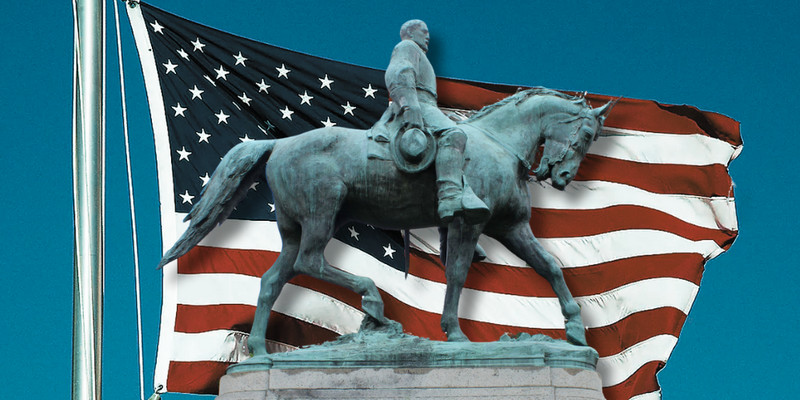
To do that, the Trump administration must restore the statue of Robert E. Lee that was removed from Charlottesville, Virginia, and destroyed in 2023.
More than any other, that statue represents the battle for control of America's history. It is the symbol of the culture wars that have wracked America with growing intensity and acrimony for the better part of two decades now.
Trump himself knows this only too well. It was the 2017 protests in Charlottesville over the planned removal of the statue that produced one of the enduring smears against him. I'm referring, of course, to the "fine people" smear that has been used ever since to suggest Trump is an admirer of "white supremacists" and maybe even a secret neo-Nazi himself.
One immediate problem is that the Lee statue was on municipal, not federal, land, meaning President Trump's Executive Order doesn't apply to it. This is a more general obstacle facing the effort to restore fallen monuments. About 170 Confederate monuments were removed after the Summer of Floyd, but only a small number of them—like the Pike and Ezekiel monuments—are on federal land.
At first glance, this fact might seem to rule out the possibility of restoring the Lee statue, but if Trump's second term has taught us anything so far, it's that there are ways and means. Illegal immigrants whose home countries won't take them back can be sent to third countries, like Sudan or Eswatini (formerly Swaziland). State governors who allow rioting to endanger federal agents conducting lawful federal business can have their state national guard commandeered and deployed on the streets, whether they like it or not. Rogue judges issuing nakedly political nationwide injunctions can simply be ignored.
Pressure could be brought to bear on the municipal authorities in Charlottesville in one of any number of ways, but perhaps the easiest would simply be to cut off federal funding. Look at the fantastic concessions the Trump administration has extracted from Harvard and Columbia universities just by threatening to shut off the money hose that allows them to maintain their preeminent positions in education. It's not hard.
But if the municipal authorities won't budge, put the statue on federal land in Charlottesville instead.
The other problem is that the Lee statue has been destroyed, unlike the Pike or Ezekiel monuments, which can simply be removed from storage and cleaned up before being put back on display.
The destruction of Lee's statue was carefully choreographed—it was actually filmed—in order to send a clear message that the left had triumphed, finally, in the culture war. Instead, they produced an image of incredible power—Lee's face melting in the furnace, its features cast in agonising relief—that made the whole thing seem even more craven and pathetic, as if that was possible, and also increased the determination of patriots not to let America's enemies win.
As far as we know, the metal is still being kept in storage, reportedly for an "art project." Again: there are ways and means.
But if the metal can't be recovered for whatever reason, the monument can be forged anew.
Of course, it wouldn't be the original, and that would diminish some of the power of the gesture, but the fundamental principle would be respected: Robert E. Lee's statue should stand in Charlottesville, as it once did. Continuity would be restored.
Of course, it would prove enormously controversial, but so are mass deportations, supposedly, and they're happening. So is bringing an end to birthright citizenship, but that's happening. I could go on.
Maybe then, with the statue restored, a new generation of American youth would hope "to emulate [Lee's] rare qualities," as President Eisenhower dreamed, and in a world that is no less dangerous or divided than in the 1960s, the nation would be "strengthened" and rediscover its "love of freedom" once again. And that, I think, is the bare minimum if America is to survive in any recognisable form.