
By all accounts, Florida's response to Hurricane Isaias, a Category 2 hurricane, was picture perfect. Congratulations to Governor DeSantis and all the emergency managers and first responders in Florida and those who joined from elsewhere. If you watched the footage, you saw state and local first responders moving into action before and during the hurricane. What you didn't see, though, and it's a good thing, is FEMA. Why? You're not supposed to.
Picture a FEMA employee. A windbreaker with the FEMA logo. A flooded street. A boat lifting a family off a rooftop. Bulldozers clearing debris, hard hats everywhere, the cavalry coming over the hill. That's what most Americans think when they think of FEMA. But that's the wrong perception.
I ran the place, a job I never sought, and I'll tell you plainly: the cavalry isn't coming.
Saving you—regardless of what FEMA employees claim—was never FEMA's job. The gap between what people think FEMA does and what it does is wide. Let me walk through it.
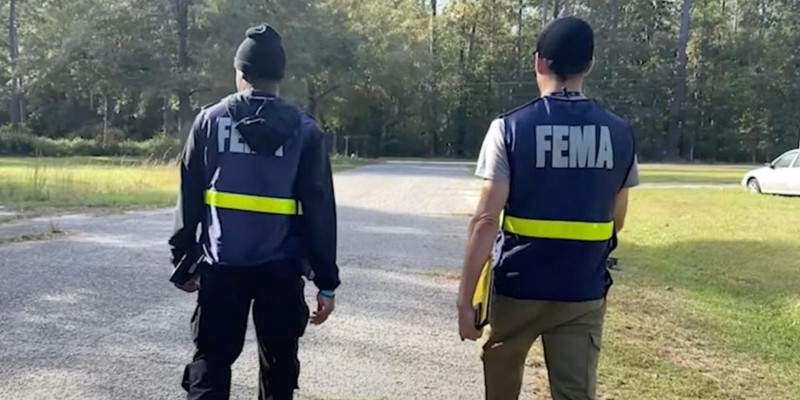
Disasters, the agency says, are "locally executed, state managed, federally supported." FEMA is the federal part. Despite FEMA emblazoned shirts and jackets, cargo pants, and near military style shoes constituting the faux uniform worn by the standard headquarters bound FEMA employee, FEMA is not a boots-on-the-ground agency.
Strip away the eye-catching windbreaker and the agency does six things:
Coordinate.
When a governor relays to the president through FEMA that the state is overwhelmed, they appeal to the President for a disaster declaration. If approved, FEMA turns on the federal dollar spigot, synchronizes other agencies, and eventually sends a horde of FEMA employees into the hinterlands and fringes of America to have a look at what's happening and then report back to D.C. FEMA HQ.
In the first few days of a disaster, FEMA has a very small footprint at the disaster site assisting with this coordination. Back in D.C., FEMA orchestrates the federal response for disasters at The National Regional Coordination Center (NRCC), largely a Washington D.C. television stage prop. It looks impressive, but what it does could be done out of the back of a mobile command center or a facility only 20% its current size and staffing. In short, the NRCC, like FEMA writ large, is mainly a jobs program.
Write Checks.
This is the big one. Through Individual Assistance, FEMA cuts checks to survivors who are required to navigate antiquated call centers and a pile of paperwork. Through Public Assistance, FEMA reimburses state and local governments for their payouts. Through the National Flood Insurance Program (NFIP), it underwrites federally subsided flood insurance policies. NFIP is wealth distribution, transferring money from all Americans to the ones living in coastal communities and who experience flood damage, much of it repetitive loss. In short, FEMA is functionally an insurance company — it writes checks, reimburses claims, and adjusts disputes. Coordinating, writing checks, and insuring is done by six thousand FEMA employees housed at 500 C Street doing this. Fifteen years ago, this was done by around a thousand federal employees.
To feed the check writing and insurance beast at FEMA, there are somewhere between eight and ten thousand FEMA people deployed across the country engaged in the paper churn of bickering over 80,000 open FEMA projects. This horde of FEMA employees live in hotels and collects perdeim as long as there are open projects; some FEMA employees have even sold their homes, choosing to live, Jack Karoac style, "on the road" for years at the expense of the American taxpayer. These vagabonds offer the hope of money but there is little incentive for closing projects. Some projects are two decades old, going back to Katrina. Nearly all projects are trapped in a loop of appeals, audits, and contractor reconciliations. This is a gravy train.
Run Logistics.
FEMA stages and moves commodities — water, meals, generators, tarps — through its distribution network. That is real, tangible work and is affected through four logistics centers around the country; the facilities are state of the art and, unlike the overstuffed HQ building in D.C., staffed by less than 200 logistics professionals. Logistics is trucking and warehousing, not search and rescue.
Sponsor Rescue Teams and Emergency Managers.
FEMA pays for and partially trains roughly 28 Urban Search and Rescue task forces in the national network. Yet, every one of those task forces is part of a local agency and staffed by local firefighters; nobody on the tasks forces is a FEMA employee. They wear FEMA patches because they are in part trained and equipped by FEMA. FEMA also pays up to 50% of the salaries for state emergency managers—giving states incentives to encourage the gravy train.
Offer Continuity of Government.
FEMA is responsible for continuity of government in the case of an incident where the capability of executive government needs preservation. During the Cold War, this was the mainstay of FEMA. In the past twenty-five years, as FEMA has become more of a social services agency than a civil defense one, Continuity has taken a backseat role and rarely garners any attention, even at the FEMA table.
Promote a False Narrative.
Although not part of its official mission, when personnel or budget cuts are planned anywhere at FEMA, FEMA employees approach the press and deliver a specific narrative. That narrative is: people will die if the cuts are made. That makes great headlines, but it's not true, even if people at FEMA, people with very limited perspectives, know that.
Most of the behind-the-scenes talk FEMA engages in is about federal dollars being delivered to the disaster industry, which FEMA pays out slowly—very slowly. The Department of Homeland Security's own Inspector General has found that weak FEMA oversight dragged out the closeout of Public Assistance projects for years.
Nearly everything you picture FEMA doing, somebody else does.
Most FEMA personnel are engaged in the paper churn of writing checks. The churn is massive, roughly $30 billion worth of checks. FEMA employees don't pull people off roofs, swing hammers, or handle chain saws. Swift-water and air rescues are done by the National Guard, the Coast Guard, state game wardens, and volunteers dubbed the Cajun Navy. Even the search and rescue federal task forces are local firefighters under a federal banner. FEMA doesn't command any responders. The mayor, the county, and the governor run the response do that.
FEMA doesn't clear your debris or turn your lights back on. The Army Corps of Engineers, large debris removal companies with sub-contractors, and others who handle temporary power, emergency roofing, and housing — FEMA pays for it.
The myth that FEMA is a first responder endures because it serves a narrative and a purpose. Senior FEMA personnel can appear at press conferences in a faux uniform and stare at the crowd. They aren't there to do anything besides ensuring the checks start flowing, regardless of the appearance.
Now that the hurricane has passed, hordes of FEMA personnel will move into the area, burrow in, and began the paper churn that will last for years.
David Richardson is the former Acting Director of FEMA in 2025 and he was a Presidential Appointee. Contact him at https://www.derichardson.com