
I finally caught up to Marco Rubio's epic speech from Athens this week and when I say it was epic, I mean go check it out and see for yourself. Consistently, Rubio has come out to speak on Western Civilization and its glory. We are living in an age where we are scolded for looking back at our past with anything other than derision, and where when looking to the future we can hardly see anything but destruction.
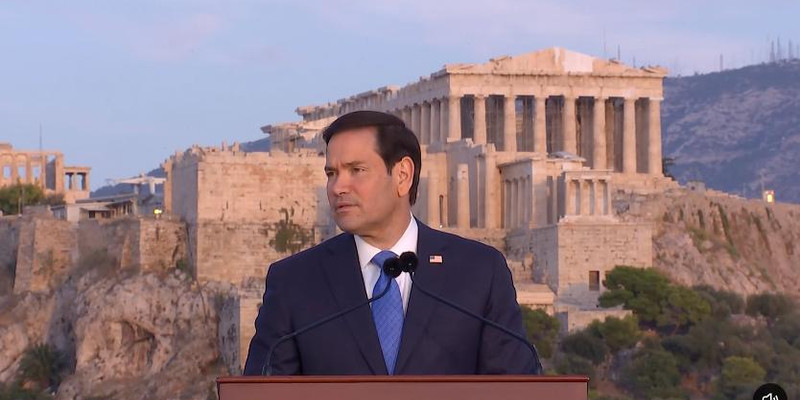
But for Rubio, our past is something to look to with awe and to inspire us to a prosperous future. He stood before the Parthenon of Athens, one of the city's great ruins, to speak about the Greeks, their legacy, and how Europe and the United States are the continuation of that legacy.
"For 25 centuries since the Parthenon has stood," he said, "empires have risen and fallen beneath its shadow, and the progeny of the men who built it, the sons of Athens and Rome, have carried their civilization with them to the ends of the earth."
And he detailed what that means, saying "Athens gave us democracy. Plato and Aristotle gave us Western philosophy. Our ideas of law, of virtue, of citizenship, and republican government were shaped in the Greek city-states. Even much of our political vocabulary, words like democracy, tyranny, the word politics itself, found its origins here. All of that is true, but the things we owe to this place as Americans and as Westerners are actually far, far deeper. These institutions and ideas, these institutions and ideas, were the outward expression of more fundamental qualities we see in the ancient Greeks, qualities that can't be reduced to any particular political system or theory."
In other words, it wasn't some happenstance that Greeks did this, these achievements were the direct result of the people themselves. It was their worldview, their understanding of the natural world, of relationships, themselves, and each other that gave us this path to a civil society with liberty and democracy.
"Here, in Athens," he went on, "we found the first full realization of all the essential traits that would come to define the West: fierce individuality and relentless ambition, daring exploration and invention, a yearning for discovery, for adventure, risk and glory, an insatiable curiosity about the world and the principles by which it operates, a hunger to know the mysteries of nature, and grasp the secrets of the cosmos, an impatience with the notion of impossibility, chafing at all boundaries, at all limits, straining to peer into the depths of the unknown.
"These were not just the formulas or precepts of a particular school of philosophy," he went on. "They were the characteristic of a people, expressed in their tradition, their stories, their imagination, and the qualities that they demanded of their citizens, and the things they lived and fought, and died for. To know them is to know ourselves. What blossomed here, in this place, was the Western desire to uncover all that ignorance, darkness, and distance had kept hidden from the mind of man."
Yet we in the West, we heirs to this fortune of thought and perseverance, are on the brink of giving it all up to chaos. "Over time," Rubio said, "we in the West came to feel ashamed of the very things that made us exceptional. We felt embarrassed that our achievements set us apart from the rest of the world. Our prosperity somehow became a source of guilt. We no longer believed we deserved and had earned our greatness. The word nationalism became a dirty word, and so we tore down our monuments. We condemned our own history, and in too many places, we taught our children to be ashamed of the countries they would inherit.
"In the process, we opened our borders, and outsourced our industry, and allowed our militaries to wither and to decay. And with every passing year, we seemed to outsource more of our sovereignty, transferring our decisions to global bureaucracies far beyond the reach of our control. But others were all too happy to fill the vacuum that we left, the vacuum left behind by our weakness. And as the West's confidence faltered, its adversaries and its rivals only grew more assertive, building up their own wealth and their own power in our stead.
"And now, today, we find ourselves at a crossroads because the next decade and the decisions we make will write the story of the next century. The course we take will determine whether the West maintains its place at the head of the world, or resigns itself to a future of atrophy, and servitude, and decline. We will either choose to act now, or lose the choice to act at all."
All around us we see factions who hate the West vying for control in order to tear down the very civilization that brought us to greatness, that created a triumph of humanity over darkness, that has filled our hearts and minds with curiosity and a determination to seek out not just answers but more questions. We have stood on the backs of these giants and now we hand out hacksaws so our enemies can cut them off at the knees.
In closing, Rubio said, "And all of us, not just Americans, but Europeans and our friends across the West, must relearn the lessons our forefathers took from this place and from its history. The history of Greece does not just offer us a glimpse of institutions in their earliest forms. The history of Greece shows us an image of ourselves.
"It shows us that ours is the inheritance of great heroes, and that we should be proud. That we should be intensely proud of where we come from. We should marvel at what our forefathers carved out of this countryside. The story of a civilization is the greatest story ever known to man, and it began here with the first men and women of the West. From them, from them, we can rediscover the virtues, the courage, and the strength to confront the dangers that we face in our time."
All across the West we must heed this call. Our virtues and values are open to any who want to take part in them, but we must stop opening our doors to those who only wish to plunder, destroy, and conquer.
This originally appeared in Libby Emmons' newsletter.