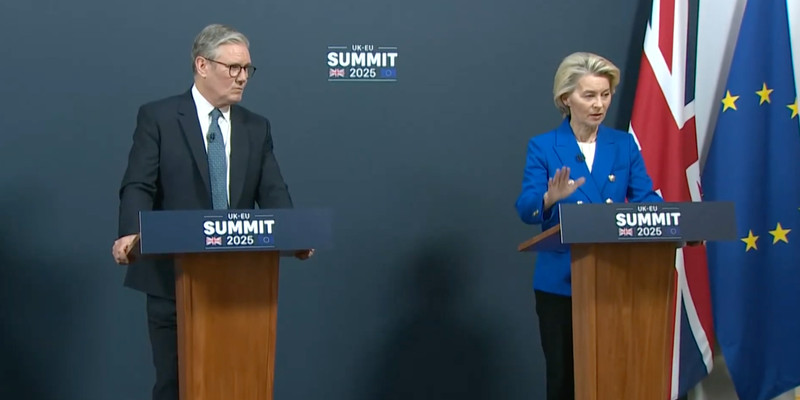
Last September, British Prime Minister Sir Keir Starmer announced the UK would get a mandatory national digital ID. The Estonian model was cited approvingly. Labour MPs believed the pitch was narrow and reasonable-sounding, especially considering Starmer had just given a migration speech so hardline it was compared to Enoch Powell’s "Rivers of Blood." The ID, called a BritCard would stop illegal Channel crossings, and prove people's right to work and residency status. However, it wasn’t long before Darren Jones, Chief Secretary to the Prime Minister, put his foot in it. He admitted the card "could have much wider uses in the future."
The country's response was one of complete fury. Nearly three million people signed a petition against it, one of the largest in British history. The aptly named Big Brother Watch called it “wholly unBritish” and said it would build "a domestic mass surveillance infrastructure." Polling from More in Common showed public support cratering from net +35 to net -14 in the space of a single announcement.
Faced with that backlash, Starmer did what he does best: a u-turn. Staging a retreat in January, ministers reportedly dropped the requirement that the card be compulsory for every adult, but confirming it would still be mandatory for right-to-work checks. Yes, if you wanted a job in the UK, you would need a card. The Daily Mail then reported that Cabinet Office minister Josh Simons had held secret talks about extending the digital ID scheme to newborn babies. Shadow minister Mike Wood asked the only question worth asking: "what do babies have to do with stopping the boats?" Nobody has answered him. Nobody will, because there is no answer. An infant does not cross the Channel on a dinghy, meaning there must be another reason to enroll a newborn baby in a national identity database.
If the BritCard was a hard sell, the child protection angle is the easy one. In June, Starmer announced Britain would ban under-16s from social media entirely, going further than any country on earth, modeled on Australia's ban. Nobody with a functioning conscience wants children exposed to the worst of the internet, making it the perfect agenda to push. A platform cannot keep out under-16s unless it first checks the age of everyone. Ofcom's own guidance names exactly two workable methods for "highly effective age assurance:" upload a government ID and have it checked against official records, or submit to a facial scan and let an algorithm guess your age from your face.
The Open Rights Group have flagged the obvious outcome: a running log of every adult's identity check against every platform they touch. Again, we have a situation where mass surveillance infrastructure is raising its head. If you think this is a peculiarly English problem, look across the water. Ireland's Communications Minister, Patrick O’Donovan, has confirmed the country will build its own government wallet, on top of the existing MyGovID system, to run age checks for social media under the Online Safety Code.
Refuse to download the wallet, and you lose access to accounts you already have. MyGovID requires a Public Services Card to obtain, the same card that got the Department of Social Protection fined €550,000 after regulators found it had been holding biometric facial data on roughly seventy percent of the entire Irish population, without a lawful basis to do so. And Ireland intends to sell this model to the whole of Europe, with Tánaiste Simon Harris openly floating mandatory identity verification for every social media user in the EU, timed to land during Ireland's own EU Council presidency.
The Northern Ireland Human Rights Commission has told Parliament, in writing, that data protection is a fundamental right sitting inside the "civil rights" guarantees of Belfast’s Good Friday Agreement, and that under the Windsor Framework's non-diminution clause, the UK cannot legally let data protection in Northern Ireland fall below the EU standard that existed the day Britain left the bloc. Now, we run the risk of eroding the legal architecture that ended decades of bloodshed.
Covid passports were sold exactly the same way, but ended up deciding who could walk into a restaurant, who could board a flight, and who had received a vaccination. Every system now under construction is more permanent, more comprehensive, and dug in far deeper than the vaccine passport ever managed. Once the rails exist to check identity for a job or a social media login, anything come next. It is arleady suspected that red meat purchases will be limited as part of "climate initiatives," just like how car emissions have already been targeted, and mandatory digital currency is already being pushed by the EU, consolidated by, of course, digital ID.
Whether the "right-to-work only" promise on the BritCard survives to the 2029 rollout remains to be seen. Starmer has already begun his social media ban with a curfew, and Andy Burnham is expected to take power next week and continue more of the same. Ireland's EU presidency is also poised to succeed in exporting mandatory ID checks for social media across the whole bloc—all in the guise of child safety and immigration concerns.