
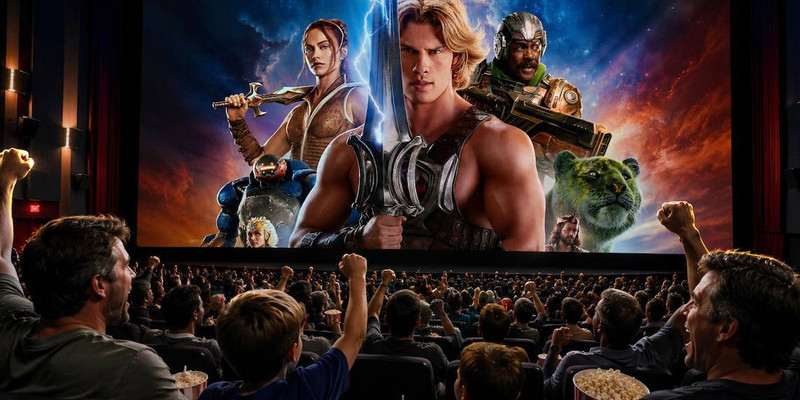

The new Masters of the Universe film has arrived, and it is more than just another summer blockbuster. It is a direct repudiation of the Longhouse.
In fact, the HR-female lead Longhouse is a direct punchline for most of the film. When we meet him, He-Man works in an HR department. Spoiler alert: It doesn't go well.
Here is what's going on: For years, boys in the West have been starved of positive depictions of masculinity. Children’s media, schools, and popular culture have operated under a feminism-based framework that treats traditional male strength, heroism, and agency as problems to be solved rather than virtues to be cultivated.
This is the Longhouse in action: a cultural and institutional environment dominated by feminine social norms. This gives us safetyism, consensus, emotional regulation, and the constant policing of “toxic” male energy. In the Longhouse, boys are taught early that their natural drive toward competition, risk, hierarchy, and physical power must be suppressed or redirected.
Mothers, female teachers, and media gatekeepers become the de facto authority figures enforcing these rules. There is little space left for unapologetic male heroes who fight evil with courage and conviction. He-Man was never part of that world.
This is actually part of He-Man's real origin story. When Mattel launched the He-Man toy line in the early 1980s, it did so with a clear purpose: to give boys something they were not getting elsewhere. Many young boys at the time felt powerless in daily life, under the constant direction of mothers at home and overwhelmingly female teaching staff at school.
The action figures and the cartoon that followed gave them an outlet. They could all pick up the sword, raise it high, and declare, “By the power of Grayskull… I have the power!”
That phrase was not empty marketing. It was an invitation to agency. In fact, Mattel veterans have said that the phrase "I have the power" came from letting young boys play with the toys and was what they themselves said. It told boys that power is not something granted by permission or consensus. It is something you claim through strength, discipline, and responsibility.
He-Man did not whine about his feelings or seek approval from the group. He protected Eternia. He stood against Skeletor. He modeled what it means to wield power rightly: to defend the weak, uphold honor, and confront evil without apology. The toys and stories taught boys they could be strong without being cruel, powerful without being domineering, and heroic without needing constant validation from female authority figures.
That is the exact opposite of the Longhouse.
Modern children’s entertainment largely operates inside the Longhouse. It prioritizes emotional introspection over action, deconstructs traditional male heroes, and lectures boys about their supposed privilege or toxicity. Positive, uncomplicated masculinity has become rare.
Boys are left to navigate a world that pathologizes the very traits that built civilizations: courage, stoicism, physical competence, and the willingness to fight for what is right.
I note that even the popular game Among Us involves winning through getting a committee to vote, not direct confrontation.
The new Masters of the Universe film breaks that pattern. It restores the classic archetype. He-Man is still the most powerful man in the universe. He still transforms, still swings the sword, and still stands for something larger than himself.
I saw this firsthand with my own boys. Something is going on. I showed them the He-Man movie, and now they keep asking to see more He-Man, so I put on the old cartoon. And now they keep running around the house saying, “I have the power!!”
Fathers, this is the spark we need. Do not stop at the theater. After the credits roll, go home and watch the original cartoon with your boys. Let them hear the iconic transformation sequence and the battle cry.
Talk to them about what it means to have the power, and what it means to use it responsibly. Explain that real strength is not about dominating others but about protecting what matters. Teach them that the Longhouse wants them small, compliant, and ashamed of their nature.
He-Man shows them another path.
The West is raising a generation of boys who are falling behind in school, struggling with purpose, and receiving constant messages that their instincts are wrong. They do not need more lectures about toxic masculinity. They need heroes who look like them, fight like them, and win like them.
The Longhouse will not voluntarily make room for such figures. We have to bring them back ourselves — one father, one son, one sword at a time.
Take your boys to see He-Man. Then teach them they have the power.
And don't let anyone ever tell them they don't.