
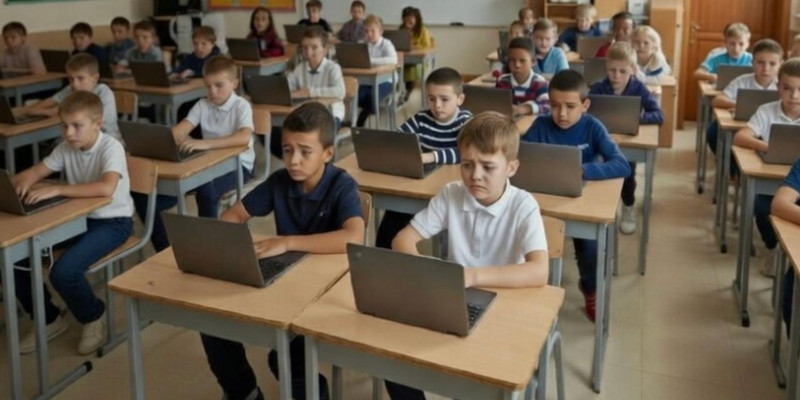

Take it from me, a high-schooler who was shut out of schools due to Covid-19 in 4th grade, who has been in classrooms seated at desks before Chromebooks ever since, and who has been subjected to program after program designed to teach everything from math to ELA: none of it belongs in schools.
i-Ready, IXL, and Amplify are all educational programs that serve a purpose better served by teachers and books before schools switched to virtual learning with the advent of Covid-19. The plague forced schooling to move into homes, so schools distributed Chromebooks to students for Zoom calls.
This led companies to develop programs that have since been relied on by many teachers. And this is actually a bad thing. Some schools, like one highlighted by The New York Times in Kansas, have noticed that books and teachers lead to better outcomes, but it’s time for all schools to ditch the programs.
The first of these applications I encountered was Class Dojo, a program used pre-pandemic to measure kids via a scoring system. The scores were public within the class, and, from my experience, the teachers generally let them affect how they treated students. It was like a social credit score, in a way, defining whether the teacher liked you.
Then came the applications used during the mid- and post-pandemic periods, such as IXL. IXL is an application that was created in 1988 and started as “Quia,” an app for sharing learning games between teachers. In 2001, the parent company launched “Quia Books,” an interactive online textbook, and in 2007, they launched IXL. This program teaches math, history, and English.
It scores lessons out of 100 based on the questions answered, and the score goes up when a question is right and down when it's wrong. If a kid gets to say 83, and the teacher wants them to get to 85, one of two things can happen: the student can get the question right and get to 85, or the student gets the question wrong and gets sent back to 71, leaving them demoralized and more likely to get the next question wrong out of frustration.
After the pandemic was used as a testing ground, these platforms saw major usage after students returned to class. i-Ready, a K-12 platform that teaches math and English using a diagnostic-first approach to measure a student's skill level, provides lessons with no teacher involvement at all. IXL also gives diagnostics, though teachers still assign lessons.
i-Ready has the function, but many teachers underuse it. Amplify is an application with premade units for teachers to use and scores based on completion, which is overall not very bad. The tamest of these applications is Quill, an ELA application that offers diagnostics and lessons. But lessons are assigned only by the teacher, not by the application itself.
A big part of the issue itself stems from the device these all run on, the Google Chromebook. When they were given out in 2020, they seemed innocent enough, giving schools a cheap way to provide students with internet access. However, what they really do is remove a lot of the teaching from teaching.
For example, where previously a textbook would be given, the child now gets a Chromebook. Where a worksheet or paper assignment would be given, a Chromebook would be used. Notes? Google Slides that the teacher makes.
Many teachers rely heavily on technology to do the actual teaching for them. Why should a teacher explain a math concept when IXL already has a lesson and a video on it? Why should a teacher explain grammar when i-Ready has a lesson on it? Why should a teacher explain Shakespeare’s sonnets and plays when Amplify can do the same thing faster? And why should a child have to read when there’s an audiobook?
The issue is simply that technology can’t replace teachers, but schools are still trying. As a result, literacy rates are continuing to drop, people are getting stupider, and grammar is in decline. Schools are still trying to use Chromebooks as the fix while failing to realize Chromebooks are the cause, not the solution.
All schools should take a lesson from McPherson Middle School in Kansas, which stopped assigning individual Chromebooks to students. They preceded this with a successful phone ban to reduce screen time and return to pencil and paper. This is what all schools need to do.
We already see how many major players in the tech world don’t even let their kids have screens and phones at all, and the rest of us should certainly take a hint. If the creators of this stuff don’t want it for their kids, why should we want it for ours?
Schools need to get back to textbooks, to paper, to teachers not having to check the Go-Guardian screen-monitoring app every minute to make sure nobody is playing some brain-rot game. If schools don’t do that soon, they may not be able to. Students could end up so stupid and illiterate that they no longer know how to learn.