
There's an old joke in cybersecurity: every few years, the tech industry discovers a new way the world might end. First, it was Y2K. Then ransomware. Then AI. Somewhere in there, people became convinced their refrigerators were probably spying on them too.
Most of the time, the panic arrives long before the actual danger. Q-Day may become the rare exception in which the danger arrives first, and the public only realizes its scale afterward. That's what makes this one different.
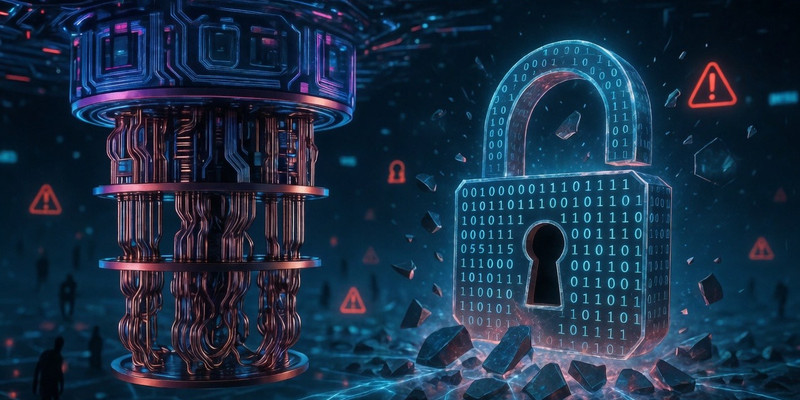
Q-Day refers to the moment quantum computers become powerful enough to break the encryption systems that currently secure modern civilization. Not just your email password or online banking login. Everything. Government communications. Military infrastructure. Corporate intellectual property. Telecommunications. Energy grids. Satellite systems—financial networks. The digital backbone of the global economy depends on cryptography so completely that most people never even notice it exists.
Until it fails, and despite how massive the implications are, much of corporate America is still behaving like cybersecurity is some annoying recurring expense sitting between them and a bigger marketing budget. This is where the conversation gets dangerous.
While executives debate whether security investments are cost-effective, hostile nation-states and sophisticated cybercriminal groups are already preparing for the post-quantum era. Intelligence agencies and security researchers have spent years warning about the 'harvest now, decrypt later' approach. operations, where encrypted information gets stolen today and stored until quantum systems become capable of unlocking it.
Think about what that means for a second. Your company's proprietary research. Trade secrets. Internal negotiations. Financial records. Strategic plans. Defense contracts. Drug formulas—AI development. Legal communications. Sensitive customer information. Stolen now. Opened later.
And unlike the Hollywood version of cyber warfare, nobody may even realize it happened until years afterward. That's the terrifying beauty of modern cyber espionage. The best attacks are invisible.
Businesses that still rely on weak endpoint protection or outdated security architecture are essentially locking Fort Knox with a luggage padlock and hoping nobody notices. Meanwhile, stealer? malware like Remus remains one of the most effective tools in the criminal ecosystem today, quietly siphoning passwords, session tokens, browser credentials, crypto wallets, and corporate access from unsuspecting users. It doesn't even require futuristic technology.
Most breaches still succeed because somebody clicked something stupid. And people click on stupid things all the time. Fake file deletion warnings. Bogus security alerts. Fraudulent system compromise notices. Social engineering scams continue working because panic remains one of the oldest hacking tools on earth.
Quantum computing may transform cybersecurity someday, but human nature has already been doing heavy lifting for cybercriminals for decades. The difference is that quantum capability threatens to remove one of the final safety nets currently holding the digital world together.
Encryption isn't just another layer of security. Encryption is the security. Once sufficiently advanced quantum systems arrive, entire categories of current cryptographic protection could become obsolete. And if that capability falls unevenly into the hands of adversarial governments or rogue actors, reaching meaningful breakthroughs before democratic nations fully transition to post-quantum systems, the geopolitical consequences become almost impossible to overstate.
Military communications. Intelligence assets. Nuclear command systems. Strategic infrastructure. Diplomatic channels. Satellite authentication. All vulnerable.
That's why this issue stretches far beyond Silicon Valley or corporate IT departments. This is about global stability itself. Modern deterrence depends heavily on secure communications and trusted systems. Once nations begin questioning whether those systems remain secure, paranoia escalates quickly.
History has shown repeatedly that uncertainty between rival powers is rarely calming. This is why the recent summit discussions between the United States and China should have included far greater urgency regarding the modernization of the outdated 1979 science and technology agreement between the two countries. That framework was built during an era when technological competition looked completely different. Today, quantum computing, cyber espionage, artificial intelligence, semiconductor supply chains, and digital infrastructure security sit at the center of geopolitical power.
This isn't theoretical anymore. The race is already underway. And while governments posture publicly, private companies remain dangerously exposed. Many executives still assume that national governments will somehow shield industry from catastrophic cyber fallout if things spiral out of control.
They won't. Or more accurately, they can't. Governments themselves are scrambling to prepare for the same vulnerabilities. Cybersecurity agencies worldwide are now warning organizations to begin transitioning to post-quantum cryptographic standards years before the threat fully materializes, because infrastructure migrations at this scale take a long time.
That's the part people underestimate. Q-Day isn't some giant red button that suddenly gets pressed one morning. It's a slow-moving collision course. A technological pressure buildup is happening quietly beneath the surface while most organizations continue operating as usual. And maybe that's the most unsettling part of all.
Not dramatic cyberattacks. Not exploding servers. Not dystopian movie scenes with cities going dark. Just a world continuing normally while hostile actors quietly collect, infiltrate, and archive the information that may define the next era of global power.
By the time the public fully understands the scale of the threat, the real damage may already be sitting in somebody else's database.
Julio Rivera is a business and political strategist, cybersecurity researcher, founder of ItFunk.org and ReactionaryTimes.com, and a political commentator and columnist. His writing, focused on cybersecurity and politics, has appeared in major publications around the world.