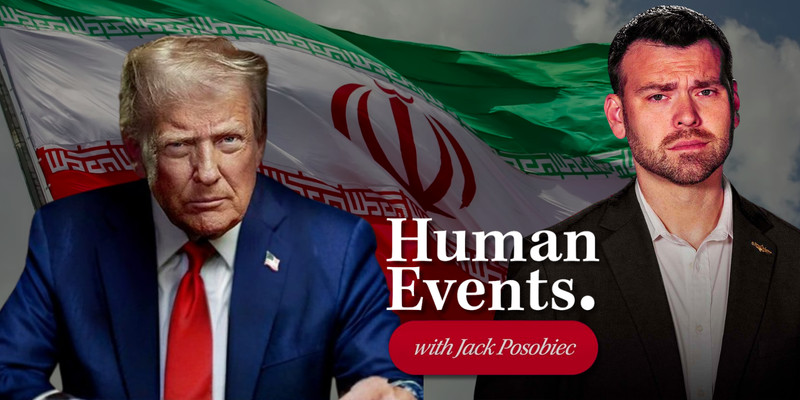

A series of new military skirmishes in the Strait of Hormuz and surrounding Gulf region are not derailing ongoing diplomatic efforts tied to a possible US-Iran ceasefire extension and memorandum of understanding, on Human Events Daily.
Bo Davidson opened the segment by pointing to reported naval conditions in the Strait and raising concerns about recent escalations. “You know, one thing I took away also from what Bessent said was that the blockade that we have there in the strait will only be proportional to the traffic that can flow through it, and that seems to make absolute sense to me because we've had this gridlock at the strait and I wouldn't back a single ship out of there until we saw that traffic was free-flowing, which of course it hasn't been. What's your take, Jack, on the news over the past, you know, 24 to 48 hours, that there have been some skirmishes? We saw that ballistic missile heading for Kuwait that got intercepted. We've knocked some drones down. Does that affect at all the timeline of this memorandum of understanding to get the two parties to the table?”
Responding to the developments, Jack Posobiec pointed to what he described as competing internal dynamics within Iran and separate military and diplomatic tracks that are continuing in parallel.
“Well, here's what's really interesting, and I got asked about this on an interview I was in last night, and what I believe is going on, again, going back to my conversation on Sunday, is that you do have these different pillars, as Secretary Besset was describing it just now, of the Iranian government. The IRGC is just one pillar. They're not the clerics, they're not the elected leaders, so what do we see? You've got essentially rogue elements of the government, or rogue elements in this case of the Revolutionary Guard, who are conducting these violations of the ceasefire, or they clearly are, but at the same time, that's the military track.”
Posobiec said US naval forces have been responding while negotiations remain in motion. “The United States Navy has been able to respond to those in tune, and then at the same time, the diplomatic track that the President is on, that the Secretary was discussing, obviously the administration in whole is discussing, has not been able to get knocked off of track while those military dust-ups are happening. So do they threaten the ceasefire? Yes, obviously, but they've not been able to knock off the diplomatic track, and that's what's so important.”
He added that broader structural changes inside Iran are also part of the context of the talks. “Now, the other piece of this is because Iran, as he said, it's not regime change, but the regime has changed. I've called it regime transition, in a sense, similar to Venezuela, and so what the Supreme Leader has yet to been able to is take full command of the entire government, of the entire regime, basically, within Iran.”
Posobiec concluded by emphasizing continued White House engagement and US military presence. “I think this is absolutely key to understanding what's going on, that we're seeing in the press, that we're seeing in the media, that we're seeing from the military, we're seeing from the world's finest Navy, which is of course the United States Navy, keeping it down, but at the same time, the President's sticking to that diplomatic plan. You can see, of course, the United States Marines are standing guard right there. Whenever you see a Marine standing outside the West Wing, that means the President is in the Oval Office. He's there right now working on it."
Bo Davidson opened the segment by pointing to reported naval conditions in the Strait and raising concerns about recent escalations. “You know, one thing I took away also from what Bessent said was that the blockade that we have there in the strait will only be proportional to the traffic that can flow through it, and that seems to make absolute sense to me because we've had this gridlock at the strait and I wouldn't back a single ship out of there until we saw that traffic was free-flowing, which of course it hasn't been. What's your take, Jack, on the news over the past, you know, 24 to 48 hours, that there have been some skirmishes? We saw that ballistic missile heading for Kuwait that got intercepted. We've knocked some drones down. Does that affect at all the timeline of this memorandum of understanding to get the two parties to the table?”
Responding to the developments, Jack Posobiec pointed to what he described as competing internal dynamics within Iran and separate military and diplomatic tracks that are continuing in parallel.
“Well, here's what's really interesting, and I got asked about this on an interview I was in last night, and what I believe is going on, again, going back to my conversation on Sunday, is that you do have these different pillars, as Secretary Besset was describing it just now, of the Iranian government. The IRGC is just one pillar. They're not the clerics, they're not the elected leaders, so what do we see? You've got essentially rogue elements of the government, or rogue elements in this case of the Revolutionary Guard, who are conducting these violations of the ceasefire, or they clearly are, but at the same time, that's the military track.”
Posobiec said US naval forces have been responding while negotiations remain in motion. “The United States Navy has been able to respond to those in tune, and then at the same time, the diplomatic track that the President is on, that the Secretary was discussing, obviously the administration in whole is discussing, has not been able to get knocked off of track while those military dust-ups are happening. So do they threaten the ceasefire? Yes, obviously, but they've not been able to knock off the diplomatic track, and that's what's so important.”
He added that broader structural changes inside Iran are also part of the context of the talks. “Now, the other piece of this is because Iran, as he said, it's not regime change, but the regime has changed. I've called it regime transition, in a sense, similar to Venezuela, and so what the Supreme Leader has yet to been able to is take full command of the entire government, of the entire regime, basically, within Iran.”
Posobiec concluded by emphasizing continued White House engagement and US military presence. “I think this is absolutely key to understanding what's going on, that we're seeing in the press, that we're seeing in the media, that we're seeing from the military, we're seeing from the world's finest Navy, which is of course the United States Navy, keeping it down, but at the same time, the President's sticking to that diplomatic plan. You can see, of course, the United States Marines are standing guard right there. Whenever you see a Marine standing outside the West Wing, that means the President is in the Oval Office. He's there right now working on it."