
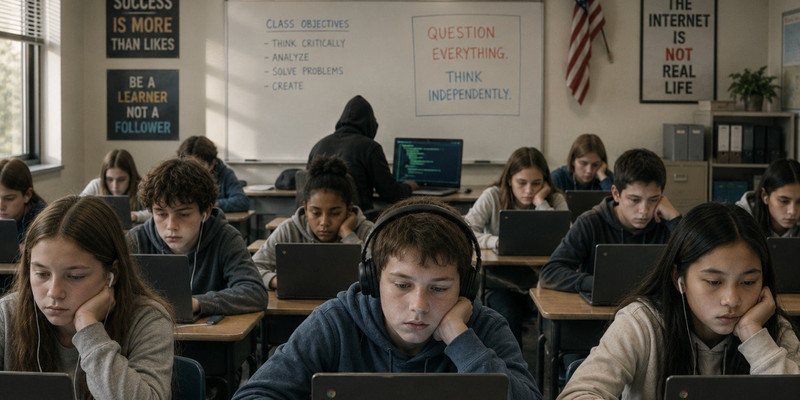

I was sitting in my English arts class just before my teacher was supposed to give us a test on chapters 1-4 of "The Outsiders" by S.E Hilton—I'd finished the book and was ready for the test. But we were unable to have the test. Why? Because Canvas, the software nearly 100,000 schools use to run their academic programs, had been hacked, leaking personal information of teachers, parents and students.
Instructure was powerless against the hack, undertaken by a group called ShinyHunters, and were forced to pay a ransom to recover stolen data culled by the hackers from about 275 million users. The ransom prevents the hackers from releasing that data—though of course they still have it—and has allowed Instructure to restore the system.
But it's not a system that should be restored. Director of Information Security and Engagement at the National Cybersecurity Alliance Cliff Steinhauer said that paying a ransom at all in a case like this "can create a dangerous feedback loop where attackers are effectively rewarded for successful breaches." He notes that the paying of a ransom "reinforces the economic incentive structure behind cyber extortion and signals to threat actors that targeting large education platforms, or any critical service, can be profitable."
In an era before Chromebooks, I imagine the teacher would have had three options: he would have printed the test; made the students write down the questions off the board and answer them; or he would have done the test orally—but the test wouldn't have been delayed. Yet in an era where software is the primary teaching tool, especially in underfunded districts like those in West Virginia, the budget would be better used on raises and more practical materials.
Teachers complain about low pay, but they are implementing the very programs that prevent raises. The money spent on software and Chromebooks could be used on improving the facilities of schools so the science room can actually use its sinks again, so that the dusty books in the back of the math room have a use beyond being paperweights, and so that teachers don't have to work with software that can be destabilized so easily. As somebody who wants to be a teacher, it is disturbing to see teachers' skills be minimized while they are used as a vehicle for digital learning.
My school district, for example, got a budget of $2,000,000 to purchase software and hardware. Chromebooks on average cost $150-$400, so let's assume a cost of $275. For new Chromebooks at the start of the 2025-26 school year, for 8,200, students that's about $2,282,500. Thats more than the amount of money the 16 public schools in the district are even given. And that's just the hardware, all the software costs are in addition to that.
Software like IXL can cost $9.50 per student, but beyond IXL and the like, the most used program on these so called books is Canvas. Canvas is used to show grades, assignments, message teachers, and is used by teachers to give assignments. The recent hack, by a group known as "Shiny Hunters," brings into question how a school can run on a software that is so vulnerable. The leaking of student messages would be only somewhat detrimental, but the selling of student and teacher data would be horrible for all parties. Canvas has access to the email, phone number, student ID, and family names, all found in one hack of one program.
Now this Canvas hack is bad, but it's unlikely it will be the last hack of software in the education space. Imagine what could happen if something like Go-Guardian was shut down. This is a software that schools use to prevent student misuse of the internet. If it was shut down due to a hack, Chromebooks would no longer have an restrictions on it, children could look up and see things like pornography, gore, and many other horrid things, and they could be solicited by bad actions online.
How can a district justify spending so much on programs that are so vulnerable? Textbooks have no user data, worksheets don't have Google, and teacher attention is far better than anything provided by the AI and algorithms contained within these expensive programs. The Canvas hack would have been avoided if the software wasn't used in the first place, and I would have been able to take my test if we simply didn't have Chromebooks in schools. Chromebooks, in some cases even have digital textbooks within applications—at that point why not just use a normal textbook and avoid the extra cost that Chromebooks add?
The presence of Chromebooks and the use of vulnerable, expensive, ineffective software diminish learning and education and are harmful to kids, the art of teaching, and to the budgets of school districts. Let's get back to basics.