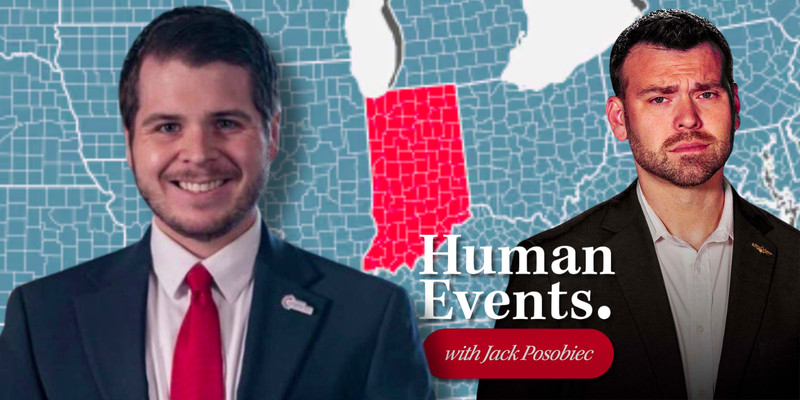
Human Events Daily host Jack Posobiec spoke with political organizer Noah Formica about voter outreach efforts in Indiana on Wednesday, following a successful election day in the state. Posobiec opened the segment by stressing the importance of direct voter engagement, saying the strategy reflected what voters are actively looking for from campaigns.
“And this is so key because this is something that not only does it prove that you're meeting the voters where they are, but also that this is what the voters want,” Posobiec said. “Talk to us about how receptive Hoosiers were when you were going out there, meeting them, and talking about these issues.”
Formica said many Indiana voters were already aware of the campaign through visible signage and online promotion, but argued that in-person contact remained the deciding factor in persuading voters.
“Right, so a lot of the Hoosiers did know what was going on,” Formica said. “They saw, you know, the Trump endorse signs that we were planting all over, you know, Terre Haute, Indiana, for the most part. They also saw the social media blast.”
He said digital outreach alone was not enough to move undecided voters, adding that direct conversations had the strongest impact. “But, you know, the real impact, how you went over the votes, is knocking on that door, talking to that voter, and making that neighborly, face-to-face connection,” Formica said.
According to Formica, some voters initially expressed hesitation about turning against incumbent candidates they were familiar with. “And as we were reaching some of these people, I mean, some of them were on the fence,” he said. “They're like, I don't know, you know, I like my current, you know, state senator. Why would I vote against him even though the other guy's endorsed by Trump?”
Formica said campaign volunteers responded by pointing to specific legislative issues, including opposition to redistricting efforts.
“Well, it's like, well, do you understand he did this?” Formica said. “Not voting for the redistricting effort that we all wanted.”
He added that once voters were presented with more information, many changed their minds. “And then, as soon as they kind of learned that, and just the impact this would have had just on international politics within, I mean, just, you know, United States, they immediately flipped,” Formica said.
Formica credited the campaign’s ground game for helping sway support away from what he described as establishment-backed candidates. “We flipped so many different voters from the establishment candidates to our candidates, just by meeting them face-to-face, talking to them at the polls, anywhere we can get, not even just at the door, but we were texting them, sending phone calls, any kind of voter contact we could do,” he said. “We were doing it day in and day out.”
“And this is so key because this is something that not only does it prove that you're meeting the voters where they are, but also that this is what the voters want,” Posobiec said. “Talk to us about how receptive Hoosiers were when you were going out there, meeting them, and talking about these issues.”
Formica said many Indiana voters were already aware of the campaign through visible signage and online promotion, but argued that in-person contact remained the deciding factor in persuading voters.
“Right, so a lot of the Hoosiers did know what was going on,” Formica said. “They saw, you know, the Trump endorse signs that we were planting all over, you know, Terre Haute, Indiana, for the most part. They also saw the social media blast.”
He said digital outreach alone was not enough to move undecided voters, adding that direct conversations had the strongest impact. “But, you know, the real impact, how you went over the votes, is knocking on that door, talking to that voter, and making that neighborly, face-to-face connection,” Formica said.
According to Formica, some voters initially expressed hesitation about turning against incumbent candidates they were familiar with. “And as we were reaching some of these people, I mean, some of them were on the fence,” he said. “They're like, I don't know, you know, I like my current, you know, state senator. Why would I vote against him even though the other guy's endorsed by Trump?”
Formica said campaign volunteers responded by pointing to specific legislative issues, including opposition to redistricting efforts.
“Well, it's like, well, do you understand he did this?” Formica said. “Not voting for the redistricting effort that we all wanted.”
He added that once voters were presented with more information, many changed their minds. “And then, as soon as they kind of learned that, and just the impact this would have had just on international politics within, I mean, just, you know, United States, they immediately flipped,” Formica said.
Formica credited the campaign’s ground game for helping sway support away from what he described as establishment-backed candidates. “We flipped so many different voters from the establishment candidates to our candidates, just by meeting them face-to-face, talking to them at the polls, anywhere we can get, not even just at the door, but we were texting them, sending phone calls, any kind of voter contact we could do,” he said. “We were doing it day in and day out.”