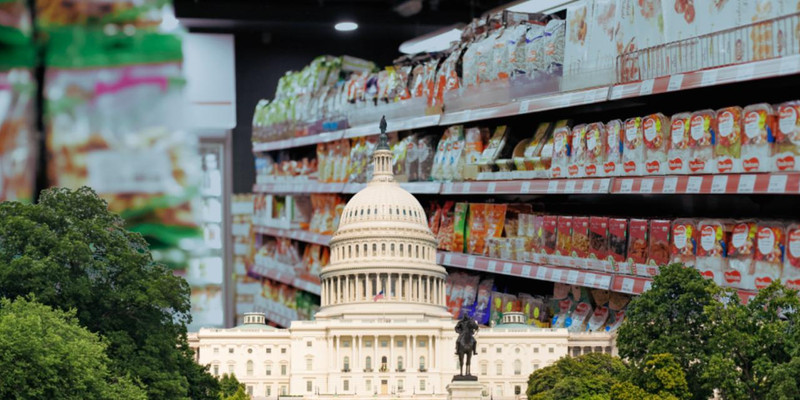

If they can’t tax your money from you fast enough, they’ll make you pay more at the checkout counter. A group of Senate Democrats want to make it more expensive for producers to give big discounts to big retailers who pass big discounts to their little customers.
Days ago, they introduced what they call the Fair Prices for Local Businesses Act. The bill targets suppliers that offer discounts to large retail chains which, in turn, pass the savings on to their customers.
They claim that the bill “would bring down prices for American families.”
“For decades, corporations have been allowed to break the law and rig the system to make small businesses pay higher prices for the exact same products,” Senator Chris Murphy of Connecticut thundered in a press release.
For decades.
Senators Richard Blumenthal (CT), John Fetterman (PA), Ruben Gallego (AZ), Amy Klobuchar (MN), and Peter Welch (VT) joined Murphy on the bill.
It’s fairly intuitive why a Dorito in a family size bag costs less than a Dorito in a snack size bag, or that two cartons of 18 eggs is cheaper than three cartons of 12 eggs. Packaging alone can dominate the cost of cheap, high-volume items.
Large portions cost less to package and transport. They offer retailers higher profits through greater sales in exchange for a slightly lower profit margin.
Right now, Senator Welch can go to his local Vermont maple sugar producer and buy a pint of amber syrup for between $11 and $17 a pint. He can slash his cost per pint to $9.37 by buying a gallon for about $75. He can buy a 5-gallon pail of syrup for $300, which sounds like a lot until figuring that comes out to only $7.50 a pint.
A little haggling on a larger purchase can bring the price down to $40 a gallon ($5 a pint) when a few seconds ago, three times that cost per pint seemed fair.
The same principles apply to the relationship between retailers and wholesalers. Walmart and Costco pay less per widget than your local mom-and-pop because they buy a lot more widgets. And then they pass those savings on to you.
There are, of course, genuine cases of price discrimination, such as collusive plots to drive competitors out of business. Federal law already addresses this. Even Murphy and his comrades admit it. The Trump administration has been very tough on predatory, monopolistic practices.
As long as a bulk discount reflects the supplier’s reduced costs due to the size of the order or the need to meet a competitor’s price — which they almost always do — it’s generally legal under antitrust law.
But not Murphy and his comrades, who are picking up where Biden’s Federal Trade Commission left off, waging valiant lawfare against big producers and sellers. The Biden FTC suits went nowhere.
Trump’s replacement chairman, Andrew Ferguson, has dropped the FTC case against Pepsi, calling it politically motivated (likely due to Team Biden’s penchant for blaming the private sector for Bidenflation). He is on record saying that her lawsuit targeting liquor distributor Southern Glazer’s was not based on “sound judgement.” He’s likely to drop it soon, especially with a discovery process uncovering even the FTC admitting that they have no evidence of any harm brought to consumers or businesses.
The senators pushing for more ridiculous prosecutions and price increases either don’t understand bulk discounts – Blumenthal, a centimillionaire whose father ran a commodities trading company, makes this unlikely – or are pretending defense of “affordability.”
This is nonsense.
Either way, if their bill ever becomes law in the future, it’ll make life a lot harder for Americans who stretch their dollars by buying groceries at big box stores instead of a random convenience store.