SHEA BRADLEY-FARRELL: President Trump’s Argentina support is strong 'America First' strategy
The time is now for the United States to bind together with Argentina and the free nations of Latin America and fight to preserve our civilization.
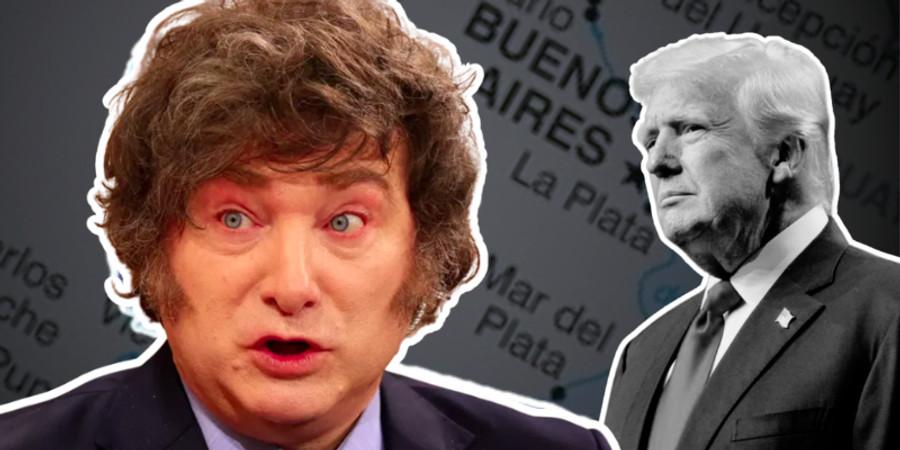
Critics in Washington, D.C. argue that the Trump-Rubio Doctrine in Latin America — such as recent economic support to Argentina — is not “America First” policy, but they are objectively wrong. President Donald Trump uniquely realizes that decades of U.S. “benign neglect” of the southern part of the Western Hemisphere have left a void now filled with our adversaries. The U.S. lost military presence, geopolitical influence, and economic opportunity to China; bad actors from China, Russia, Iran, Hamas, Hezbollah, and narco-terrorism have formed complex business and criminal networks in our own backyard, pushing drug and human trafficking, illegal immigration, terrorists, and more across our borders.
Recently, I met with Vice President Victoria Villarruel of Argentina and her Senate about the many great opportunities the U.S. and Argentina have right now -- during the Trump-Milei era -- for a mutually-beneficial partnership based on fraternity, hemispheric security, and homeland defense.
The United States needs the Milei administration. After almost a century of oppressive socialism, poverty, crime, and corruption, Argentina elected President Javier Milei, who has the courage to fight for freedom, drastically cut federal spending, eradicate corruption, and do the hard work to help Argentina prosper over the long term. Vice President Villarruel has even more in common with MAGA conservatives—she is pro-life, honors the military, stands for strong family values, and has a deep Catholic faith.
For the sake of our shared hemisphere, Argentina’s current leadership must not fail.
Allies of freedom, democracy, and free markets are shrinking in the Western Hemisphere. Authoritarianism, Marxism, and socialism are spreading. Consider Venezuela’s fraudulent authoritarian regime, Cuba’s one-party totalitarian communist regime, the repressive dictatorship in Nicaragua, and the Sao Paulo Forum, the “world’s largest and most impactful Marxist international organization,” active across Latin America, founded by Fidel Castro and Lula da Silva, and connected to guerrilla groups, terrorists, and drug trafficking.
President Trump and U.S. Secretary of State Marco Rubio have put Latin America and the Western Hemisphere back at the center of U.S. foreign policy. Some call this a return to the Monroe Doctrine of 1823, and there are similarities in that the U.S. rejects the influence of outside global powers, but the Trump-Rubio Doctrine is not patriarchal nor neocolonial. Instead, it seeks a mutual strategy for economic prosperity, hemispheric security, and shared homeland defense.
This is important: The Trump-Rubio Doctrine recognizes that in order to stop China’s plan of expansion and domination, just combating Chinese takeover in the Indo-Pacific is not enough; we must also stop China’s “victories” in our own hemisphere. This is how we win; this is how we protect our homeland.
Most Americans are aware of China’s growing influence in the Indo-Pacific, its intellectual property theft, and its cybersecurity threat to the United States. However, China’s “whole of government campaign” against America and its citizens is much more: it includes the insidious infiltration of illegal aliens and fatal drugs in record numbers into the U.S. For example, fentanyl precursor chemical ingredients are supplied by China directly to the drug cartels below our southern border, then trafficked by the cartels illegally into the U.S. Under the Biden administration, fentanyl-related deaths became the number one killer of younger U.S. citizens between the ages of 18 to 45.
Obviously, supporting a free, law-abiding, and prosperous Latin America is an “America First” strategy. Under the Trump administration, the U.S. no longer tolerates drug cartels, as other administrations have, and is conducting military strikes against the cartels -- attacking drug boats before they arrive in our country to make billions of dollars from exploiting our communities and killing our young people.
There are many opportunities for the U.S. to collaborate with and support free Latin America. Here are two important opportunities for collaboration with Argentina.
First, the $20 billion currency swap line agreement with Argentina’s central bank (which allows Argentina to exchange pesos for U.S. dollars) and the $20 billion credit line through private banks and sovereign wealth funds are both investments in our shared security. The U.S. is simply supporting Milei’s administration as it fights to restructure Argentina’s economy and become less economically reliant on Chinese investment and currency swap lines.
Decades of socialist and corrupt Peronist and Kirchnerist-led governments not only bankrupted Argentina but also pushed it toward heavy reliance on Chinese investment, trade, and business “partnerships” in infrastructure and technology, which China uses to spread its military intelligence and power. However, Milei has expressed a desire to sever some ties with China and strengthen economic and military ties with the U.S. Recently, Rubio signed a historic trade deal with Argentina’s foreign minister, which opens Argentine markets to U.S. industries.
As U.S. Secretary of the Treasury Scott Bessent put it: “I would rather use ‘peace through economic strength’ than have to shoot at narco boats coming offshore if the government collapsed …we are preempting the collapse of a government (from) going back to a Peronist agenda and a Left-Wing government. What if someone had … said, ‘look at what’s happening with Hugo Chavez, (or) Maduro,’ and had helped the opposition there?”
For critics to call U.S. economic support to Argentina “a bailout” is silly. The U.S. government did not just give away money (like we did to Ukraine); instead, it has already made a profit from the currency swap with Argentina, at the same time helping to stabilize an allied government during its congressional elections. And Milei’s party won in a landslide, giving him the legislative power to continue economic reforms in Argentina. This will also have positive effects on future democratic elections throughout Latin America.
Second, Argentina’s geographical location is an incredible strategic asset for monitoring and evaluation in the South Atlantic Ocean and Antarctic with satellite surveillance, and maintaining our shared hemispheric defense and security. Argentina’s satellite leadership, with the National Space Activities Commission (CONAE), and its unique position and autonomy, give great advantages for launching satellites, ground operations, and testing and experimentation.
But the sale of Chinese military equipment and arms, and the establishment of Chinese ports, military bases, and observation facilities in Latin America, including the Espacio Lejano (“Outer Space”) Station run by the Chinese military in Patagonia, are serious security concerns. Although China denies nefarious intentions, the station enables global tracking and surveillance by the Chinese People’s Liberation Army, with the ability to interfere with U.S. and other partners’ satellites.
Argentina has the ability to lead in space-based technology, and the U.S. is the best option for investment and partnership. Together, we can roll back China from our hemisphere.
The success of the Milei administration has created a platform for Argentina to take a position as a leader and model for regional success. The time is now for the United States to bind together with Argentina and the free nations of Latin America and fight to preserve our civilization. As Secretary Bessent rightly said, “We have a generational opportunity in Latin America to create allies.” I argue that we also have an obligation.
Tragically, under previous administrations, the U.S. lacked a clear strategy for partnership, investment, and presence in Latin America. In collaboration with Milei’s administration, the Trump-Rubio Doctrine for the Western Hemisphere can bring new and “out of the box” opportunities for U.S.-Latin American economic integration, defense, and security.
The time to seize these opportunities – together – is now.
Shea Bradley-Farrell, Ph.D. is a strategist in national security and foreign policy in Washington, D.C. and president of Counterpoint Institute for Policy, Research and Education. Her latest book is Last Warning to the West. Follow her at counterpointinstititute.org or “X” @DrShea_DC and @CounterpointDC.
Related
More World