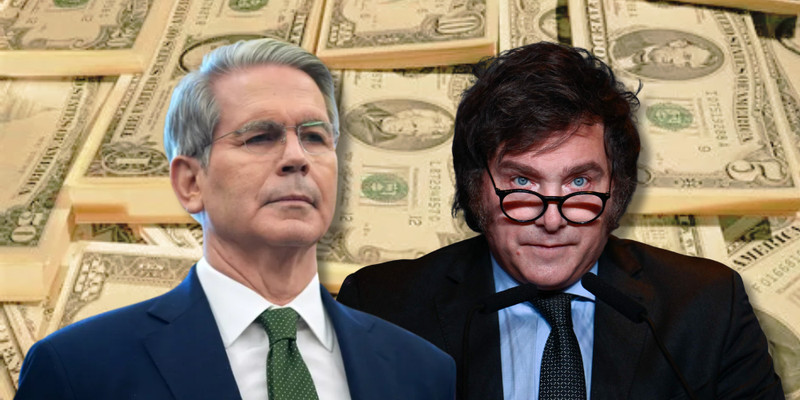

Scott Bessent went on MSNBC on Tuesday and did something unusual. He told the truth on television. When the host tried to score a gotcha over his involvement in Argentina’s recent currency stabilization, it backfired.
Jonathan Lemire, doing his best impression of a man holding note cards prepared by a producer who has never opened a balance sheet, tried to accuse Bessent of giving Argentina a twenty billion dollar bailout. He asked, with that familiar tone cable anchors adopt when they believe they’ve cornered a Republican, “How does a twenty billion dollar bailout of Argentina help Americans?”
Bessent didn’t flinch. He didn’t raise his voice. He asked, “Do you know what a swap line is?”
Lemire pretended like he did. He did not. And everyone knew it.
For viewers paying attention, the moment was revealing. Our media class has opinions about geopolitics, inflation, and international trade, but a limited understanding of the underlying mechanisms behind these concepts. Bessent, who has actually moved capital on a global chessboard, exposed that gap in under sixty seconds. A currency swap is not exotic. It is a standard tool of statecraft. China frequently uses them to draw developing nations into its orbit. The United States used to do the same before our foreign policy elite decided that democracy could be spread with lectures instead of leverage.
Bessent reintroduced leverage.
And the beneficiary of that leverage was Javier Milei, the President of Argentina, who has spent the last year sawing through the bureaucratic rot of his nation with the enthusiastic precision of a man who refuses to preside over managed decline. Milei is not simply trimming budgets. He is attempting to break a national mythology that the government is the mother, father, and god of the Argentine people. One does not simply wipe away Peronism overnight.
Bessent’s currency operation gave Milei breathing room to do that. It wasn’t a bailout, as MSNBC accused it of being. It protected Argentina’s reform window from Chinese dependency. And it did so while making money. Not imaginary stimulus money, not the phantom liquidity we conjure when Congress decides inflation is a myth. Capital. Real capital. Real return.
The United States did not lose anything in this case. It gained. Strategically and financially. Argentina gained sovereignty. China lost a foothold. And the market rewarded discipline. That is the story. That should have been the headline.
Milei’s revolution is no longer a South American curiosity. It is a live question for us. The United States is witnessing an actual experiment in cutting government spending, stabilizing the currency, and informing citizens about the truth regarding inflation. And the question lurking behind every headline is obvious:
If Argentina can do this, why can’t we?
What Milei represents is not just Argentinian reform. It is a reminder of the intellectual language America used to speak before we outsourced seriousness to think tank interns and middle managers at the Treasury.
Trump has spent the last week hammering the cost of beef in the United States, pointing out what every family already knows: groceries are eating paychecks alive. When Milei talks about renewing open trade in cattle markets with the United States, that is not a whimsical idea. That is material relief. That is the kind of exchange sovereign nations engage in when they view one another as partners rather than competitors in decline.
It is funny to call this “beef diplomacy.” But history has been shaped by stranger trade alignments. Salt. Tea. Oil. Grain. There is nothing unserious about food. It is the foundation of civilization. For over a century, Argentine beef has been one of the world's great agricultural products.
So let us put the pieces together:
A media elite that cannot define the terms it uses.
A financial strategist who knows how to defend American interests.
An Argentine president who is cutting the state like it is a tumor.
And an American president who recognizes an ally when he sees one.
What do we call that?
I’d call it a winning formula.
If Washington had even five more Scott Bessents, we would not be debating how to survive inflation. We would be discussing how to end it. And if the American right had the courage of Milei AND the brains of Bessent, we would not be asking whether the government should shrink. We would like to know how much of it we need.
Sometimes a nation needs an accountant. Sometimes, a savvy businessman. Sometimes a prophet with a chainsaw.
This moment requires all three.
Austin Petersen is the founder of the 4Liberty Network and host of the Wake Up America podcast on Rumble. A former Libertarian presidential candidate turned media entrepreneur, he lives in Jefferson City, Missouri, with his wife and daughter, is a Japanese Karate instructor, and produces independent films and content about liberty and American history.