
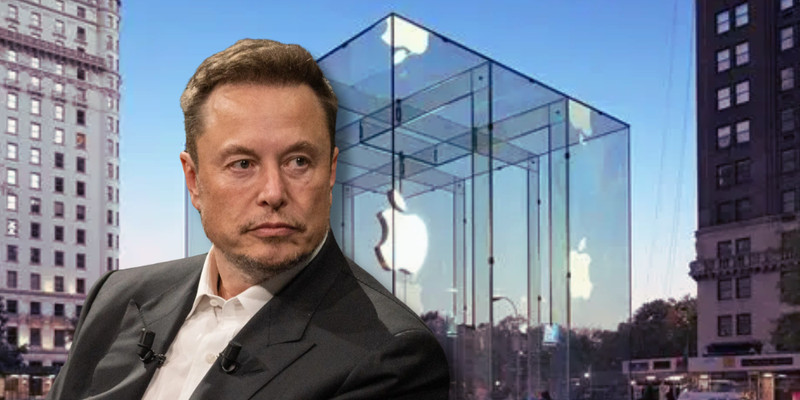
This week, Elon Musk announced that he will be taking “immediate legal action” against Apple for an “unequivocal antitrust violation.” He claimed that his company, xAI, has no choice, since “Apple didn’t just put their thumb on the scale, they put their whole body!”
And he’s right – Apple does abuse its App Store monopoly. Smaller tech companies and third-party app developers have been saying this for years. It’s time for real change and to break up Apple’s monopoly.
As I said last month, Americans have become numb to Apple’s monopolistic, anti-competitive behavior. We didn’t permit big tech monopolies 25 years ago, and we shouldn’t permit them now. Apple cites “privacy” and “security measures” to defend its anti-competitive behavior, which includes intentionally degrading users’ experience on third-party apps to push them to Apple’s own alternatives. Their rationale for this behavior, however, fails to hold up under scrutiny.
For one thing, MacBook users can visit any website and download an app for their laptop without having to go through the App Store. But if the App Store is a security measure on the iPhone, why isn’t it a security measure on the MacBook? The answer is that requiring users to use the App Store exclusively on the iPhone is not just for security. It also protects and maintains Apple’s app distribution monopoly: the monopoly that enables it to charge third-party app developers a 30% fee for every transaction. It’s a multi-billion-dollar revenue stream for Apple that they aren’t going to give up without a fight.
Furthermore, when it comes to the interoperability of third-party hardware that users may want to connect to their iPhones, Apple degrades functionality to push users to Apple’s own products. Do consumers actually think that Garmin can’t make a watch capable of pairing with the iPhone to send text messages over iMessage? Some probably do. The truth is, Apple won’t allow Garmin access to the back-end code of the iPhone to let them make a watch that communicates with the iMessage app. So, if customers want a watch that can send texts on iMessage, they’re forced to buy an Apple Watch.
We all forget that iMessage, where most of us text every day, is one of Apple’s apps. The blue text (for texts with another Apple user) vs. the green text (for texts with a non-Apple user) is one of Apple’s most diabolical and anti-competitive ideas – arbitrarily ensuring that iPhone users texting one another will have a better experience, particularly when group chats are involved. Apple makes it that way to maintain control, and their monopoly on how most people text (iMessage) leads to unassailability when it comes to things like endangering children, which no other app could get away with.
Some lawmakers see the importance of holding Apple accountable. U.S. Representative Kat Cammack, for one, has introduced the App Store Freedom Act, “which seeks to promote competition and protect consumers and developers in the mobile app marketplace by prohibiting certain anti-competitive practices by dominant app store operators.” Every member of Congress should support that legislation.
Elon Musk should, too. “Apple is the gateway to the internet for half of America,” he added on X, the day after he threatened to sue Apple. He’s right. The kind of anti-competitive control we have allowed one company to wield over the internet, our phones, and our access to apps is unacceptable. Competition always benefits consumers in terms of costs, innovation, and user experience. Hopefully, we’re seeing the beginning of a new era of real competition at the App Store level.
Brandon Kressin is the executive director of the Coalition for a Competitive Mobile Experience and the founding partner of Kressin Powers, a law firm focusing on antitrust litigation.