
The Girl Scouts were founded in 1912 in Savannah, Georgia, by Juliette "Daisy" Low, with the idea that girls could "unlock their full potential, find lifelong friends, and make the world a better place." Women didn't have the same opportunities that they would later gain and Low wanted girls to find their strengths and create their own opportunities.
The Girl Scouts that were intended to liberate girls from what the Girl Scouts call "strict social norms" now advocates for a religion that oppresses girls and women in the same of a higher power. While they have a faith program, and say "everything in Girl Scouting is based on the Girl Scout Promise and Law, which include many principles and values that are common across religion," it is the Muslim troops that get the press for sharing their religious faith and for creating exclusively Muslim Girl Scout troops.
It's a way to gain American cultural acquiescence to Islam while remaining segregated and not assimilating to that US culture. Many of the tenets of Islam specifically for girls appear to be in direct conflict with the reason Low founded the groups in the first place. In some troops, girls are required to wear a hijab, which makes the troop not at all inclusive to girls of other faiths.
The first Muslim Girl Scouts troop of New York City was launched in the spring of 2026 and is in affiliation with the Islamic Leadership Council of New York. Scouts can get special badges with girls wearing hijabs on them. In April, the first Muslim Girl Scouts troop of Manhattan met with the first Muslim mayor of New York, Zohran Mamdani. "This is what leadership looks like," said the troop leader on social media. But there are hundreds of Muslim Girl Scout troops in the US.
A featured article on the Girl Scouts website is about two Girl Scout troops in North Carolina that formed after the targeted killings of three Muslim students in Chapel Hill in 2015. The girls won the Girl Scout Silver Award for putting out a video about the kindness and charity of Islam. They held an Open Mosque Day to invite the community in to gain more of an understanding of Islam. For Girl Scouts World Thinking Day, they petitioned to be able to represent Palestine and were granted permission, even though it's not recognized as a country.
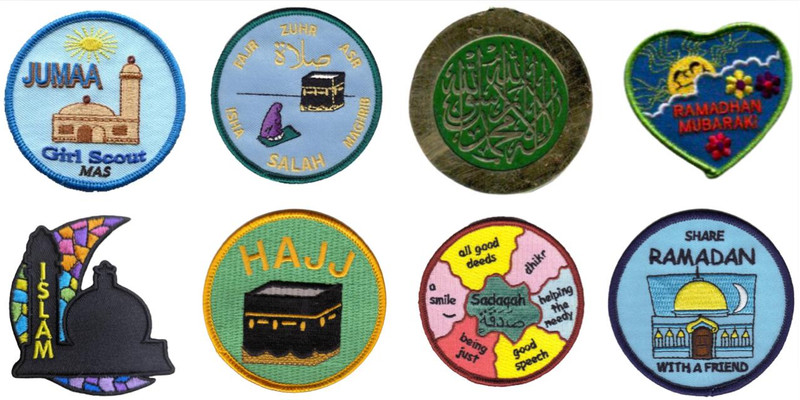
There are for special badges that can be earned for the Islamic faith. The Bismillah, In the Name of Allah, Quartua'in, and Muslimeen badges are on the list of faith badges. Each of them has booklets that go along with the badge and represent the performing of Islamic prayers and tasks. There are five other patches offered about Islamic prayer from The National Islamic Center, including one with a girl in full modesty dress.
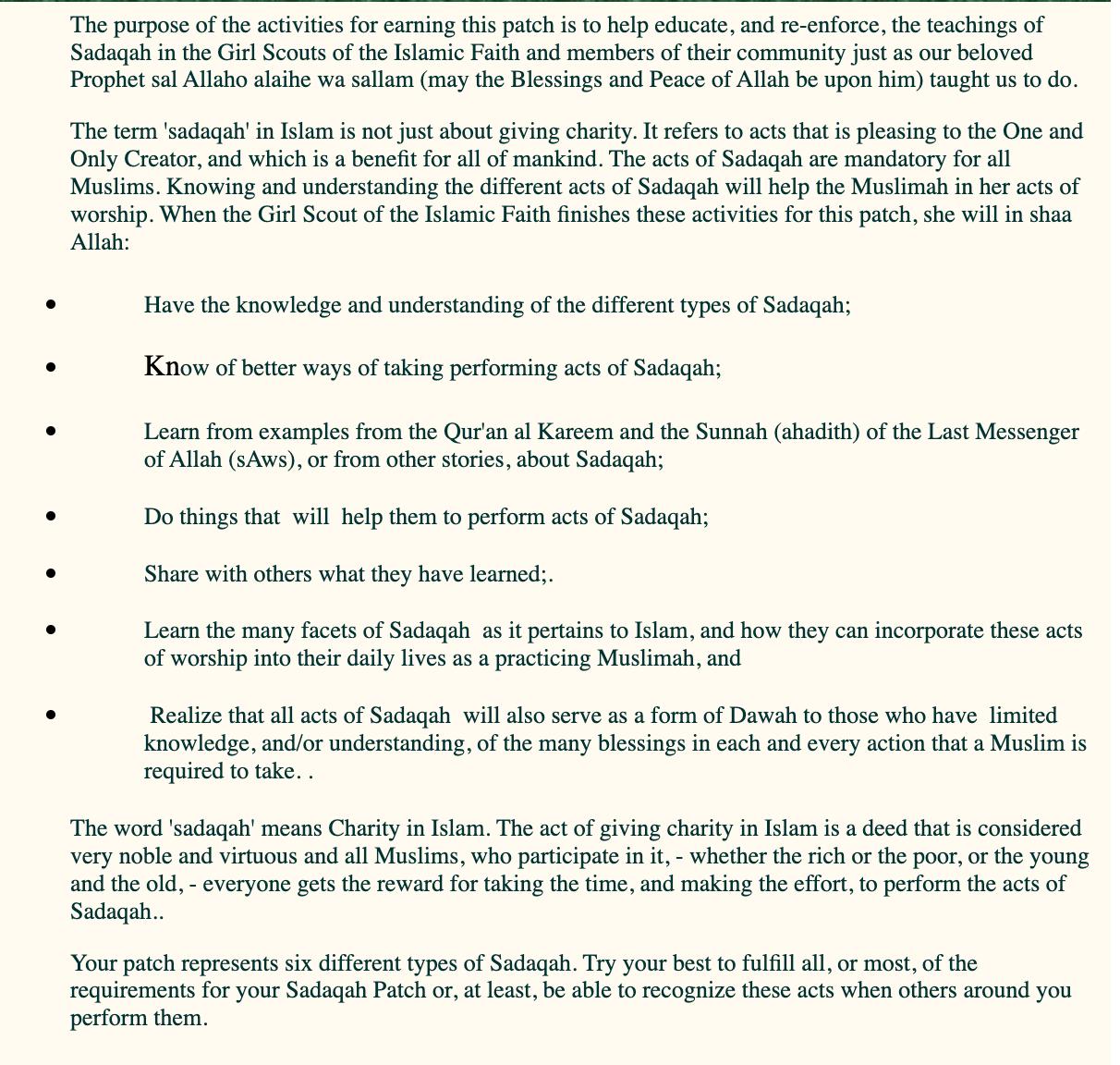
National Islamic Center on Girl Scouting: how to earn the Sadaqah patch
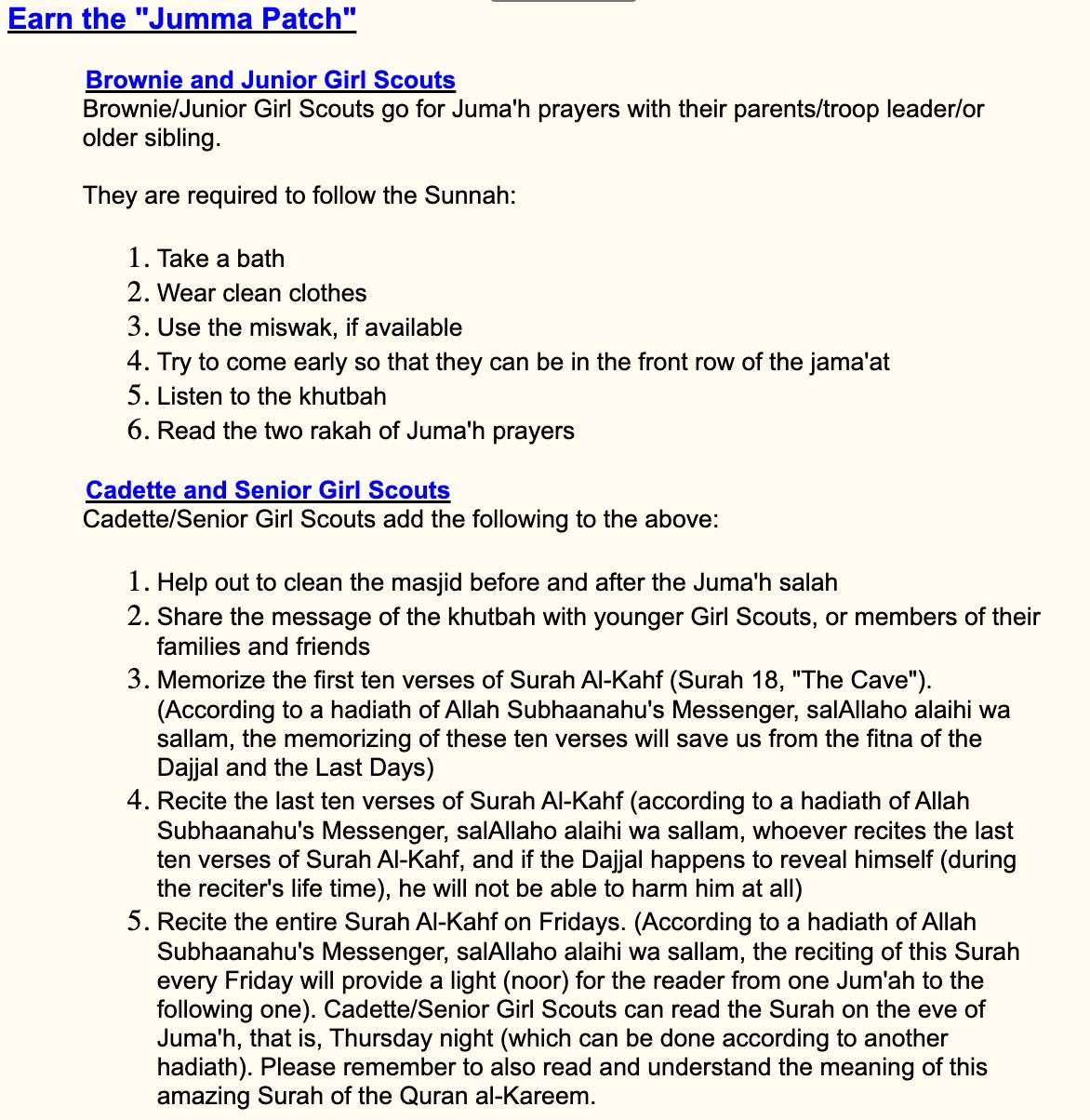
National Islamic Center on Girl Scouting: how to earn the Jumma patch
The SALAM Islamic Center in Sacramento promises "strong Islamic values" along with "cultural exchanges." At one event in 2025, the group offered a hijab photo booth where girls could learn about "the significance of modesty." There was also an "informative booth about Palestine." A Ramadan sleepover featured fasting and prayer all night.
Boy Scout troops for Muslim boys have also grown in popularity. Harvard University's Pluralism Project sympathized with Muslim parents trying to keep their children Muslim in America. "Whatever their background, all Muslims face a common challenge: encouraging their children to practice Islam in a society often dominated by Christianity and the mass media... To respond to this challenge, mosques and Islamic centers across the country have started Boy Scout and Girl Scout troops that provide recreational programs for children while also incorporating elements of the Muslim faith."
"The troops allow children to learn about their religion and culture and meet other kids from similar backgrounds. The troops mix traditional scout activities with ones that are designed specifically for Muslim children," they wrote. There were 112 Islamic Boy Scout troops in 2006 and that number has surely grown.
Troops across the country are affiliated with houses of worship and meet in those locations. The Girl Scouts of America offers badges, created "by the faith communities for their members who are Girl Scouts," including a number of Protestant religious groups as well as Roman Catholic, Jewish, Buddhist, and others. National religious groups, such as the National Catholic Committee for Girl Scouts and Camp Fire, also offer faith-specific patches. Many of these groups and secular groups hold events for refugees to make them feel welcome in the US.
One could say, religion is religion, troops that meet at houses of worship are the same as other troops that meet at houses of worship, and make an equivalency. But the foundation of the Muslim troops is to retain their Muslim segregation and to dispel concerns about Islam in broader American society while not integrating with American society.
In 2007, The New York Times reported on a Muslim Girl Scout troop in Minneapolis and how they are "a sort of assimilation tool to help girls who often feel alienated from the mainstream culture, and the give Muslims a neighborly aura."
The outlet noted that "most Muslim scouts belong to predominantly non-Muslim troops," but that "Minneapolis is something of an exception, because a few years ago the Girl Scout Council" in that city "surveyed its shrinking enrollment and established a special outreach coordinator" for Muslims in the area. That resulted in "about 10 predominantly Muslim troops" in Minneapolis. There are now predominantly Muslim troops in New York, North Carolina, and other locations across the US.
The Times wrote that The Girl Scouts, as of 2007, "has become flexible in recent years about the old trappings associated with suburban, white, middle-class Christian scouting. Many troops have done away with traditions like saying grace before dinner at camp, and event he Girl Scout Promise can be retooled as needed."
But, they say, the Muslim troops always say their prayers, make sure their cuisine is halal, ensure that girls can wear their hijabs or be protected from public view when they are not, such as in swimming, uphold Ramadan fasting, and assure Muslim parents that the girls won't stray too far from their Islamic culture.
What makes the Muslim faith-based troops different than troops that are also faith-affiliated is that these troops reach out essentially to spread acquiescence to Islam, they use their troops to preserve Islamic tradition carved out from American life, and they participate in the Girl Scouts and Boy Scouts in a segregated way. The Girl Scout mission is for girls to "develop strong values, leadership skills, social conscience, and conviction about their own potential and self-worth that will serve them all their lives."
The mission for the Muslim Girl Scouts is to "develop qualities such as strong Islamic values, social conscience, and conviction about their own potential and self-worth. They learn to be loyal, honest, considerate, caring, unselfish, courageous, cooperative, responsible, courteous, and respectful Muslim leaders following the steps of our Great role-model Sayyida Fatima AlZahraa." One mission focuses on the girl, the other focuses on adherence to a strict, oppressive faith.
Al-Zahraa was the youngest daughter of Islamic Prophet Muhammed. When she is depicted she is fully covered in black, from head to toe, with long gloves covering her hands. She was married off by her father to his friend. The literature surrounding her seems primarily to be about defending her father's honor as a prophet and housework. This does not seem to be in keeping with Juliette Low's founding vision for troops of girls to go hiking around in the woods, building campfires, and learning independence in a society that hindered women's opportunities.