World
15-year-old ARRESTED for burning woman's face with flamethrower as far-left riots rage on in France
“This is no longer about high school student protests. It is about riots organized by professionals and overseen by deputies from La France Insoumise.”
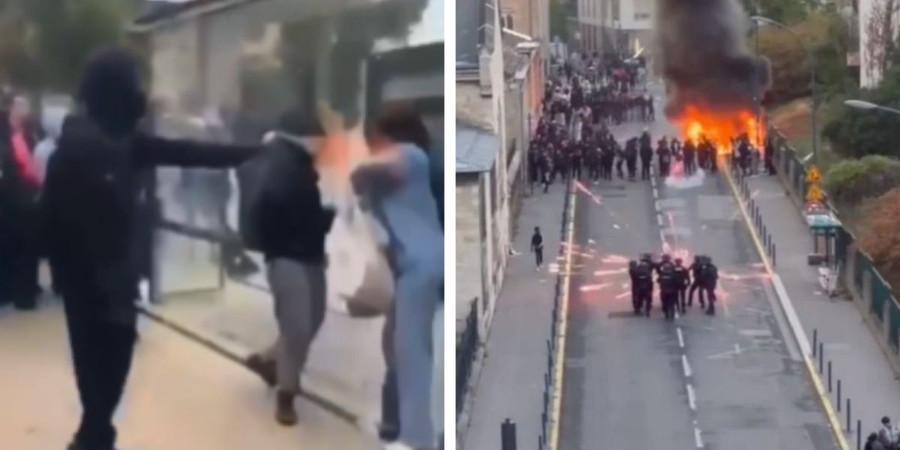
A 15-year-old boy was arrested for firing a makeshift flamethrower at a woman's face during France's latest series of riots.
The incident took place in Marseille on Friday, with video showing a hooded teenager using an aerosol can and a lighter to try to burn a woman who was calling for the riots to stop. French police arrested the suspect on Friday night, and the woman suffered first-degree burns, according to Le Parisien.
French police made the arrest on Friday evening and took teenage suspect into custody. The woman suffered first-degree burns, according to the Telegraph.
Violent riots have erupted at high schools across France this week have left dozens of school staff injured and resulted in roughly 2,000 arrests. While media outlets have attributed the unrest to complaints over education funding and teacher shortages, critics have accused the riots of evolving into a broader political movement backed by the country’s left-wing and Islamist groups. According to a report from Reuters, the riots were initiated by hard-left politicians.
"Shared assessment by the intelligence services on the origin of the movement: an operation organised by LFI (France Unbowed) and its proxies on the far left," a memo that was read in a crisis meeting with the prime minister said.
On Friday, teenagers clashed with police as demonstrators set garbage bins on fire, launched fireworks, and carried out other acts of violence. Roughly 400 high schools were shuttered, and approximately 2,000 people were arrested. Euronews reported that at least 65 school staff members had been injured.
The protests were portrayed as a response to concerns over overcrowded classrooms, teacher shortages, and deteriorating facilities. However, this narrative has been disputed. According to journalist Michael Shellenberger, the riots are actually a result of “decades-old Left-Islamist political alliance that much of the media supports.”
Shellenberger noted that France’s primary school classes have averaged nearly 30 students in the 1960s, compared with an average of 21 this year. He also noted that the share of students earning the baccalauréat has increased from 20 percent in 1970 to nearly 80 percent today.
Additionally, spending per student in France has increased by 1.6 percent a year. Shellenberger also noted that France spends 4.5 percent of its GDP on educational institutions, higher than Germany’s 3.7 percent.
“Students burn schools because they are ’deprived,’ say the media. But the students are protesting *too much* class time, per pupil spending is higher than ever, and a radical left party organized the riots to attack a right-wing party that the government & media want to censor,” Shellenberger wrote.
The unrest has drawn scrutiny over the role of the left-wing La France Insoumise (LFI). French officials have accused the party of exploiting the movement for political purposes, and French Education Minister Edouard Geffray warned that the demonstrations have been taken over by “ultra-violent fringe groups.”
French intelligence agencies have identified LFI and other hard-left activists as responsible for initiating parts of the riots. The demonstrations are also becoming a political issue ahead of next year’s presidential election. LFI leader Jean-Luc Mélenchon has critizied the government’s response while other LFI officials have supported the demonstrations.
National Rally’s Marine Le Pen has accused LFI of playing a direct role in the riots, writing on X, “This is no longer about high school student protests. It is about riots organized by professionals and overseen by deputies from La France Insoumise.” Le Pen also called for a new anti-rioters law so that “participation in a riot is a clearly identified offense."
The French government has deployed specialized riot police to contain the demonstrations.
Hayden Cunningham
Hayden Cunningham reports for Human Events. [Placeholder bio — pending editorial copy]
Related
More World