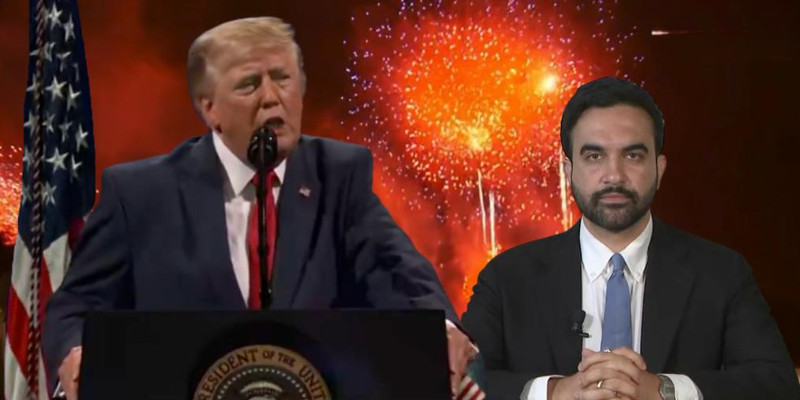

We Americans were told two stories this weekend about what it means to be an American. As we bought extra bags of charcoal, loaded our coolers with ice, set flame to firework fuses, and donned our favorite red white and blue, two men revealed the two very different, very divergent stories that are being told about America and Americans today. One story brings hope, courage, and a love of country while the other was intent on destroying our nation just as she hits her 250th birthday.
It matters what story we tell each other about ourselves and our nation. That story guides how we feel about our country, about our place in it, about opportunities and potential. The story we tell is the story we live out—let's live out the best story we can. President Donald Trump told his story flanked by military heroes and praised their sacrifice. NYC Mayor Zohran Mamdani used newly naturalized citizens as a prop to justify his diatribe against America.
On Friday, Mamdani spoke while seated at the desk of America's first president, George Washington, though oddly he sat in front of it and not behind it. He used the opportunity to deliver backhanded compliments to a nation he appears to despise, even though that nation embraced him as a child, provided a privileged education, granted him citizenship, and elected him as mayor of her greatest city. He didn't buck the odds, he just took advantage of the vast opportunity America offers.
Mamdani thinks America is "an asylum for the persecuted," where trillionaires squander their wealth as children starve, where companies dominate industries, and "oligarchs buy elections." He believes there are "masked agents terrorizing our streets" who "spirit" people away in "unmarked vans." Had those new citizens standing stone-faced holding their little flags signed on for hearing a tirade against the nation they just pledged allegiance to?
Mamdani's story of America is one where people are divided based on their level of wealth and status, where the wealthy are always wealthy and use that money and power to keep other people down. He sees America as a place where class is definitive and there can be no traveling upwards if you're at the bottom. "We see a nation whose immense wealth has been built by those with calloused, dirt-streaked hands, those who toil on factory floors and chisel into stone and we see a nation that has allowed so much of that wealth to be held instead in the soft hands of a precious few," he said.
Mamdani tells us all that there are powerful and there are oppressed and the oppressed must rise up against the powerful who will only ever oppress people. "Each hold a special power," he said, "the power to determine what America means."
And then he proceeded to lie: "The powerful have always known their answer. America, in their view, is an arena of supremacy, where only a select few are allowed freedom, where not all are created equal. America, if you ask them, becomes less the more people it welcomes. America, they will tell you, belongs only to those with the right accent or the right trade of skin. The rest of us, they insist, should be grateful for merely being allowed to visit, how small they are, how weak, how unoriginal. At every moment in our past, those who led through exclusion and isolation have tried to win power and enrich themselves by turning us against one another. Division is the oldest trick in politics, and the cheapest."
It is Mamdani who seeks to "turn us against one another." And his view of American exceptionalism, that unique and enduring aspect of American identity, is this: "We are told that America is exceptional because we are richer, stronger, more powerful than everyone else. The truth, my friends, is that America is exceptional because here nothing is fixed into place." Again, he is wrong. Our rights are "fixed into place" and they cannot be moved and our government has endured for 250 years—not just our nation, but our system of government.
And then there was Trump. His late night Independence Day speech was not one I'd intended to stay up for, but when I started watching I was so enraptured with the story of America and Americans Trump was telling that I could not look away. It was a story of endurance and success, of prosperity and drive.
Trump told a story of American greatness for all Americans, the story of a great nation that is only getting better. "Our American republic has stood as the crowning achievement of human history," Trump said. "This country is the home of freedom. This is the land of liberty, and this is a flag that's the banner of the most extraordinary, most exceptional, most incredible nation ever to exist on the face of the earth. And we're doing better now than we've ever done before."
This is a story of triumph, and not triumph for a few but a triumph for all of us. Trump says come on, let's all go get rich, which is far from Mamdani's message of grievance and malcontent. "We'll never let anyone take our freedom away," Trump said, "won't happen. And all this talk from the communists, they haven't got a chance, not even a chance. We don't want communists in our country."
One message brings hope and a will to fight with steadfast determination for one's nation, to work hard for one's family, one's self, while the other revels in grievance, pits "us" against "them," and claims that those who work hard are being exploited. You know which story makes you feel good about your country and which one makes you feel like it's all trash. You know which story will make you work to make it better and which one will make you want to step back and watch it burn.
"Americans must never forget that we are a historic and heroic people with a heroic spirit and a heroic purpose on this beautiful earth of ours," Trump said. "We are made the courage and the fire and the flesh and the blood of the best and the bravest people this world has ever produced. We are the bravest and the best. Tonight, we pledge allegiance to the flag they gave us, and we say, God bless the immortal patriots of 1776 and long live the cause of independence."
"We will always be on top," Trump said. "We will never let our country fail. We will always be the best. Our founders not only won our liberty, they secured it with the most righteous political document ever conceived. It's called the Constitution of the United States, very special."
Do you want to celebrate our strengths or criticize our flaws? Do you want to feel powerful or weak? These are the options laid out before us in a tale of two speeches. Mamdani represents weakness, misery, and outrage politics, while Trump gives us bravery, moxie, steadfastness and ambition.
The fight between them is for the story of America, the soul of it, who we are, where we're going and where we came from. The stories we tell ourselves about ourselves matter. They are not just the story of our past but our future. Mamdani is the defacto head of a Democrat Party that sees nothing but shame when they look at our flag. Trump is the head of a Republican Party that offers every American the chance to write their own destiny. There's only darkness in Mamdani's view of America. And I, for one, am choosing light.