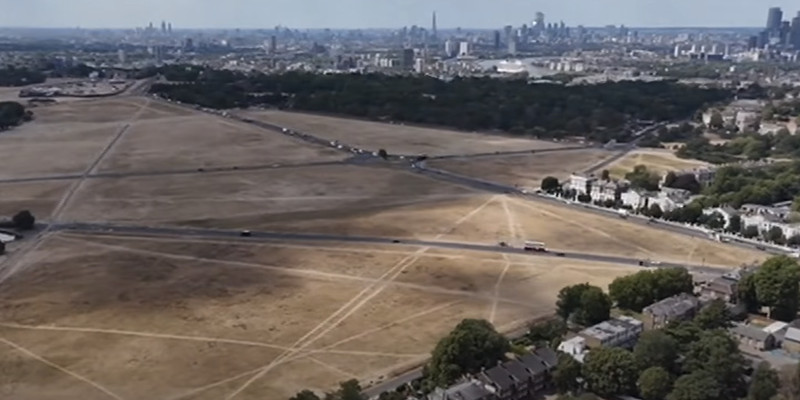

More than 1,000 wildfires have been recorded across England and Wales this year, prompting renewed calls for the government to change policies that countryside groups say are increasing the risk of major fires. A total of 1,017 wildfires have been recorded so far, according to figures from the National Fire Chiefs Council (NFCC), matching the record-breaking total recorded last year, reports GB News.
The latest figures come as the country goes through prolonged hot and dry conditions, with nearly three quarters of England and Wales reportedly in drought. A Met Office study into the 2022 heatwave found climate change had made wildfires six times more likely, but is that really the cause?
Campaigners say environmental policies restricting controlled burning are also leaving large areas of upland vegetation vulnerable to fire.
The Country Land and Business Association (CLA) has argued that restrictions on prescribed burning have effectively removed an important tool for reducing wildfire fuel loads. In May, the group told a Government consultation that “hotter, drier summers create the risk for bigger and more frequent wildfires.”
The CLA added: “Recent Defra’s policy in England has de facto banned prescribed burning on any peat soils deeper than 30 cm, which we believe will worsen wildfire risk.” Jonathan Roberts of the CLA told the Daily Mail that last year’s fires should have prompted ministers to reconsider the restrictions.
He said: “Last year was the worst on record for wildfires, yet ministers responded by making it harder for land managers to carry out the controlled burning necessary to stop wildfires taking hold in the warmer months.”
The Countryside Alliance has made a similar argument, saying the Government has more than trebled the area where controlled burning is effectively prohibited.
“The Countryside Alliance has repeatedly warned that by ignoring the latest scientific evidence, the Government is significantly increasing the risk of catastrophic wildfires,” it said.
Former England cricket captain Lord Botham also slammmed the approach, writing in the Telegraph: “The winter burns used to create firebreaks. Now we have huge expanses of continuous, ageing vegetation. “The result is disaster after disaster.”
Defra says controlled burning on deep peat should be a “last resort” and allowed only “in exceptional circumstances”. The department argues that peatland restoration and rewetting provide a more sustainable long-term way to reduce wildfire fuel.
A Defra spokesman said: “Peatland restoration is the most effective, sustainable, and long-term solution for reducing fuel load on degraded peatlands, as wetter, healthy-functioning peatlands hold more water in the landscape for longer and are more resilient to the impacts of wildfire.”
Prime Minister Andy Burnham chaired a Cobra meeting on Wednesday as the Government responded to the prolonged period of exceptionally hot and dry weather.
The latest figures come as the country goes through prolonged hot and dry conditions, with nearly three quarters of England and Wales reportedly in drought. A Met Office study into the 2022 heatwave found climate change had made wildfires six times more likely, but is that really the cause?
Campaigners say environmental policies restricting controlled burning are also leaving large areas of upland vegetation vulnerable to fire.
The Country Land and Business Association (CLA) has argued that restrictions on prescribed burning have effectively removed an important tool for reducing wildfire fuel loads. In May, the group told a Government consultation that “hotter, drier summers create the risk for bigger and more frequent wildfires.”
The CLA added: “Recent Defra’s policy in England has de facto banned prescribed burning on any peat soils deeper than 30 cm, which we believe will worsen wildfire risk.” Jonathan Roberts of the CLA told the Daily Mail that last year’s fires should have prompted ministers to reconsider the restrictions.
He said: “Last year was the worst on record for wildfires, yet ministers responded by making it harder for land managers to carry out the controlled burning necessary to stop wildfires taking hold in the warmer months.”
The Countryside Alliance has made a similar argument, saying the Government has more than trebled the area where controlled burning is effectively prohibited.
“The Countryside Alliance has repeatedly warned that by ignoring the latest scientific evidence, the Government is significantly increasing the risk of catastrophic wildfires,” it said.
Former England cricket captain Lord Botham also slammmed the approach, writing in the Telegraph: “The winter burns used to create firebreaks. Now we have huge expanses of continuous, ageing vegetation. “The result is disaster after disaster.”
Defra says controlled burning on deep peat should be a “last resort” and allowed only “in exceptional circumstances”. The department argues that peatland restoration and rewetting provide a more sustainable long-term way to reduce wildfire fuel.
A Defra spokesman said: “Peatland restoration is the most effective, sustainable, and long-term solution for reducing fuel load on degraded peatlands, as wetter, healthy-functioning peatlands hold more water in the landscape for longer and are more resilient to the impacts of wildfire.”
Prime Minister Andy Burnham chaired a Cobra meeting on Wednesday as the Government responded to the prolonged period of exceptionally hot and dry weather.