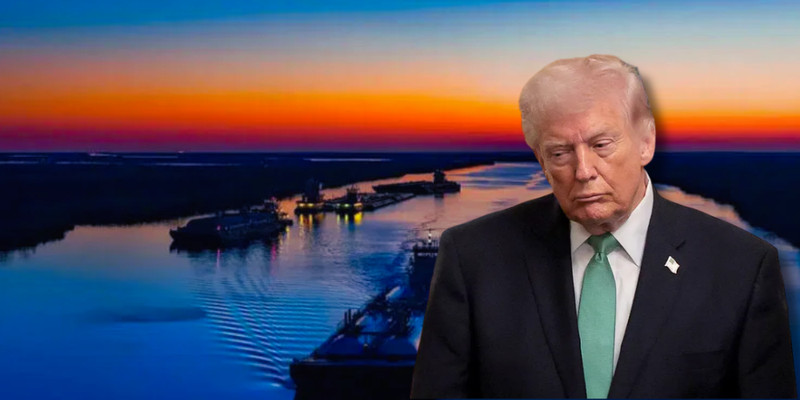

There are moments when policy debates stop being theoretical and start carrying real consequences. The debate over the Jones Act is one of those moments. The Jones Act of 1920 requires that all goods carried on water between US ports be done so on US-built, US-owned, US-crewed ships.
With tensions escalating into open conflict involving Iran, the United States is dealing with a volatile mix of energy uncertainty, supply chain pressure, and national security concerns. That context matters. It is exactly why the Trump administration’s decision to waive the Jones Act, even temporarily, deserves a second look.
Let’s be clear about something upfront. The Trump administration has been batting close to 1.000 on major issues, especially in rethinking America’s dependence on foreign supply chains and taking a tougher stance toward adversaries. That instinct has been proven correct time and again. But this is one area where the policy may be moving in the wrong direction at the wrong time.
The Jones Act is often reduced to a talking point about shipping costs. That misses the bigger picture. At its core, it ensures that domestic maritime trade is handled by American-built, American-crewed, American-flagged vessels. That framework supports more than commerce. It supports national readiness.
In calm times, that may sound like a technical detail. In a conflict environment, it becomes something else entirely.
When you allow foreign-flagged ships to move goods between US ports, you are not just changing a line item on a balance sheet. You are introducing variables into a system that depends on control, accountability, and security. Ports are not just economic hubs. They are critical infrastructure. They are entry points. They are potential targets.
Iran is not a hypothetical concern. It is widely recognized as the world’s leading state sponsor of terrorism with a history of asymmetric tactics. It has backed proxy groups, targeted infrastructure, and shown a willingness to exploit vulnerabilities wherever they exist. In that context, increasing the presence of foreign-flagged vessels moving between domestic ports raises legitimate questions.
During times like these, we must assume that every foreign vessel is a potential threat. We must also recognize that expanding access during a period of instability increases risk. Security is built on layers of control, and the Jones Act is one of those layers. It ensures a level of oversight that becomes harder to maintain when the system is opened.
Supporters of the waiver argue that it is necessary to ease supply chain bottlenecks and bring down costs. National Economic Council Director Kevin Hassett and others have framed the Jones Act as a constraint that slows down commerce and drives up prices.
That argument sounds appealing, especially in a moment of economic pressure. But it rests on assumptions that deserve closer scrutiny.
It assumes that global shipping markets are stable and readily available. It assumes that foreign vessels will step in seamlessly without introducing new complications. It assumes that short-term relief will not carry long-term consequences.
Those assumptions are shaky even in normal conditions. In the middle of a geopolitical crisis, they become even more questionable. The waiver undermines our national security. General Randall Reed, Commander of the United States Transportation Command, recently told the Senate Armed Services Committee that the Jones Act is vital.
“We must continue this vital work and champion the Mariners who form the backbone of our fleet and underwrite our national security. We support maritime policies, including the Maritime Security Program, the Tanker Security Program, the Cable Security Program, the Jones Act, and cargo preference laws. Together, these programs secure our flag vessels and the merchant Mariners necessary to move sensitive defense material.”
Furthermore, Shipping markets are influenced by conflict, insurance rates, and shifting trade routes. Availability can tighten quickly. Costs can rise just as fast. Relying more heavily on foreign shipping under those conditions is not a guarantee of stability. It introduces another layer of uncertainty into an already unpredictable environment.
And that uncertainty is not theoretical. As tensions rise around the Strait of Hormuz, key US allies have refused to commit naval resources to escort commercial vessels through one of the world’s most critical chokepoints. If allied nations are unwilling to guarantee the security of global shipping lanes in a moment of crisis, it raises a more fundamental question: why would the United States voluntarily expand its dependence on those same foreign actors by weakening the Jones Act and giving them greater leverage over our domestic maritime economy?
Then there is the longer-term issue that tends to get overlooked.
A sixty-day waiver may sound limited, but policy changes rarely exist in isolation. Once a precedent is set, it becomes easier to revisit. Today, it is a temporary measure tied to a crisis. Tomorrow, it becomes part of a broader argument for further loosening the law. Over time, the conversation shifts toward permanent changes.
That kind of gradual erosion is how industries lose their footing, and Americans lose their jobs. The United States has already seen what happens when critical sectors are allowed to move offshore. Manufacturing, semiconductors, pharmaceuticals. Each time, the shift was justified in the name of efficiency. Each time, the strategic cost became clear later.
Maritime capability should not follow that same path.
The Jones Act supports a domestic shipbuilding and maritime industry that has made substantial investments in infrastructure and workforce. These are not abstract commitments. They are shipyards, skilled labor, and logistical networks that exist because of a consistent policy framework.
That industry also plays a role beyond commercial shipping. In times of crisis, civilian vessels can be called upon to support military logistics, Coast Guard operations, and emergency response. That flexibility depends on having a domestic fleet that is available and ready.
If that capacity declines, it does not come back overnight.
What often gets lost in the conversation is the tradeoff. Lower costs in the short term may sound attractive, but if they come at the expense of security, control, and long-term capability, the equation changes.
Some sectors carry strategic weight that goes beyond immediate economics. Maritime transport is one of them.
Right now, the global environment is anything but stable. Iran’s role in regional conflict, its history of supporting proxy activity, and its willingness to test limits all add to the uncertainty. In that kind of climate, the United States should be reinforcing its logistical and security frameworks, not loosening them.
There is also a simple question that deserves an honest answer. If maintaining a strong domestic maritime system is important enough during normal times, why take steps that could weaken it during a period of heightened risk?
That is where the case for a waiver begins to break down.
The Jones Act is not perfect. No policy is. But it exists for reasons that become more relevant when conditions deteriorate. It provides structure, predictability, and a degree of control in a system that does not respond well to uncertainty.
This is not about rejecting flexibility outright. It is about recognizing that some guardrails are there for a reason.
At a time when the stakes are higher than usual, this is one decision worth reconsidering before temporary relief turns into a longer-term problem.
Julio Rivera is a business and political strategist, cybersecurity researcher, founder of ItFunk.Org and ReactionaryTimes.com, and a political commentator and columnist. His writing, which is focused on cybersecurity and politics, is regularly published by many of the largest news organizations in the world.