
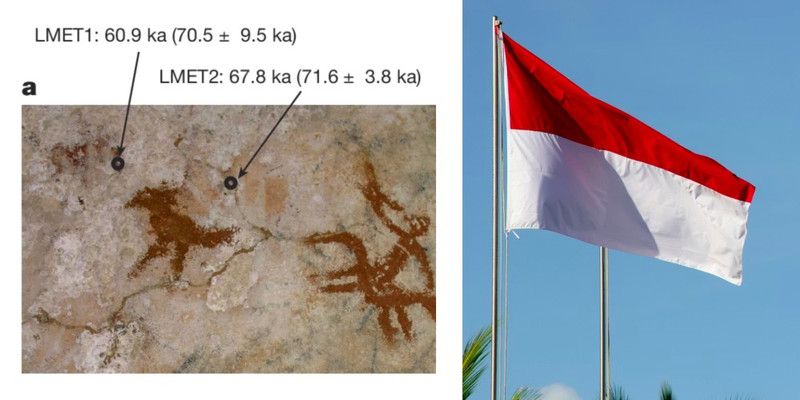

Researchers say they have identified the world’s oldest known cave painting off the coast of the Indonesian island of Sulawesi, a finding that pushes back the origins of symbolic human art by at least a thousand years.
The discovery centers on a red hand stencil found inside a limestone cave on Muna Island, off southeastern Sulawesi. Scientific analysis shows the artwork is at least 67,800 years old, making it older than the previous record holder, a controversial hand stencil in Spain dated to around 66,700 years ago, according to the BBC.
According to researchers, the image is not just a simple handprint. After the original stencil was created, the fingers were deliberately reshaped, narrowed, and elongated to form a claw-like appearance. Scientists say this alteration reflects early symbolic thinking rather than a purely decorative act.
The findings were published in the journal Nature and are the latest in a decade-long series of discoveries on Sulawesi that have steadily pushed the origins of complex image-making further back in time.
The hand stencil was found in Liang Metanduno cave, where mineral crusts that formed over the pigment allowed scientists to establish a minimum age for the artwork. Similar techniques have been used to date other ancient cave paintings across the region.
Professor Adam Brumm of Griffith University, who co-led the research, said the discovery undermines the long-standing idea that symbolic art emerged suddenly in Ice Age Europe around 40,000 years ago.
“When I went to university, we were taught that the creative explosion happened in Europe,” Brumm said. “But evidence like this from Indonesia makes that argument very hard to sustain.”
Previous finds on Sulawesi include animal figures and hunting scenes dated between 40,000 and 51,000 years ago. Each new discovery has extended the known timeline of sophisticated art-making by tens of thousands of years.
Researchers also say the location of the cave matters. Earlier Sulawesi discoveries were concentrated in the island’s southwest, but the Muna Island find shows that cave art traditions were widespread across the region, not limited to one cultural pocket.
The dating has broader implications beyond art history. Sulawesi sits along a key migration route between mainland Asia and the ancient Australia–New Guinea landmass, known as Sahul. The presence of symbolic art there nearly 68,000 years ago supports claims that Homo sapiens may have reached Australia much earlier than the commonly cited 50,000-year timeline.
Archaeologists say the evidence increasingly points to creativity being an innate human trait that existed long before humans spread into Europe.
The discovery centers on a red hand stencil found inside a limestone cave on Muna Island, off southeastern Sulawesi. Scientific analysis shows the artwork is at least 67,800 years old, making it older than the previous record holder, a controversial hand stencil in Spain dated to around 66,700 years ago, according to the BBC.
According to researchers, the image is not just a simple handprint. After the original stencil was created, the fingers were deliberately reshaped, narrowed, and elongated to form a claw-like appearance. Scientists say this alteration reflects early symbolic thinking rather than a purely decorative act.
The findings were published in the journal Nature and are the latest in a decade-long series of discoveries on Sulawesi that have steadily pushed the origins of complex image-making further back in time.
The hand stencil was found in Liang Metanduno cave, where mineral crusts that formed over the pigment allowed scientists to establish a minimum age for the artwork. Similar techniques have been used to date other ancient cave paintings across the region.
Professor Adam Brumm of Griffith University, who co-led the research, said the discovery undermines the long-standing idea that symbolic art emerged suddenly in Ice Age Europe around 40,000 years ago.
“When I went to university, we were taught that the creative explosion happened in Europe,” Brumm said. “But evidence like this from Indonesia makes that argument very hard to sustain.”
Previous finds on Sulawesi include animal figures and hunting scenes dated between 40,000 and 51,000 years ago. Each new discovery has extended the known timeline of sophisticated art-making by tens of thousands of years.
Researchers also say the location of the cave matters. Earlier Sulawesi discoveries were concentrated in the island’s southwest, but the Muna Island find shows that cave art traditions were widespread across the region, not limited to one cultural pocket.
The dating has broader implications beyond art history. Sulawesi sits along a key migration route between mainland Asia and the ancient Australia–New Guinea landmass, known as Sahul. The presence of symbolic art there nearly 68,000 years ago supports claims that Homo sapiens may have reached Australia much earlier than the commonly cited 50,000-year timeline.
Archaeologists say the evidence increasingly points to creativity being an innate human trait that existed long before humans spread into Europe.