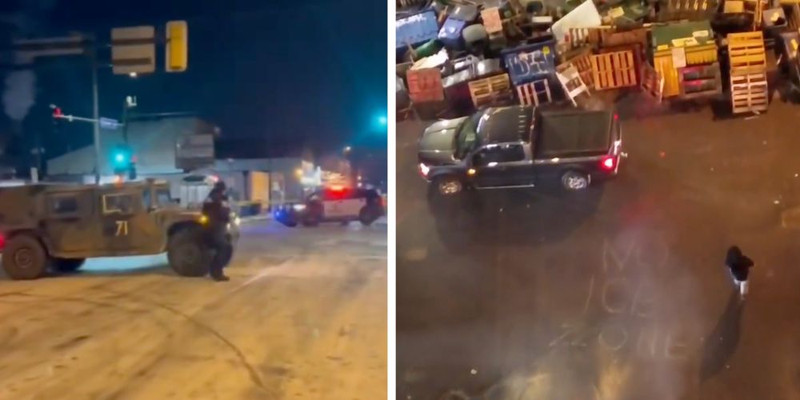

Scenes from Minneapolis on Saturday night showed anti-ICE protesters occupying a “no-ICE zone,” an area that appeared to be protected by Minneapolis police and the National Guard, which was deployed by Governor Tim Walz earlier that day.
Footage from the scene showed National Guard members and police officers lining surrounding streets, with outer barricades set up on each block in all directions. Dozens of people remained inside the zone despite temperatures dropping below zero throughout the night. The situation drew comparisons to the CHOP or CHAZ autonomous zone established in Seattle in 2020 during the height of the George Floyd protests, when protesters created a self-declared autonomous area within the city.
Many protesters gathered in the cold to pay tribute to Alex Pretti, an armed protester who was shot by federal agents during a confrontation over the weekend. Protesters were seen lighting candles and laying flowers in a quiet vigil.
City officials confirmed that the zone was established in part by Minneapolis authorities. Police Chief Brian O'Hara announced that the city had created a vehicle exclusionary zone in the area where the shooting took place. According to O'Hara, police officers, alongside the National Guard, would maintain the zone, and he encouraged those wishing to protest to do so “lawfully” and “peacefully.”
"The number one priority of our police officers is to protect life and maintain public safety for all people in our community," O'Hara said.
Graffiti visible throughout the so-called autonomous zone included anti-ICE messages reading “Kill ICE,” “no ICE Zone,” “Suck my d***,” and “f*** ICE.”
The city of Minneapolis has continued to decline cooperation with ICE operations. Mayor Jacob Frey said the city will file a declaration on Monday requesting that a judge issue a temporary restraining order to halt ICE operations within the city.
"The relief we're asking for is stopping this Operation Metro Surge in the immediacy. It's preventing this massive influx of agents that is making it very difficult for us to do our jobs in the city as well as we need to do them, and we need to do regular day law enforcement as well," Frey said.