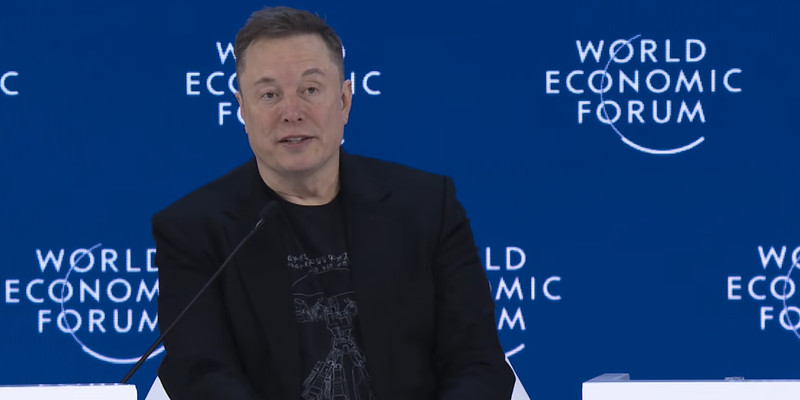

Elon Musk made his first-ever appearance at the World Economic Forum's annual meeting in Davos, Switzerland, on Thursday, using the stage to predict a future where robots outnumber humans and artificial intelligence drives what he described as “abundance for all.”
The appearance marked a shift for Musk, who has long criticized the Davos gathering and its influence. The annual forum this week has drawn many heads of state and senior officials, including President Donald Trump, French President Emmanuel Macron, and European Commission President Ursula von der Leyen.
Speaking in a one-on-one interview with BlackRock CEO and WEF co-chair Larry Fink, Musk talked about how robotics has become central to the mission of his companies, particularly Tesla. He said Tesla’s focus now extends beyond electric vehicles to what he called “sustainable abundance,” driven by advances in AI and automation.
“With robotics and AI, this is really the path to abundance for all,” Musk said. “People often talk about solving global poverty — how do we give everyone a very high standard of living? The only way to do this is AI and robotics.”
Musk said he expects robots to become “ubiquitous” and predicted that their widespread use would trigger a major expansion of the global economy. “My prediction is there will be more robots than people,” he said, adding that humanoid robots could eventually fill gaps in elder care as aging populations outpace the number of younger workers.
Tesla is currently developing a humanoid robot known as Optimus, alongside automated robotaxi systems. The broader humanoid robotics market is currently valued between $2 billion and $3 billion, according to Barclays analysts, but is projected to grow to at least $40 billion by 2035, with some estimates reaching $200 billion as robots move into labor-intensive industries like manufacturing.
Musk also addressed the infrastructure challenges facing AI development, warning that energy supply, not computing chips, may soon become the primary constraint. “The limiting factor for AI deployment is fundamentally electrical power,” he said, noting that the cost of AI infrastructure shifts almost monthly.
He argued that hardware manufacturers may soon produce more AI chips than can be powered, though he pointed to China as an exception due to what he described as “tremendous” electricity growth. Musk said China is deploying more than 1,000 gigawatts of solar power.
“Solar is by far the biggest source of energy. It’s really all about the sun,” Musk said, adding that SpaceX plans to launch solar-powered AI satellites within a few years.
Musk has previously slammed Davos as “an unelected world government that the people never asked for and don’t want.”
The appearance marked a shift for Musk, who has long criticized the Davos gathering and its influence. The annual forum this week has drawn many heads of state and senior officials, including President Donald Trump, French President Emmanuel Macron, and European Commission President Ursula von der Leyen.
Speaking in a one-on-one interview with BlackRock CEO and WEF co-chair Larry Fink, Musk talked about how robotics has become central to the mission of his companies, particularly Tesla. He said Tesla’s focus now extends beyond electric vehicles to what he called “sustainable abundance,” driven by advances in AI and automation.
“With robotics and AI, this is really the path to abundance for all,” Musk said. “People often talk about solving global poverty — how do we give everyone a very high standard of living? The only way to do this is AI and robotics.”
Musk said he expects robots to become “ubiquitous” and predicted that their widespread use would trigger a major expansion of the global economy. “My prediction is there will be more robots than people,” he said, adding that humanoid robots could eventually fill gaps in elder care as aging populations outpace the number of younger workers.
Tesla is currently developing a humanoid robot known as Optimus, alongside automated robotaxi systems. The broader humanoid robotics market is currently valued between $2 billion and $3 billion, according to Barclays analysts, but is projected to grow to at least $40 billion by 2035, with some estimates reaching $200 billion as robots move into labor-intensive industries like manufacturing.
Musk also addressed the infrastructure challenges facing AI development, warning that energy supply, not computing chips, may soon become the primary constraint. “The limiting factor for AI deployment is fundamentally electrical power,” he said, noting that the cost of AI infrastructure shifts almost monthly.
He argued that hardware manufacturers may soon produce more AI chips than can be powered, though he pointed to China as an exception due to what he described as “tremendous” electricity growth. Musk said China is deploying more than 1,000 gigawatts of solar power.
“Solar is by far the biggest source of energy. It’s really all about the sun,” Musk said, adding that SpaceX plans to launch solar-powered AI satellites within a few years.
Musk has previously slammed Davos as “an unelected world government that the people never asked for and don’t want.”