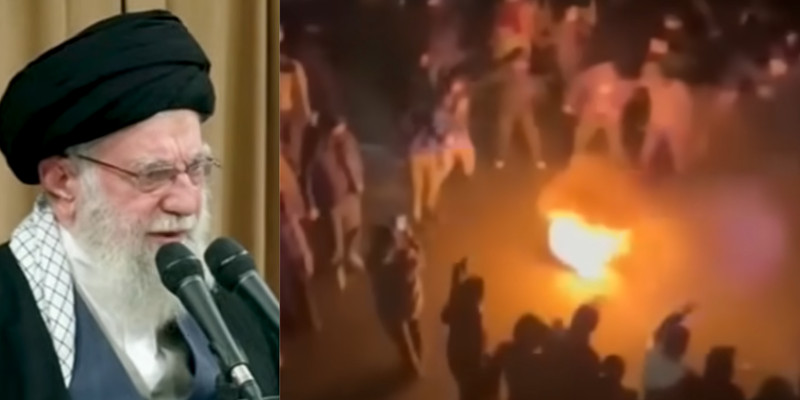

Iranian government officials backed pro-government protests in some cities on Monday as the country remained largely cut off from the internet and international scrutiny, while the United States warned that Tehran is approaching a threshold that could trigger a response, as it has already warned. The demonstrations followed nearly two weeks of ongoing anti-regime, anti-Khamenei protests that have spread nationwide.
State media broadcast images throughout the day showing supporting crowds marching in Tehran and other large urban centers. Because a nationwide internet blackout has now stretched beyond three days, independent verification of the scale and composition of the rallies remains limited.
President Masoud Pezeshkian appeared at one of the Tehran gatherings, greeting smaller pro-government protests and walking alongside them. Over the weekend, Pezeshkian had urged supporters to turn out, saying he was prepared to hear economic grievances while also warning of what he described as “terrorist elements” within the protest movement.
Iran’s foreign minister, Abbas Araghchi, addressed foreign ambassadors in Tehran, saying the country is not seeking war but is prepared for it. “The Islamic Republic of Iran is not seeking war but is fully prepared for war,” Araghchi said, cautioning adversaries against “miscalculation.” He added that Iran is open to negotiations if they are conducted on equal terms and with mutual respect, claiming the country is more prepared than during its 12-day conflict with Israel in June.
Meanwhile, President Donald Trump said Sunday that the oppressive Islamic regime appears to be nearing American red lines, with reports of civilian deaths. Speaking to reporters aboard Air Force One while traveling from Palm Beach to DC, Trump said his administration is weighing “very strong options.”
“They’re starting to, it looks like, and there seem to be some people killed that aren’t supposed to be killed,” Trump said. “These are violent—if you call them leaders, I don’t know if they're leaders or just they rule through violence. But we're looking at it very seriously the military's looking at it. And, we’re looking at some very strong options. We’ll make a determination.”
Trump said some deaths occurred during shootings while others happened in stampedes, noting that he is receiving hourly briefings. He had given earlier warnings that the US would respond forcefully if the Iranian regime escalates its crackdown, saying any response would not necessarily involve ground troops.
Opposition-linked groups cited by the Associated Press said protests have reached at least 190 cities. Activists claimed at least 544 people have been killed, including 483 protesters, though the numbers have not been verified. The US-based Human Rights Activists News Agency reported more than 10,600 detentions, saying most of those killed were protesters.
Iranian authorities have warned that US forces and Israel would be considered legitimate targets if Washington intervenes. Officials also imposed a broad communications blackout, sharply limiting access to the outside world.
In Europe, pressure on Tehran increased as European Parliament President Roberta Metsola announced that the parliament would bar Iranian diplomats and representatives from its premises. Metsola said it “cannot be business as usual” while protests continue, adding that the parliament would not legitimize what she described as a repressive regime.
State media broadcast images throughout the day showing supporting crowds marching in Tehran and other large urban centers. Because a nationwide internet blackout has now stretched beyond three days, independent verification of the scale and composition of the rallies remains limited.
President Masoud Pezeshkian appeared at one of the Tehran gatherings, greeting smaller pro-government protests and walking alongside them. Over the weekend, Pezeshkian had urged supporters to turn out, saying he was prepared to hear economic grievances while also warning of what he described as “terrorist elements” within the protest movement.
Iran’s foreign minister, Abbas Araghchi, addressed foreign ambassadors in Tehran, saying the country is not seeking war but is prepared for it. “The Islamic Republic of Iran is not seeking war but is fully prepared for war,” Araghchi said, cautioning adversaries against “miscalculation.” He added that Iran is open to negotiations if they are conducted on equal terms and with mutual respect, claiming the country is more prepared than during its 12-day conflict with Israel in June.
Meanwhile, President Donald Trump said Sunday that the oppressive Islamic regime appears to be nearing American red lines, with reports of civilian deaths. Speaking to reporters aboard Air Force One while traveling from Palm Beach to DC, Trump said his administration is weighing “very strong options.”
“They’re starting to, it looks like, and there seem to be some people killed that aren’t supposed to be killed,” Trump said. “These are violent—if you call them leaders, I don’t know if they're leaders or just they rule through violence. But we're looking at it very seriously the military's looking at it. And, we’re looking at some very strong options. We’ll make a determination.”
Trump said some deaths occurred during shootings while others happened in stampedes, noting that he is receiving hourly briefings. He had given earlier warnings that the US would respond forcefully if the Iranian regime escalates its crackdown, saying any response would not necessarily involve ground troops.
Opposition-linked groups cited by the Associated Press said protests have reached at least 190 cities. Activists claimed at least 544 people have been killed, including 483 protesters, though the numbers have not been verified. The US-based Human Rights Activists News Agency reported more than 10,600 detentions, saying most of those killed were protesters.
Iranian authorities have warned that US forces and Israel would be considered legitimate targets if Washington intervenes. Officials also imposed a broad communications blackout, sharply limiting access to the outside world.
In Europe, pressure on Tehran increased as European Parliament President Roberta Metsola announced that the parliament would bar Iranian diplomats and representatives from its premises. Metsola said it “cannot be business as usual” while protests continue, adding that the parliament would not legitimize what she described as a repressive regime.