
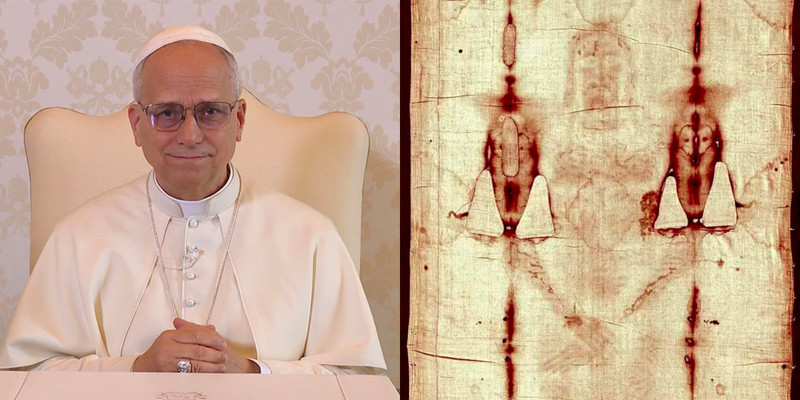

Pope Leo XIV announced on Wednesday that he intends to travel to Turin to visit the city and personally view the Shroud of Turin, marking the first papal visit connected to the relic in nearly a decade, according to Italian outlet Torino Today. The Pope made the declaration aboard the flight carrying him to Ankara at the start of his trip through Turkey and Lebanon.
“It is my intention to come to Turin, visit the city, and see the Shroud,” Leo XIV told reporters during an in-flight press conference attended by more than eighty journalists. The Pontiff said the Vatican is still organizing the details of the visit. “There is still no confirmation of the day I will be in Turin,” he said.
The Archbishop of Turin, Roberto Repole, welcomed the announcement. “The Church in Turin, and I believe the entire city, are ready to welcome Leo XIV with great joy, if he confirms his desire to visit Turin and the Shroud,” Repole said. He added that “from the first day of his Pontificate, Leo XIV has brought attention to the gaze of Jesus, the one and true source of the peace the world is invoking with such trepidation.”
Repole said that the Shroud “reminds us of the death and suffering, but above all the resurrection of Jesus and the victory of life—a sign that from Turin spreads to the whole world.”
The Pope’s interest in the Shroud comes at a time of renewed interest over its origin. Italian researchers recently uncovered evidence suggesting the cloth may date back to the time of Jesus. A radiocarbon dating study in the 1980s suggested the linen was medieval, dating between 1260 and 1390 AD—roughly aligning with the Shroud’s first documented appearance in 14th-century France. These findings have been contested, though, as the shroud had been repaired at several times through its known history, which could have affected the results.
New research by Liberato De Caro and colleagues at Italy’s Institute of Crystallography flips that conclusion. Using Wide-Angle X-ray Scattering to analyze degradation patterns in linen fibers, researchers found results “fully compatible” with a sample dated to 55–74 AD. The findings, published in Heritage, suggest the Shroud could be a 2,000-year-old artifact consistent with the era of Christ.
The team cautioned that further analysis is necessary, stating that “a more accurate and systematic X-ray investigation of more samples taken from the Turin Shroud fabric would be mandatory to confirm the conclusions.”
Scientific examinations have repeatedly shown that the Shroud’s image was not created with paint, dye, or heat. Researchers have found no trace of pigment, no brushwork, and no known medieval method capable of generating the image as it appears on the linen.
The injuries visible on the figure correspond to what is known about Roman crucifixion practices and match the Biblical description of Christ’s passion. Forensic analysis has identified human AB-type blood, including plasma separation patterns often seen in victims of severe trauma.
Digital studies have revealed that the Shroud’s image carries real three-dimensional information, something traditional artwork or ordinary photography cannot replicate. Even with today’s technology—from high-powered lasers to sophisticated chemical tests—scientists have never been able to recreate the Shroud’s unique image. The Vatican does not officially recognize the shroud as being legitimate.
“It is my intention to come to Turin, visit the city, and see the Shroud,” Leo XIV told reporters during an in-flight press conference attended by more than eighty journalists. The Pontiff said the Vatican is still organizing the details of the visit. “There is still no confirmation of the day I will be in Turin,” he said.
The Archbishop of Turin, Roberto Repole, welcomed the announcement. “The Church in Turin, and I believe the entire city, are ready to welcome Leo XIV with great joy, if he confirms his desire to visit Turin and the Shroud,” Repole said. He added that “from the first day of his Pontificate, Leo XIV has brought attention to the gaze of Jesus, the one and true source of the peace the world is invoking with such trepidation.”
Repole said that the Shroud “reminds us of the death and suffering, but above all the resurrection of Jesus and the victory of life—a sign that from Turin spreads to the whole world.”
The Pope’s interest in the Shroud comes at a time of renewed interest over its origin. Italian researchers recently uncovered evidence suggesting the cloth may date back to the time of Jesus. A radiocarbon dating study in the 1980s suggested the linen was medieval, dating between 1260 and 1390 AD—roughly aligning with the Shroud’s first documented appearance in 14th-century France. These findings have been contested, though, as the shroud had been repaired at several times through its known history, which could have affected the results.
New research by Liberato De Caro and colleagues at Italy’s Institute of Crystallography flips that conclusion. Using Wide-Angle X-ray Scattering to analyze degradation patterns in linen fibers, researchers found results “fully compatible” with a sample dated to 55–74 AD. The findings, published in Heritage, suggest the Shroud could be a 2,000-year-old artifact consistent with the era of Christ.
The team cautioned that further analysis is necessary, stating that “a more accurate and systematic X-ray investigation of more samples taken from the Turin Shroud fabric would be mandatory to confirm the conclusions.”
Scientific examinations have repeatedly shown that the Shroud’s image was not created with paint, dye, or heat. Researchers have found no trace of pigment, no brushwork, and no known medieval method capable of generating the image as it appears on the linen.
The injuries visible on the figure correspond to what is known about Roman crucifixion practices and match the Biblical description of Christ’s passion. Forensic analysis has identified human AB-type blood, including plasma separation patterns often seen in victims of severe trauma.
Digital studies have revealed that the Shroud’s image carries real three-dimensional information, something traditional artwork or ordinary photography cannot replicate. Even with today’s technology—from high-powered lasers to sophisticated chemical tests—scientists have never been able to recreate the Shroud’s unique image. The Vatican does not officially recognize the shroud as being legitimate.