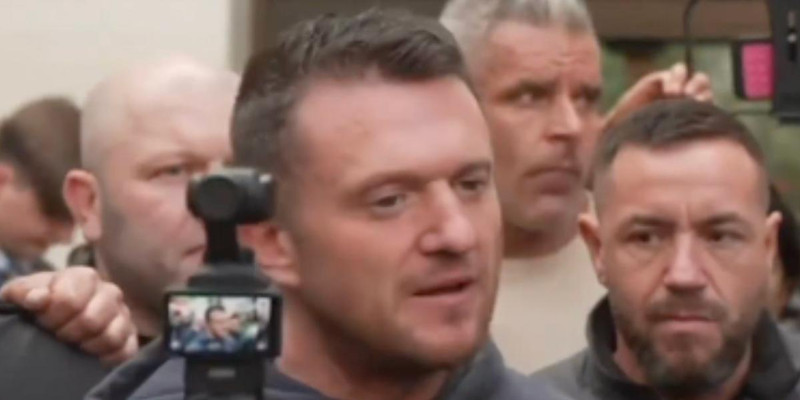

British activist Tommy Robinson has been found not guilty on Friday morning after he was charged with terror offenses for not giving police access to his phone during a border stop. Robinson was driving to Spain when he was stopped at the Channel tunnel in 2024.
Judge Sam Goozee determined that Robinson was not guilty of the charge of failing to comply with counter terrorism measures. Goozee stated that he believed that Robinson was stopped by police not as part of a routine stop or for probable cause, but because of Robinson's beliefs.
"I cannot put out of my mind that it was actually what you stood for and your political beliefs that acted for the principle reason for this stop," Goozee said. He went on to say that the stop was based on a "protected characteristic" and told Robinson "I cannot convict you."
Police asked him at the time what he was doing and claimed that he offered "vague replies," the prosecutor said. Officers demanded that he turn over his iPhone under Schedule 7 of the Terrorism Act.
Police have the authority to stop anyone at a border crossing or port "to determine whether they may be involved or concerned in the commission, preparation or instigation of acts of terrorism," per The Independent.
Prosecutor Jo Morris in the case said that officers "became concerned" about Robinson's "demeanor" when he drove to a police check point. Officers detained him and demanded his phone, but Robinson would not give them the pin number to open it.
Robinson told officers that his journalistic work was on his phone and that he would not share that. Morris told the court that Robinson was told that officers would "protect" that work.
Robinson has exposed the lack of protection police have given to young girls who were raped and brutalized in Britain. Officers also detained him because he was driving a nice car that was not registered to him and had some $15,000 on him in pounds and euros.
After the verdict, Robinson asked Nigel Farage to apologize for comments he had made. "We will please now correct this @Nigel_Farage? Now that I've been found NOT GUILTY? Can you now accept that I was targeted for my political beliefs? Like the judge found? You should have spoken up, but didn't, instead you lied, why?"
He also spoke after the verdict, saying "The public can see all this now so it doesn’t matter." He also spoke out about recent violent attacks in in the UK that were downplayed by British media, such as the murder of girls in Southport by the son of Rwandan migrants and contrasted that with his own coverage.
Citizen journlists, he said, are a threat to both government and media narratives and that's why, in his view, he was targeted. He said the government and media are the main "proponents" of misinformation.
Judge Sam Goozee determined that Robinson was not guilty of the charge of failing to comply with counter terrorism measures. Goozee stated that he believed that Robinson was stopped by police not as part of a routine stop or for probable cause, but because of Robinson's beliefs.
"I cannot put out of my mind that it was actually what you stood for and your political beliefs that acted for the principle reason for this stop," Goozee said. He went on to say that the stop was based on a "protected characteristic" and told Robinson "I cannot convict you."
Police asked him at the time what he was doing and claimed that he offered "vague replies," the prosecutor said. Officers demanded that he turn over his iPhone under Schedule 7 of the Terrorism Act.
Police have the authority to stop anyone at a border crossing or port "to determine whether they may be involved or concerned in the commission, preparation or instigation of acts of terrorism," per The Independent.
Prosecutor Jo Morris in the case said that officers "became concerned" about Robinson's "demeanor" when he drove to a police check point. Officers detained him and demanded his phone, but Robinson would not give them the pin number to open it.
Robinson told officers that his journalistic work was on his phone and that he would not share that. Morris told the court that Robinson was told that officers would "protect" that work.
Robinson has exposed the lack of protection police have given to young girls who were raped and brutalized in Britain. Officers also detained him because he was driving a nice car that was not registered to him and had some $15,000 on him in pounds and euros.
After the verdict, Robinson asked Nigel Farage to apologize for comments he had made. "We will please now correct this @Nigel_Farage? Now that I've been found NOT GUILTY? Can you now accept that I was targeted for my political beliefs? Like the judge found? You should have spoken up, but didn't, instead you lied, why?"
He also spoke after the verdict, saying "The public can see all this now so it doesn’t matter." He also spoke out about recent violent attacks in in the UK that were downplayed by British media, such as the murder of girls in Southport by the son of Rwandan migrants and contrasted that with his own coverage.
Citizen journlists, he said, are a threat to both government and media narratives and that's why, in his view, he was targeted. He said the government and media are the main "proponents" of misinformation.