
The Chinese Communist Party is making inroads in America’s backyard, investing heavily in ports, energy, and digital infrastructure across Latin America. These moves are aimed at supplanting the United States in a region long considered vital to American national security but seldom a priority. A new National Defense Strategy may usefully challenge Washington to implement hemispheric and homeland defense efforts that counter Beijing’s advance.
The Trump Administration’s National Defense Strategy reportedly landed on Secretary of War Pete Hegseth’s desk last month. Many expect the strategy to reorient U.S. defense priorities toward protecting the Western Hemisphere and the homeland, rather than emphasizing great power competition.
However, this framing rests on a false dichotomy. There is no either-or tradeoff. China’s aggressive international strategy and global presence features several material beachheads in Latin America, in addition to Beijing’s hand in the destabilizing forces of fentanyl trafficking and illegal immigration. Those areas place a new premium on hemispheric defense and homeland security. They demand that the Trump administration push back against China’s growing influence in America’s backyard.
The American national security strategy has lagged in internalizing this threat because it presents itself differently. Unlike the U.S. model of power projection, China’s military-civil fusion leverages seemingly commercial assets and supply chain dominance – such as operating the Panama Canal or owning the refining and processing nodes on which Argentine lithium mines depend – to secure overseas economic interests and accrue coercive power.
Those positions provide Xi Jinping with an intimidating arsenal. It can be wielded against regional actors, such as Venezuela or Ecuador, to ensure that China has preferential access to resources. China’s regional arsenal also delivers leverage in everything from trade negotiations with Washington to potential military conflict: The Chinese military could use its Western Hemisphere outposts to threaten the U.S. homeland and North American sea lanes.
The Trump administration has actively sought to address China’s presence. President Trump, Secretary of War Hegseth, and Secretary of State Rubio have all prioritized wresting away ownership and operation of the Panama Canal from Chinese-linked entities. But even that update risks fighting yesterday’s battles.
For instance, in Peru, Beijing is leveraging close economic ties and subnational political relationships to develop megaprojects that promise to supplant the Panama Canal—and will operate under Chinese control. Almost a year ago, Xi Jinping oversaw the opening of Chancay Port, a Chinese-led infrastructure project positioned to transform Latin American transit and trade with China. A newly proposed bi-oceanic railway is set to link Brazil with Chancay. Those Chinese-backed megaprojects will replace the Panama Canal as the region’s critical transit hub, rewire regional trade relations, and create a direct path between the region and China.
China’s influence in America’s backyard also threatens the U.S. homeland. It allows for more fluid movement of Chinese-origin fentanyl products into the United States. It provides the Chinese intelligence apparatus with proximity for collecting information on and executing intrusions into the United States. And then there are the immediate economic impacts: Chinese sorghum imports from Brazil, for example, are set to increase dramatically, thereby shrinking the bottom lines of American farmers. The proposed Brazil-to-Peru railway will further decrease Brazilian costs, making it all the more difficult for U.S. producers to compete in a global marketplace distorted by China’s non-market approach.
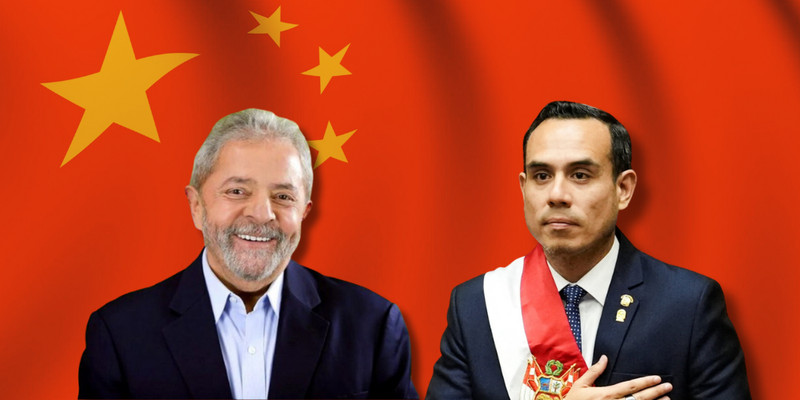
Solidifying homeland and hemispheric security is a necessary, if insufficient, condition for fighting China globally and securing a new era of American excellence. It will require catching up to Beijing’s playbook as well as China’s existing positioning. The Brazilian government under President Ignacio Lula da Silva has embraced China’s “Panama Canal 2.0” rail project as a top priority, as has Lima’s “wanna-be MAGA” Mayor Rafael Lopez Aliaga, who is seeking Peru’s presidency next year. China’s map of the proposed bi-oceanic rail line bends through the Peruvian city of Cusco before ending at Chancay, where PeruRail – co-founded and co-owned by Lopez Aliaga – has its principal rail hub. China’s support in Peru underscores that it’s not just Beijing’s investment but also its subnational influence with which the United States needs to contend.
With local political elites squarely in China’s corner, the Chinese Communist Party is several moves ahead and actively operating in America’s backyard. A National Defense Strategy that recognizes the importance of hemispheric security and imposes costs for Latin American leaders who facilitate China’s anti-American goals can’t come soon enough.
Nathan Picarsic is a senior fellow at the Foundation for Defense of Democracies with a focus on China policy. He is also the co-founder of Horizon Advisory, a consulting firm focused on the implications of China’s competitive approach to geopolitics.