
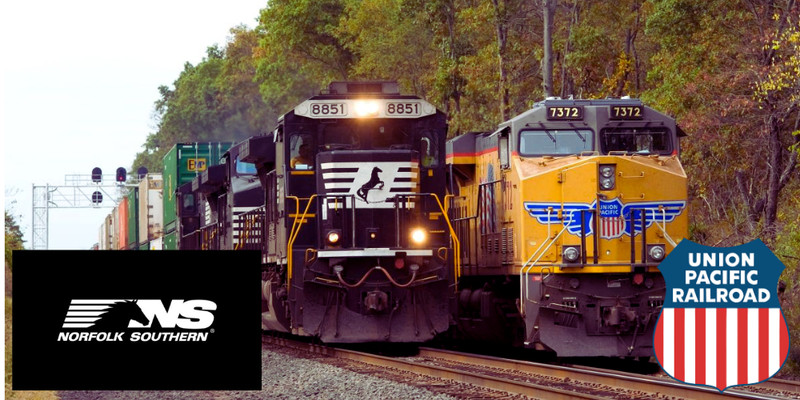

America’s freight rail system has always been a symbol of our economic strength, built by innovators, sustained by hard work, and vital to expanding American industry. When Abraham Lincoln signed the Pacific Railway Act in 1862, helping to unite America’s western railroads, he made a bold bet that a strong rail network would embolden and strengthen American industry and hold the country together.
Today, America is at a similarly pivotal moment. Will we allow our rail system to fall further behind, or will we rebuild at home, putting American workers first and restoring the backbone of our economy?
The proposed merger of Union Pacific and Norfolk Southern offers an opportunity to build on Lincoln’s legacy and put the country on the right path, the America First path. By creating the first unified, coast-to-coast rail network, the merger would strengthen U.S. competitiveness, unlock economic benefits, and support the reindustrialization of our nation. It is exactly the kind of bold, pro-American infrastructure investment that can help make our nation strong again.
A unified network would deliver immediate benefits. Manufacturers would enjoy savings on shipping costs, supply chains would grow more resilient, and highways would face less wear and tear from freight trucks. That means more jobs in the heartland, stronger American businesses, and lower costs for families.
Railroads have always been engines of opportunity, linking farms to markets, workers to jobs, and towns to thriving commerce. When we strengthen freight rail, we aren’t just moving cargo — we are opening doors for communities that have been left behind in the global economy. Every mile of track represents not only an investment in steel and locomotives, but also in the workers who build, maintain, and operate them. This merger offers a chance to reinvest in those workers and those communities, creating new opportunities in places that too often see jobs outsourced overseas.
Moreover, a coast-to-coast rail system would not simply modernize transportation; it would reaffirm America’s commitment to self-reliance and national strength. By reducing dependence on foreign supply chains and cutting costly inefficiencies, the merger would help ensure that “Made in America” once again means competitive, affordable, and world-class. From energy producers in the West to manufacturers in the Midwest and exporters in the East, the benefits would ripple across the entire country — lifting the economy while putting America back in charge of its own destiny.
A unified transcontinental railroad would be on a stronger footing to compete against long-haul trucking, which in recent decades has commanded a growing and dominant share of freight volume in the U.S. Shifting volume back to rail would be a win for America, businesses, and families.
Overdependence on trucking has clogged our roads, cost taxpayers billions in repairs, and endangered lives. In 2023, 5,472 people died in large-truck crashes, while rail freight is associated with far fewer fatalities and injuries than long-haul trucking.
Heavy reliance on trucking also continues to strain our crumbling highways. Long-haul trucks cost taxpayers billions by creating wear and tear on publicly funded highways. Railroads, in contrast, invest in and maintain their own infrastructure, often to the tune of billions of dollars in a year. Rather than costing taxpayers a dime, railroads’ private infrastructure investments create jobs and economic activity in communities across the country.
Unifying two complementary rail networks will also streamline coast-to-coast shipping by eliminating costly interchange delays, which are caused by the handoff of railcars from one line to another. These delays often leave railcars sitting for days, driving up inventory costs and creating reliability concerns for shippers. A unified rail network means more cost savings for businesses, confidence for shippers, and the ability to deliver goods to market more quickly.
Some may worry that a rail merger would reduce competition. In fact, instead of eliminating competition, this merger expands it – creating real competition against Canadian railroads, foreign-controlled shipping, and over-reliance on trucking. Ultimately, it increases options for U.S. producers while boosting America’s strategic position in global trade.
These benefits are foundational to the American manufacturing renaissance that President Trump is pursuing. Whether it's semiconductor chips and other cutting-edge technological hardware, or apparel and agriculture, a strong rail network will help get those products where they need to be. This merger will give us a freight rail system that is worthy of a modern, America First economy.
This merger is an investment not in Wall Street, but in main streets, factory floors, and small towns across the country. Steel, auto, agriculture, and countless other industries will benefit from faster, cheaper, more reliable freight rail – ensuring factories stay open, workers stay on the job, and communities thrive.
America has always risen when we choose to be bold. Lincoln’s railroads knit together a young nation. Today, a coast-to-coast network can do the same for a modern America First economy. It is time to seize this opportunity, support this merger, and put American workers, businesses, and families back on track. It is time to put America First, and one of the important places that starts is with rail.
George Landrith is the President of Frontiers of Freedom, a public policy think tank founded by U.S. Senator Malcolm Wallop to promote the principles of individual freedom, strong national defense, free markets, and constitutionally limited government. Landrith is a nationally recognized conservative commentator and advocate for America First policies.