
Germany's Alternative for Germany (AfD) party is reportedly focusing its response to last weekend's deadly attack at Berlin Pride on immigration and Islamist extremism, an analyst told the New York Times.
The attack left one woman dead and 29 others injured after authorities said the suspect, a 21-year-old Muslim German citizen of Lebanese descent, drove into crowds before carrying out a machete attack. Officials said the suspect had previously attempted to join the Islamic State. Police shot and killed him.
The day after the attack, Berlin AfD leader Kristin Brinker issued a statement that opened with the words: "Protect Berliners from violent Islamists!" Several political analysts told The Times the attack is likely to push security and immigration back to the center of Germany's political debate, with an election scheduled for January 2027.
The populist party is currently polling strongly ahead of elections in Berlin. Kai Arzheimer, a politics professor at the University of Mainz, said the Pride attack "will help the AfD" politically, though he claimed that "it's not perfect from their point of view, because of the target of the attack."
The AfD has long campaigned for tougher immigration policies and mass deportations while opposing many virtue-signaling Pride initiatives. The party's platforms have called for banning Pride flags from public buildings, and senior party figure Beatrix von Storch previously wrote: "The instrumentalization of the rainbow agenda during so-called Pride Month must stop." She added, "Political correctness and woke ideology attack the family, consisting of man and woman, as the fundamental unit of society."
Brinker said the Berlin branch of the party does not oppose gay rights or Pride events. "We ourselves have, within the party and in my caucus, a great many gay people — a great many people who live different lifestyles," she said. "That's completely OK, absolutely fine. Nobody here says otherwise — quite the opposite, in fact."
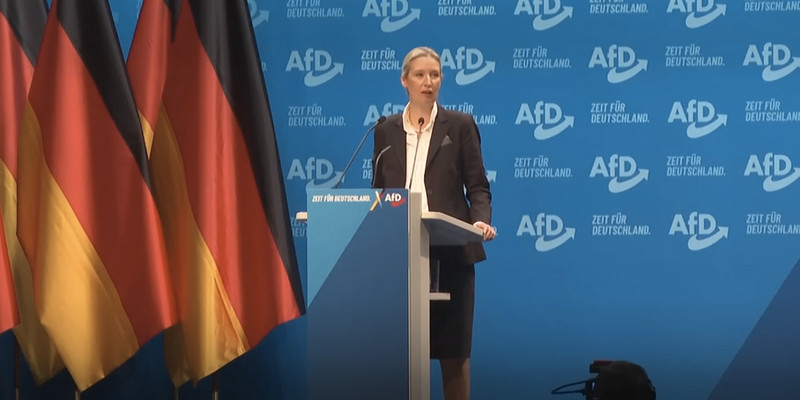
The leader of the AfD, Alice Weidel, is a lesbian in a relationship and has children with her partner. She has stated previously that she is in favor of Germany's current gay marriage laws and would be in favor of keeping them as-is.
The attack has also prompted Germany's governing Christian Democrats to call for tougher counterterrorism measures, with some politicians pushing proposals that would go further than previous government policy.
Saxony-Anhalt Governor Sven Schulze said authorities should seek ways to remove extremists from Germany, even when they hold German citizenship.
Research cited by the Times suggests terror attacks have historically benefited the AfD in local elections. A study by researchers at Goethe University Frankfurt found the party gained an average of 4.5 percentage points in municipalities that experienced terrorist attacks compared to similar areas where planned attacks were unsuccessful. Researcher Navid Sabet said, "The AfD uses these attacks as a selling point for itself."
The attack left one woman dead and 29 others injured after authorities said the suspect, a 21-year-old Muslim German citizen of Lebanese descent, drove into crowds before carrying out a machete attack. Officials said the suspect had previously attempted to join the Islamic State. Police shot and killed him.
The day after the attack, Berlin AfD leader Kristin Brinker issued a statement that opened with the words: "Protect Berliners from violent Islamists!" Several political analysts told The Times the attack is likely to push security and immigration back to the center of Germany's political debate, with an election scheduled for January 2027.
The populist party is currently polling strongly ahead of elections in Berlin. Kai Arzheimer, a politics professor at the University of Mainz, said the Pride attack "will help the AfD" politically, though he claimed that "it's not perfect from their point of view, because of the target of the attack."
The AfD has long campaigned for tougher immigration policies and mass deportations while opposing many virtue-signaling Pride initiatives. The party's platforms have called for banning Pride flags from public buildings, and senior party figure Beatrix von Storch previously wrote: "The instrumentalization of the rainbow agenda during so-called Pride Month must stop." She added, "Political correctness and woke ideology attack the family, consisting of man and woman, as the fundamental unit of society."
Brinker said the Berlin branch of the party does not oppose gay rights or Pride events. "We ourselves have, within the party and in my caucus, a great many gay people — a great many people who live different lifestyles," she said. "That's completely OK, absolutely fine. Nobody here says otherwise — quite the opposite, in fact."
The leader of the AfD, Alice Weidel, is a lesbian in a relationship and has children with her partner. She has stated previously that she is in favor of Germany's current gay marriage laws and would be in favor of keeping them as-is.
The attack has also prompted Germany's governing Christian Democrats to call for tougher counterterrorism measures, with some politicians pushing proposals that would go further than previous government policy.
Saxony-Anhalt Governor Sven Schulze said authorities should seek ways to remove extremists from Germany, even when they hold German citizenship.
Research cited by the Times suggests terror attacks have historically benefited the AfD in local elections. A study by researchers at Goethe University Frankfurt found the party gained an average of 4.5 percentage points in municipalities that experienced terrorist attacks compared to similar areas where planned attacks were unsuccessful. Researcher Navid Sabet said, "The AfD uses these attacks as a selling point for itself."
Pro-Palestinian demonstrations have appeared alongside LGBTQ events in German cities since the attack took place, arguing that some groups within the Palestinian movement hold views that conflict with LGBTQ rights.
The issue has created friction within parts of the German left, where debates over Israel, Gaza, immigration and integration have increasingly overlapped with debate about LGBTQ politics. Critics of pro-Palestinian activism argue that portions of the movement have been unwilling to confront hostility toward LGBTQ people among some Islamist groups. Supporters say criticism of Israel and advocacy for Palestinian civilians should not be conflated with opposition to LGBTQ rights.