
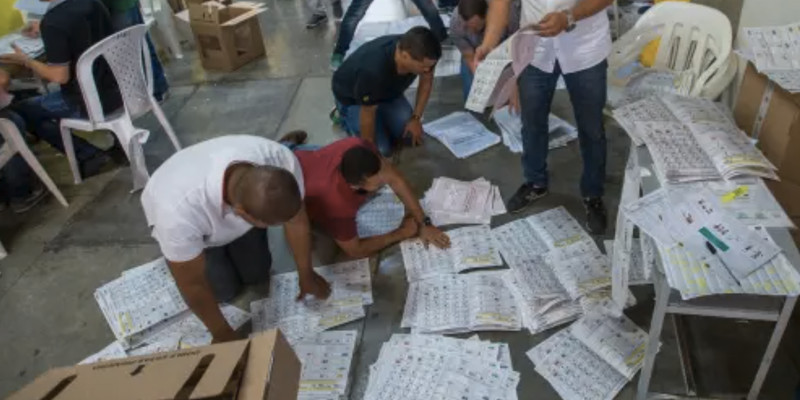

Colombia’s presidential election results were effectively known within a few hours of polls closing, showing a system that uses paper ballots and manual counting at each polling station before results are transmitted nationally.
Ballots in Colombia are hand counted by election jurors at each precinct, according to El Colombiano, with results recorded on official tally sheets and then sent electronically to the national electoral authority. That process produces an initial nationwide “preconteo” that gives a highly reliable picture of the outcome the same night, even though the final certification takes longer, reports Infobae.
In the most recent election held yesterday, preliminary results were made publicly clear roughly two to three hours after polls closed; once enough tallies had been processed to establish a national trend. No voting machines are used and no algorithm is used, according to Verifica. At that point, officials had already received and aggregated millions of individually counted ballots from across the country, allowing the race outcome to be determined well before full certification.
By the time 99.65 percent of ballots were included in the preliminary count, the result was already stable and widely understood as decisive.
That count showed populist candidate and Trump ally Abelardo de la Espriella narrowly defeating leftwing senator Iván Cepeda in a tight runoff. De la Espriella secured 12.91 million votes, or 49.65 percent, ahead of Cepeda’s 12.67 million votes, or 48.7 percent, a margin of 248,310 votes. About 1.6 percent of ballots were recorded as blank.
The close finish marked a tighter gap than the first round three weeks earlier, when de la Espriella led by 673,000 votes.
De la Espriella, a millionaire lawyer who has presented himself as an anti-establishment populist, is scheduled to take office on August 7. His campaign centered heavily on security policy, with pledges to take a more aggressive approach against armed groups and drug trafficking organizations.
Violence and public safety remained dominant themes throughout the campaign, with Colombia still managing the long tail of armed conflict despite the 2016 peace deal with most of the Revolutionary Armed Forces of Colombia. Authorities have noted that while violence is far below historical highs, recent years have seen a relative uptick compared with post-peace agreement lows.
De la Espriella has proposed building 10 maximum-security “mega-prisons,” and previously said criminals would be targeted “like rats and cockroaches.” He has also vowed to “disembowel” the left, later calling the remark figurative.
Ballots in Colombia are hand counted by election jurors at each precinct, according to El Colombiano, with results recorded on official tally sheets and then sent electronically to the national electoral authority. That process produces an initial nationwide “preconteo” that gives a highly reliable picture of the outcome the same night, even though the final certification takes longer, reports Infobae.
In the most recent election held yesterday, preliminary results were made publicly clear roughly two to three hours after polls closed; once enough tallies had been processed to establish a national trend. No voting machines are used and no algorithm is used, according to Verifica. At that point, officials had already received and aggregated millions of individually counted ballots from across the country, allowing the race outcome to be determined well before full certification.
By the time 99.65 percent of ballots were included in the preliminary count, the result was already stable and widely understood as decisive.
That count showed populist candidate and Trump ally Abelardo de la Espriella narrowly defeating leftwing senator Iván Cepeda in a tight runoff. De la Espriella secured 12.91 million votes, or 49.65 percent, ahead of Cepeda’s 12.67 million votes, or 48.7 percent, a margin of 248,310 votes. About 1.6 percent of ballots were recorded as blank.
The close finish marked a tighter gap than the first round three weeks earlier, when de la Espriella led by 673,000 votes.
De la Espriella, a millionaire lawyer who has presented himself as an anti-establishment populist, is scheduled to take office on August 7. His campaign centered heavily on security policy, with pledges to take a more aggressive approach against armed groups and drug trafficking organizations.
Violence and public safety remained dominant themes throughout the campaign, with Colombia still managing the long tail of armed conflict despite the 2016 peace deal with most of the Revolutionary Armed Forces of Colombia. Authorities have noted that while violence is far below historical highs, recent years have seen a relative uptick compared with post-peace agreement lows.
De la Espriella has proposed building 10 maximum-security “mega-prisons,” and previously said criminals would be targeted “like rats and cockroaches.” He has also vowed to “disembowel” the left, later calling the remark figurative.