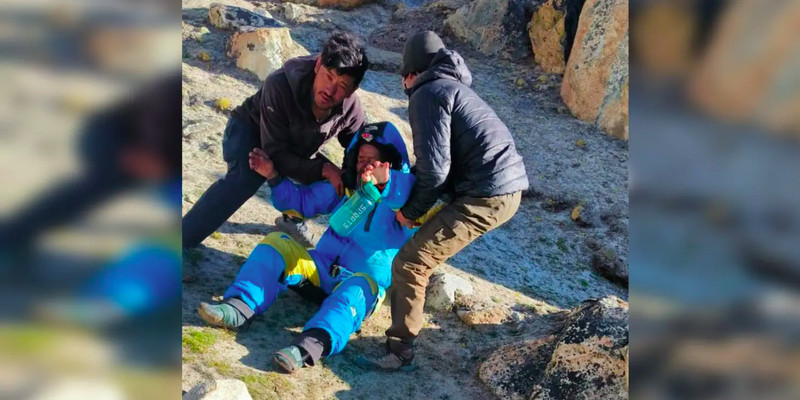

A Nepalese mountain guide presumed lost on Mount Everest has been rescued after surviving nearly a week alone on the world’s highest peak, in a case climbers and officials are calling extraordinary. Dawa Sherpa, 57, was found near base camp on Thursday by members of the Sagarmatha Pollution Control Committee, a Nepalese team responsible for maintaining routes and removing waste on Everest.
He had been missing since late May after being separated from his climbing party during a descent in harsh conditions. Officials said he had been without food, water, and supplemental oxygen for an extended period while navigating difficult terrain near the Khumbu Icefall.
His wife, Damu, said she had already begun preparing for his death before news of his survival reached her. “We were very happy to hear the news, we had given up hope. We also began puja [death prayers] yesterday," reports GB News.
She added that he was now conscious and stable but being treated for frostbite.
A base camp manager said Sherpa survived in part by eating a “small packet of biscuits” and consuming ice after losing his equipment, including his boots and bag.
“He survived alone for nearly a week without food, water, or supplemental oxygen navigating the treacherous Khumbu Icefall (even after the fixed ladders were removed for the season),” said the Nepal Mount Everest hiking company in a social media statement. “This is nothing short of a miracle.”
Sherpa, known locally as “Hillary” after Edmund Hillary, was later airlifted by helicopter to Kathmandu for treatment.
His disappearance followed a descent from Camp Four at roughly 7,950 meters. Fellow climber Chris Thrall said Sherpa had paused during the climb down before the group became separated in worsening conditions.
“He sat down for a rest with his backpack — these guys carry huge loads. And I turned and I said, 'Hillary, are you OK, brother?'
"He said, 'Yes, yes, fine Chris, please go, go!' This is nothing new, you know. I'd go ahead, he'd go ahead."
Thrall said he later diverted to assist another climber in distress, a decision that took him away from Sherpa’s location for hours as conditions deteriorated on the mountain.
Mingmar Tendi Sherpa, a base camp manager, said the guide had fallen into a crevasse near 5,600 metres and remained trapped for several days before managing to escape and move toward base camp, where he was eventually located by a clean-up team.
“Not everyone can survive in a crevasse... for such a long time, in such confined spaces. It is extreme cold, [with] limited oxygen, and a high risk of asphyxiation there,” he said.
He had been missing since late May after being separated from his climbing party during a descent in harsh conditions. Officials said he had been without food, water, and supplemental oxygen for an extended period while navigating difficult terrain near the Khumbu Icefall.
His wife, Damu, said she had already begun preparing for his death before news of his survival reached her. “We were very happy to hear the news, we had given up hope. We also began puja [death prayers] yesterday," reports GB News.
She added that he was now conscious and stable but being treated for frostbite.
A base camp manager said Sherpa survived in part by eating a “small packet of biscuits” and consuming ice after losing his equipment, including his boots and bag.
“He survived alone for nearly a week without food, water, or supplemental oxygen navigating the treacherous Khumbu Icefall (even after the fixed ladders were removed for the season),” said the Nepal Mount Everest hiking company in a social media statement. “This is nothing short of a miracle.”
Sherpa, known locally as “Hillary” after Edmund Hillary, was later airlifted by helicopter to Kathmandu for treatment.
His disappearance followed a descent from Camp Four at roughly 7,950 meters. Fellow climber Chris Thrall said Sherpa had paused during the climb down before the group became separated in worsening conditions.
“He sat down for a rest with his backpack — these guys carry huge loads. And I turned and I said, 'Hillary, are you OK, brother?'
"He said, 'Yes, yes, fine Chris, please go, go!' This is nothing new, you know. I'd go ahead, he'd go ahead."
Thrall said he later diverted to assist another climber in distress, a decision that took him away from Sherpa’s location for hours as conditions deteriorated on the mountain.
Mingmar Tendi Sherpa, a base camp manager, said the guide had fallen into a crevasse near 5,600 metres and remained trapped for several days before managing to escape and move toward base camp, where he was eventually located by a clean-up team.
“Not everyone can survive in a crevasse... for such a long time, in such confined spaces. It is extreme cold, [with] limited oxygen, and a high risk of asphyxiation there,” he said.