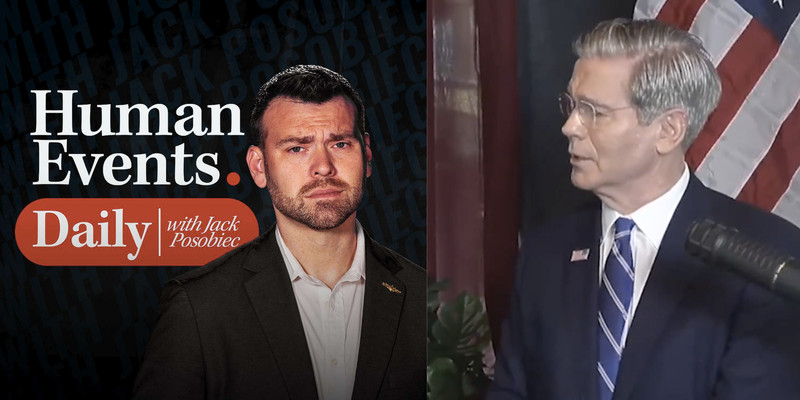

Speaking at the World Economic Forum's annual meeting in Davos, Switzerland, Human Events host Jack Posobiec and US Treasury Secretary Scott Bessent discussed Greenland’s strategic importance, arguing that the territory sits at the center of growing geopolitical competition involving China, rare earth minerals, and Arctic security.
Posobiec framed Greenland as a natural convergence point for global power politics, pointing to European sovereignty concerns, China’s expansion, and resource access. He said that Greenland has already become a flashpoint, citing Denmark’s decision to pull back from recent discussions and the absence of senior UN leadership at a critical moment. Posobiec asked directly how Greenland fits into the Trump administration’s broader strategy and what message US officials were delivering in Davos.
“The message here is sit down and listen to President Trump,” Bessent responded. He said there has been a “visceral reaction and a lack of imagination” from European leaders and Danish officials who reject the idea that Greenland could be “safer, sounder, and put to much better use in American hands.”
Bessent argued that US acquisition of strategic territory has historical precedent, pointing first to Alaska. He said it was “somewhat ironic” that critics now oppose the idea of acquiring Greenland, noting that Alaska’s purchase from Russia was once derided as “Seward’s Folly.” “It wasn’t popular at the time,” he said. “Then guess what happened twenty years later? The gold rush.”
He extended that argument to other acquisitions, citing the Panama Canal and the US purchase of the Virgin Islands from Denmark during World War I. “Denmark remained neutral during World War I. They were not an ally,” Bessent said. “But the US bought the Virgin Islands because it wanted a safe Caribbean after finishing the Panama Canal.”
According to Bessent, President Trump’s view is forward-looking. “President Trump has a strategic vision. He is trying to avert a calamity that could happen,” he said, noting that whether the risk emerges in one year or fifteen years, US control would remove uncertainty. “If it’s US territory, no one is going to lay claim to it.”
Bessent warned that Denmark has allowed Chinese firms to mine in Greenland, a point Posobiec reinforced by highlighting the island’s military history. Posobiec recalled that US defense of Greenland during World War II prevented German access and helped establish a critical air bridge for Lend-Lease to the UK, later supporting troop movements ahead of the Normandy invasion.
“There’s a deep military history between the United States and Greenland,” Posobiec said, “and it’s always been about defending that island.”
Posobiec framed Greenland as a natural convergence point for global power politics, pointing to European sovereignty concerns, China’s expansion, and resource access. He said that Greenland has already become a flashpoint, citing Denmark’s decision to pull back from recent discussions and the absence of senior UN leadership at a critical moment. Posobiec asked directly how Greenland fits into the Trump administration’s broader strategy and what message US officials were delivering in Davos.
“The message here is sit down and listen to President Trump,” Bessent responded. He said there has been a “visceral reaction and a lack of imagination” from European leaders and Danish officials who reject the idea that Greenland could be “safer, sounder, and put to much better use in American hands.”
Bessent argued that US acquisition of strategic territory has historical precedent, pointing first to Alaska. He said it was “somewhat ironic” that critics now oppose the idea of acquiring Greenland, noting that Alaska’s purchase from Russia was once derided as “Seward’s Folly.” “It wasn’t popular at the time,” he said. “Then guess what happened twenty years later? The gold rush.”
He extended that argument to other acquisitions, citing the Panama Canal and the US purchase of the Virgin Islands from Denmark during World War I. “Denmark remained neutral during World War I. They were not an ally,” Bessent said. “But the US bought the Virgin Islands because it wanted a safe Caribbean after finishing the Panama Canal.”
According to Bessent, President Trump’s view is forward-looking. “President Trump has a strategic vision. He is trying to avert a calamity that could happen,” he said, noting that whether the risk emerges in one year or fifteen years, US control would remove uncertainty. “If it’s US territory, no one is going to lay claim to it.”
Bessent warned that Denmark has allowed Chinese firms to mine in Greenland, a point Posobiec reinforced by highlighting the island’s military history. Posobiec recalled that US defense of Greenland during World War II prevented German access and helped establish a critical air bridge for Lend-Lease to the UK, later supporting troop movements ahead of the Normandy invasion.
“There’s a deep military history between the United States and Greenland,” Posobiec said, “and it’s always been about defending that island.”