Opinion
ROD THOMSON: 9 ways Trump's fight against cartel boats is like Jefferson's takedown of the Barbary Pirates
Jefferson didn't capture the Barbary Pirates' ships—he destroyed them, and if they would not surrender, they were killed.
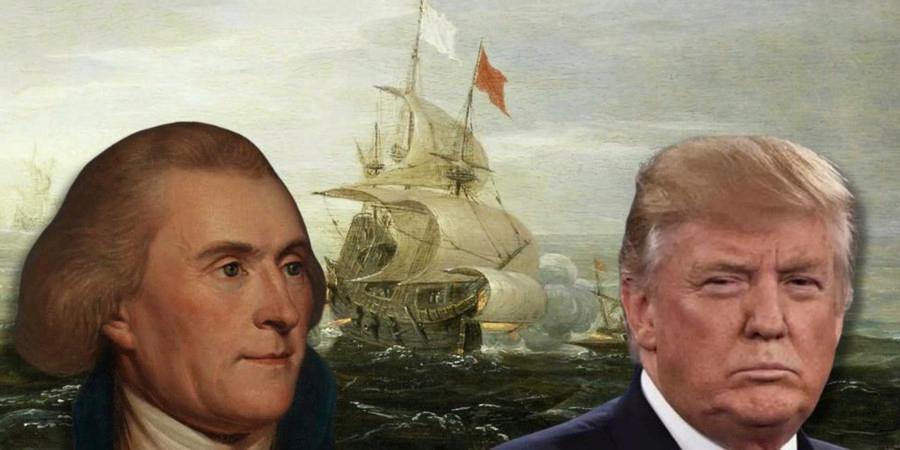
President Trump is in good company with his campaign against the drug cartels and their narco terrorist state sponsors — no less than President Thomas Jefferson. Jefferson, like Trump, had to battle criminals on the high seas.
After America won independence from the British Empire, we lost our powerful British navy protection. This severely impacted the young nation's trade routes in the Mediterranean, a vast trade route for the young nation reaching the southern European powers, including Spain, Italy, and Portugal. American ships were being boarded, taken over, and American seamen were caputured.
Without the British navy, our merchant ships fell to the not-so-tender mercies of the Barbary pirates of North Africa — operating under the protection of Tripoli, Tunisia, and Algiers — and their mighty fleet of pirate ships. They captured American merchant ships, stole the cargo and vessels, and enslaved the crews.
Many European nations not protected by the British paid annual tribute to Muslim powers to stop piracy for a year at a time, and the young United States also did. But these tributes came at a high cost — reaching up to 20 percent of the young federal budget — and the young republic's honor, commerce, and finances were at stake.
Americans had had it. They had just defeated the most powerful empire in the world, and now they were being held captive by backwater pirates? No more. President John Adams was paying tribute and did not want a standing navy. Thomas Jefferson ran against Adams partly on building a navy big enough to stop the Barbary pirates. He won and kept his promise.
After a few years of naval battles and a small land invasion of Tripoli by U.S. Marines, Tripoli caved and negotiated a treaty ending its piracy of American vessels. This is the action from which we get the famous line in the U.S. Marines' hymn, "From the Halls of Montezuma to the shores of Tripoli."
Jefferson didn't capture the Barbary Pirates' ships—he destroyed them, and if they would not surrender, they were killed. This was a win for America and the smaller European nations, who realized they, too, could stop paying tribute to the bad guys and defeat them at sea.
The comparisons between Jefferson's actions against the Barbary pirates and Trump's actions against the drug cartels are compelling.
1. The bad guys in each both instances were not the actual nations but the criminal privateers who had the protection and approval of those nations.
2. The pirates were materially harming Americans and American interests by capturing ships, stealing goods, and enslaving Americans. The modern drug cartels are fueling the illegal drug trade in the US which leads to drug overdoses, killing 100,000 Americans annually.
3. The bad guys in both used and use the high seas to conduct their criminal enterprises against America.
4. The Barbary pirates aimed to conduct criminal commerce at the expense of Americans. The drug cartels are also engaged in criminal activity with the intent of violating American law.
5. Both Adams and Jefferson tried negotiations, but they ultimately failed. Trump also attempted peaceful talks with several countries, from China to Mexico and even Venezuela. But ultimately, these failed, although his signature style of using all of America's leverage has been successful with Mexico. China remains a significant problem, and the boats keep coming.
6. Jefferson didn't worry about due process for pirates on the open sea, nor does Trump.
7. Jefferson did not ask for Congress's permission or a declaration of war. While he invaded a nation, he did not declare war on Tripoli or the others. He did it to end the criminal enterprise — precisely the purpose that Trump is pursuing. Trump also has no need to ask Congress if he has permisison to eradicate criminals on the high seas.
8. Jefferson pursued regime change in the nations sponsoring the criminal enterprises as part of ending them. Trump, too, is interested in seeing Venezuela under a leadership regim that does not sanction criminal activity against the United States.
9. Jefferson operated on the overarching principle that it is correct, appropriate, and a duty of the President to project American power outside our shores to protect Americans and American interests. Trump has the same idea. Stopping the boats stops the drugs from coming into America and it stops much of the incentive for those who would helm the crafts that would transport the substances to our shores.
Comparisons centuries apart are never perfect. The war against the cartels is far more complicated in that they are multi-state actors with suppliers and beneficiaries from China to Russia to Central and South America. And the drug flow is fueled by demand in America, albeit a ginned-up demand by the cartels.
Dissimilarities aside, what we find in the comparison is how ahistorical the unconstitutional argument against Trump's actions from Democrats, progressives, and deluded libertarians really is.
American intervention along the Barbary coast was a win for everyone except the bad guys. And now, everyone can benefit from our military intervention to cripple the drug cartels and their narco-state protectors—except the bad guys.
Rod Thomson is a former daily newspaper reporter and columnist, Salem radio host and ABC TV commentator, and current Founder of The Thomson Group, a Florida-based political consulting firm. He has eight children,seven grandchildren, and a rapacious hunger to fight for America for them. Follow him on Twitter at @Rod_Thomson. Email him at [email protected].
Related
More World